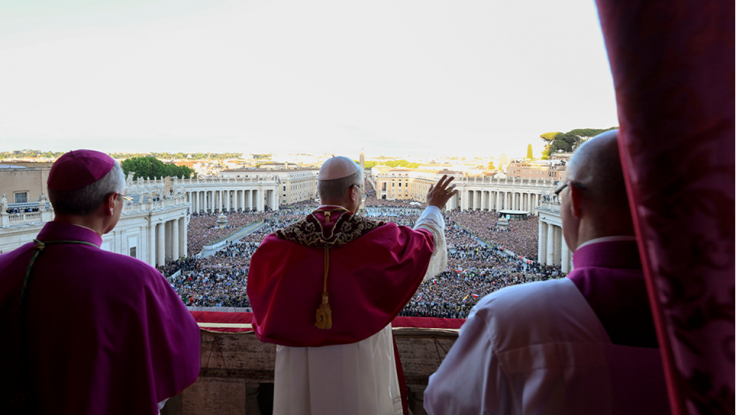
As conflicts across the Middle East and Ukraine increasingly draw on religious rhetoric for justification, Pope Leo XIV has delivered an unusually direct message: faith cannot be used as a tool of war.
With tension in the Middle East and Ukraine getting more and more intertwined with religious rhetoric to justify the warfare, Pope Leo XIV made the surprisingly explicit statement, addressing tens of thousands of people assembled in the St. Peter Square at the Palm Sunday Mass.
The pontiff structured his discourse around a firm theological stance, namely, that God is the king of peace and that he is opposed to violence and that it would be against the spirit of religion to make war allied with its purpose. He said that God is the "king of peace" who rejects violence and comforts those who are oppressed.
"Brothers and sisters, this is our God: Jesus, King of Peace, who rejects war, whom no one can use to justify war," the Pontiff said. "He does not listen to the prayers of those who wage war, but rejects them."
The rejection of war by "Jesus, whom no one could make a pretext of war, is one of the most striking things" he said, and was not to be mistaken, though there were political overtones in it.
Religion And Politics Smash Headlong
The comments of the Pope are timed as the world conflicts become rather religious. Faith has been used by political leaders and institutions in various regions to justify military campaigns, thus bringing the line of ideology and state authority.
Leaders on all sides of the Iran war have used religion to justify their actions, while U.S. officials, especially Defense Secretary Pete Hegseth, have invoked their Christian faith to cast the war as a Christian nation trying to vanquish its foes with military might.
Russia's Orthodox Church had earlier justified Russia's invasion of Ukraine as a "holy war" against a Western world.
It is against this background that the intervention of the Vatican is indicative of a greater issue; that is the fact that religion is being transformed into a political tool, that is likely to distort its original message.
Reclaiming Moral Authority
By specifically refuting the notion that God approves war, the message by Pope Leo can be interpreted as a way of reasserting the moral authority over the interpretation of religion in the life of the masses. Instead of an overall appeal to the peace, the homily makes a direct assault on the theological accounts of violence that are being employed.
The Vatican is not simply calling on a ceasefire to conflict, it is doubting the validity of religious excuses that are being used to propagate it.
The weight of the message is further enhanced by the timing of the message. The Palm Sunday is the start of the Holy Week, which is a week in the Christian calendar that is based on the theme of sacrifice, suffering, and redemption.
However, the yearly celebration is much observed in the backdrop of the escalating violence. The Pope particularly referred to communities stuck in battlefields especially the Christians in the Middle East with many of them being unable to carry out religious practices to the fullest because of the hostilities.
In Jerusalem, church officials recorded unheard of measures with the top clergy unable to access major holy places during the Palm Sunday, an incidence that highlights how not only is the conflict being justified by religion, but also infringing upon its practice.
Consistency and Discontinuity in Vatican Speech
The scene is also a continuation of the more humanitarian focus of Pope Francis, but adds a more acute doctrinal point.
Francis frequently spoke about the plight of the less privileged in society, and symbolic actions like washing the feet of the prisoners, refugees, etc. helped reinforce the message of being humble and open to others. His strategy was less focused on theoretical sympathy.
Although still having that same concern, Pope Leo seems to be more willing to meet the ideological framing of conflict head-on. The message he delivers on Palm Sunday is an indication that he is ready to examine not only the effects of war, but also the discourses that perpetuate it.
The Pope interfering at its most basic level points to the struggle that is deeper one not of territory or power, but of meaning itself.
Who determines the role of religion during war? Leaders of political regimes drawing on God to justify their deeds, or religious leaders stamping their feet on the issue of peace as a fundamental virtue?
Pope Leo has made a definite line, one that confronts governments, institutions and believers, by claiming that God does not hear the prayers of people who are at war.
The importance of the message of the Pope is not just in the message of peace, but also in the fact that there is a tendency in the world to increase the tradition of using religion as a pretext to commit violence.
By so doing the Vatican has found itself on the heart of a new debate; a debate that is not only theological but also political, identity and power.


