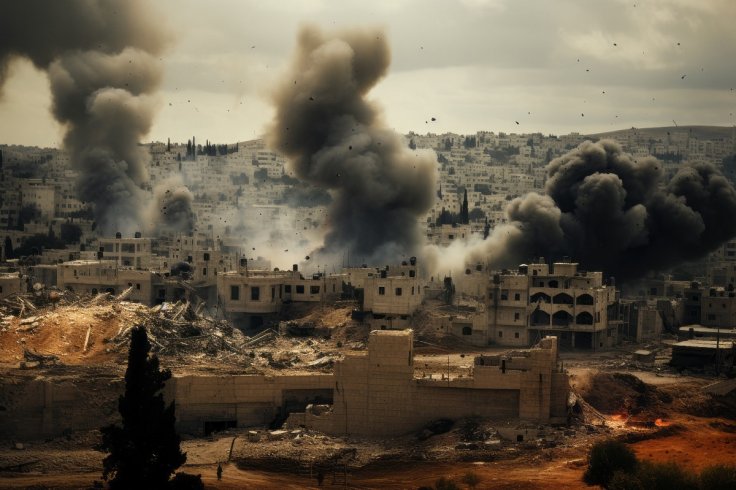
- ISIS is trying to use the unrest that exists between Iran and its neighbors to rebuild its operational networks throughout the region
- The reported killing of Ali Khamenei has created a power vacuum that exists throughout the entire region
- U.S. intelligence reports that ISIS is reconstructing its forces in the northeastern part of Syria
- Experts warn diverted counterterrorism efforts could enable an ISIS resurgence
The A-10 Warthog planes are also undertaking their daily combat missions in the Strait of Hormuz region with the American paratroopers in the region to guard against a veiled threat that has modified its style of operation. The Sunni extremist organization, the Islamic State (ISIS), which, at one-point, occupied territory larger than the United Kingdom in Iraq and Syria, is relying on the present U.S.-Israel military campaign against Iran to re-establish their networks, refine their communications, and set a stage to play a greater role in a post-conflict Middle East.
As a tool of regional power politics, analysis published by Jordan News indicates that ISIS has positioned itself as a working instrument in its previous form as opposed to attempting to achieve the caliphate-building ethos that characterized its high in 2014. The counterterrorism activities demand surveillance methods that are further complicated when they are no longer on active war fields but are under their present basic operations.
How Iran's Decapitated Leadership Created an Opening for ISIS
The assassination of Iranian Supreme Leader Ali Khamenei and the top command of the Islamic Revolutionary Guard Corps (IRGC) in what Fair Observer reporting reports as a precision decapitation attack has left precisely the type of institutional vacuum that ISIS has always sought to occupy.
The system of proxy armies in West Asia, the Axis of Resistance as it has come to be known by analysts, produced an annual revenue of more than $700 million and led the operations of the Shia militants and Sunni militants in Lebanon and Yemen, respectively. Those relations are in dire need of centralized command and funding arrangements, made in Tehran.
ISIS takes such strain as an invitation. According to Newsweek, the group has increased its sectarian messages to Iran, and it views the present conflict as a chance to destroy its adversaries. The ISIS ideologically hates the United States and Iran, and its propagandists have long branded Shia Islam, the religion in the very heart of Iranian theocratic identification, as apostasy. Weakened Iran is, both theologically and in terms of operations, a twofold triumph on the part of ISIS.
That calculation is reflected in the mood found in the detained population of ISIS. In a report by Al-Hurra, the detainees of ISIS in Baghdad's Cropper Prison were seen shouting celebrations during the attacks of Iranian rockets on one of the American bases nearby, celebrating the mutual annihilation of its two main opposers. That fact is a minor yet bright sign of organizational morale during the time when the leadership of ISIS has something to feel positive about.
ISIS Rebuilds in Syria While American Eyes Look Elsewhere
In Syria, the rebuild at ground level is taking place. In her introduction to the Senate Select Committee on Intelligence (SSCI) to present the 2026 Annual Threat Assessment, the U.S. Director of National Intelligence, Tulsi Gabbard, was direct in saying that ISIS is "still actively rebuilding in Syria, re-engaging detainees and recruiting out of camps located in the northeast of the country." That is a testimony, based on the complete strengths of the U.S. intelligence community, and it is the most confident of any sources in this environment.
In the northeast Syrian camps, tens of thousands of people, with different levels of affiliation with ISIS, are located. Those camps are also secure in large part because of the Syrian Democratic Forces (SDF), the Kurdish-led military coalition that joined forces with the U.S. military to bring about the territorial caliphate of ISIS between 2015 and 2019.
The ability of the SDF to sustain the security of the camps without the aid of the U.S. is being put to the test with American military attention and logistics now focused on the Iran conflict. ISIS recruits within and outside of those camps are taking advantage of that loophole.
The Atlantic Council, a Washington-based policy research organization, has evaluated that ISIS is simultaneously increasing its messaging activities to win new adherents in the West, leveraging the images and sectarianism packaging of the war to recruit new adherents. Those externally oriented propaganda campaigns accompany the domestic reconstruction in Syria, hinting at a two-track policy: strengthening the working capacity at the regional level at the same time as establishing the ideological foundation at the diasporic level.
Also Read: Iran Releases AI Video Showing Statue of Liberty Under Attack After Rejecting Trump Deal [WATCH]
The Threat to Americans at Home and Abroad
According to data released by the Vision of Humanity research project, Iran has made 157 foreign operations in the past five years, 27 of which were targeting the United States and 54 targeting Europe. That number, which cannot be independently validated through a second source on this package, sets the minimum level of threat environment against which the ambitions of ISIS will have to be compared.
The security services in the West now have a new problem to contend with, a residual Iranian-linked threat network, and, at the same time, keep an eye on a now revitalized ISIS propaganda machine aimed at the English-speaking populations.
The United States embassy in Mauritania posted a high-security alert, warning American nationals against high-risk terror attacks at installations in the nation, a message that the danger range goes far beyond the area of action. Those types of embassy-level alerts are usually based on any good intelligence and not a boilerplate precaution.
As the Trump administration considers its next action in the conflict, the Pentagon has deployed 2,000 soldiers of the Immediate Response Force of the 82nd Airborne Division to the Middle East. OSINT613 News also reports that elite units such as special operations elements are present in the region. Such an investment in Iraq, in other words, reduces the allocated counterterrorism resources to the ISIS campaign in Syria and Iraq, a resource trade-off that the planners of the ISIS campaign are almost certainly considering in their time list.
The group's current attitude is characterized by a long-suffering historical perspective. It is not airing imminent assaults or publicizing mass-killing videos at the pace of its 2015-vintage zenith. Instead, it is taking on the pandemonium in its surroundings, enlisting at the periphery and biding its time until the lapse of time when global focus subsides and security structures are diluted. The playbook that ISIS has operated on since the 2011 U.S. withdrawal from Iraq because a worn-out al-Qaeda in Iraq reorganized into the group that overran Mosul three years later.


