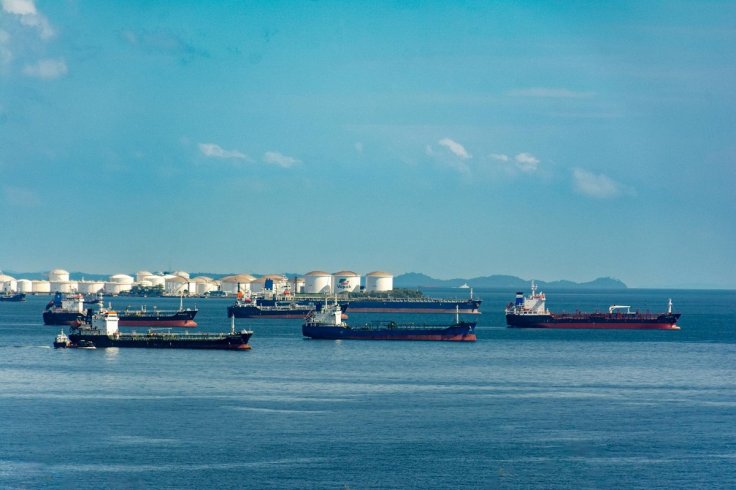
A fully loaded Kuwaiti crude oil tanker caught fire near Dubai on Monday. Iran carried out the strike. No one was killed.
Those three facts, taken together, raise a question that has received far less attention than Trump's threats or the oil price spike: under international law, deliberately attacking a civilian commercial vessel in peacetime waters is a potential war crime, and no government has formally said so out loud.
Iran struck and set ablaze the Kuwaiti tanker on March 31, 2026, as part of what Tribune India described as a broader series of Iranian assaults on merchant vessels since the United States and Israel struck Iran on Feb. 28. Dubai emergency authorities contained the fire with no oil leak or crew injuries reported, according to India Today.
The Kuwait Petroleum Corporation (KPC), the state-owned energy company that owns the vessel, warned of a possible oil spill and confirmed damage assessments were underway.
The attack was not an isolated provocation. Iran has effectively closed the Strait of Hormuz, the narrow waterway between the Persian Gulf and the Gulf of Oman through which roughly one-fifth of global oil supply passes, disrupting energy and commodity trade flows worldwide. The conflict entered its fifth week with thousands killed and economic disruption spreading across markets.
Iran's Tanker Campaign and the Law of the Sea
Under the United Nations Convention on the Law of the Sea (UNCLOS) and the customary international humanitarian law principle of distinction, deliberate strikes on civilian vessels not directly participating in hostilities are prohibited. No state has yet formally charged Iran with a violation before an international body, and Iran has not responded publicly to requests for comment on the legal status of its maritime campaign.
The KPC tanker was a commercial ship carrying crude oil, not a military vessel. It was operating in international waters near a major civilian port. That profile places it squarely within the category of protected civilian objects under the laws of armed conflict, a category that, if confirmed, would make the strike a serious violation of international law regardless of the broader conflict's political context.
Brent crude, the global oil benchmark, rose more than 2% to $115.17 per barrel following the attack. Crude futures also climbed more than $3 per barrel in the immediate aftermath, the Economic Times reported. For context, Brent crude posted its largest monthly percentage gain since trading began in 1988, rising roughly 55% across March 2026.
Also Read: US-Iran Peace Deal Soon? Trump Threatens to Blow Up Iran if Tehran Doesn't Agree to End War
For American households, the price signal is direct. U.S. gasoline prices crossed $4 per gallon for the first time in more than three years, and polling data cited by Ynetnews indicated the majority of American households reported the higher fuel costs were already affecting their finances.
President Trump responded to the tanker strike with an escalating public threat. "I will obliterate Iran's energy plants and oil wells," Trump said, directing the warning specifically at Iran's failure to reopen the Strait of Hormuz. The Guardian reported the threat on March 31. Separately, Tribune India, citing people familiar with internal White House discussions, reported that Trump had told aides he was willing to end the military campaign even if the strait remained closed, a position that could not be independently verified from a second source.
The gap between Trump's public ultimatum and the private position attributed to him by Tribune India reflects the difficulty of reading U.S. intentions from official statements alone. Both positions are on record. The strait remains closed.
For American drivers filling up this week, the legal fine print around what constitutes a war crime in the Persian Gulf is an abstraction. The $4-plus price on the pump is not.
Disclaimer: This article was produced with the assistance of artificial intelligence.


