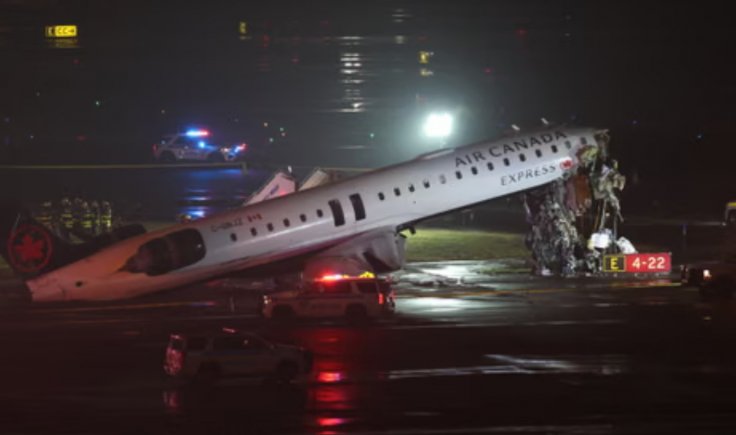
The audio from LaGuardia's tower tells the story of a clearance that should never have been given, and a collision that followed in seconds.
At 11:37 p.m. on Sunday, an air traffic controller at LaGuardia Airport cleared a Port Authority fire truck to cross Runway 4. Air Canada Express Flight 8646, carrying 72 passengers from Montreal, was on short final approach to the same runway at that exact moment.
One minute later, the truck and the jet collided. Both pilots were killed. More than 40 people were hospitalized.
Released audio from the tower captures what happened in the seconds between clearance and catastrophe. "Stop, Truck 1. Stop," a controller can be heard saying. "Frontier 4195, stop there please. Stop, stop, stop, stop. Truck 1, stop, stop, stop." After the collision, a voice on the frequency says: "I messed up."
That three-word admission now sits at the center of a federal investigation that will determine whether the deadliest runway incursion in recent American aviation history was the product of a single catastrophic judgment call, a systemic failure, or both.
ONE CONTROLLER, TWO EMERGENCIES, ONE RUNWAY
At 11:18 p.m., United Airlines Flight 2384, a Boeing 737 MAX 8 bound for Chicago, aborted its takeoff from LaGuardia twice after anti-ice warning lights activated. The crew reported a foul odor in the cabin, flight attendants were feeling ill, and the pilots declared an emergency when no gate was immediately available. A firefighting truck and a stair truck were dispatched to assist.
The Port Authority fire truck radioed air traffic control, requesting permission to cross Runway 4 to reach the stricken United aircraft. ATC granted the clearance. The Air Canada Express flight was descending onto the same runway at that moment.
Aviation experts note that the same voice on the control tape can be heard clearing the aircraft to land and clearing the fire truck across the runway. In a standard tower configuration, ground control handles surface traffic while tower control manages arrivals and departures. At LaGuardia that night, one controller appears to have been managing both functions simultaneously.
Transportation Secretary Sean Duffy confirmed there was more than one person in the control tower but declined to specify roles or assignments, citing the active NTSB investigation.
Aviation law is unambiguous on this point. Former U.S. Department of Transportation Inspector General Mary Schiavo told CBC News that when a plane is given clearance to land, it has the right of way on that runway. "We hear clearly the communication that put the fire truck on a runway, when by federal aviation regulation, that aircraft owned the runway," she said.
What the audio does not capture is whether ground controllers were coordinating with the tower at all. Schiavo put the problem plainly: "We seem to have three people that needed to know what's going on, or actually four different entities, and we don't hear any co-ordination among them. There are three people communicating but not with each other."
LaGuardia is one of 35 major U.S. airports equipped with an advanced surface surveillance system that uses radar and locator data to alert controllers to potential runway conflicts. Whether that system generated any alert before the truck was cleared, and whether any such alert was registered or acted upon, is among the questions NTSB investigators will put to the cockpit voice and flight data recorders, both of which have been transported to Washington for analysis.
What pilots knew and when
The pilots of Flight 8646 had no way of knowing a fire truck had been cleared to cross their runway. The Air Canada cockpit was on tower frequency for landing instructions; the ground control frequency clearing the truck was separate.
Passenger Rebecca Liquori said she felt the pilots brake hard to slow the plane in the final moments, protecting passengers as much as they could. "I wouldn't be here had it not been for the pilot acting quickly," she said. FAA Administrator Bryan Bedford described both men as "young pilots at the start of their careers," calling their deaths an absolute tragedy. One has been identified as Antoine Forest, from Coteau-du-Lac, Quebec.
The aircraft was traveling at approximately 93 to 105 mph at the moment of impact. The collision destroyed the cockpit and forward galley. The jet came to rest near taxiway Echo, its nose gone, its tail tilted upward from the runway. A flight attendant seated in a jump seat behind the cockpit door was ejected from the aircraft and found outside, still strapped to her seat.
Not the first time
Sunday's collision was not LaGuardia's first clearance failure. In March 1997, a Gulfstream 2 jet collided with a maintenance truck on the same runway after being given landing clearance by a control tower that had also approved a vehicle to work on that runway. No one was killed. In the two years leading up to Sunday, pilots filed multiple voluntary reports to a NASA safety database describing situations at LaGuardia where collisions were narrowly avoided due to inaccurate or conflicting ATC clearances. Those reports were reviewed by safety analysts. The runway kept operating.
Port Authority Executive Director Kathryn Garcia said Monday that procedure at LaGuardia always defers to the control tower: "Anytime anyone is moving on any of our runways or taxiways, they have to get clearance from the tower to move." That chain of authority is precisely what investigators are now examining. The tower gave the clearance. The tower tried to reverse it. The tower, by its own admission, messed up.
The NTSB said it will not rest until the investigation is complete. Runway 4 remains closed until Friday morning. LaGuardia is operating on a single runway. The two pilots who brought Flight 8646 in from Montreal are not coming home.


