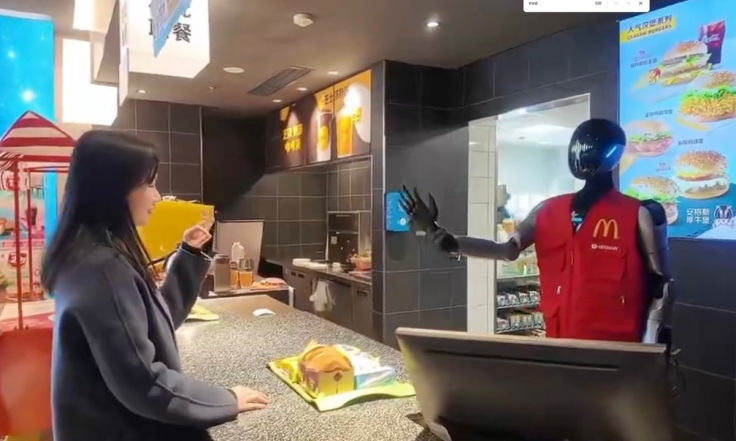
- McDonald's tests humanoid robots in Shanghai restaurant operations
- Robots perform greeting, ordering, delivery, and cleaning tasks
- Trial reflects labor shortages and automation interest in China
- Technology remains limited; hybrid human-robot model expected in the short term
A McDonald's restaurant in Shanghai is testing humanoid robots as front-line staff, and this gives an insight into how robots are going to change the face of the front-line service jobs in the fast-food sector.
The robot, which is piloted by a Chinese company known as Keenon Robotics, advances the machines to occupy the positions that have long been occupied by employees, such as greeting customers, dealing with diners, and helping do the simple service chores. The restaurant is also testing other automated systems to assist in the operations, like food delivery and cleaning.
The trial is a manifestation of a wider trend of restaurant chains around the world to consider automation as labor relations changes. The robots are not highly developed, but the fact that they are present denotes the increased interest in the development of artificial intelligence and robotics into the world of everyday consumers.
Striking a Balance Between Labor Shortages and Automation
The test has come when China is witnessing economic contradiction as businesses in some of its sectors report employment problems in an economy where youth unemployment is still high. This is an imbalance that has seen corporate organizations seek other ways of doing staffing other than the traditional ones.
Automation is becoming something that restaurant operators are considering in order to help them deal with costs and increase uniformity of operations. Given that they are dependable, robots may offer a scalable labor force for repetitive work, especially in high-volume service sectors.
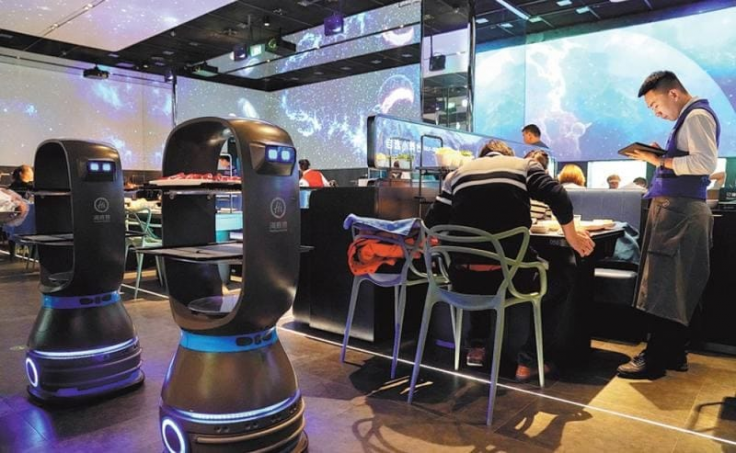
Meanwhile, analysts also observe that "the trends in the Chinese demographics are redefining the labor market." An aging and shrinking working population and a lack of enthusiasm in low-paying service jobs are leaving gaps that can be closed with automation."
Observers in the industry say that "this context is what makes this round of trials exceptional as compared to previous fears of massive job displacement." Instead, it is making the technology look as a complement to human labor and not a substitute, at least in the short term.
Technology Yet to Replace Completely
In spite of the hype created around humanoid robots, the technology is still in its infancy. As has been demonstrated, robots are not as flexible, fast, and problem-solving as needed to run a restaurant in full.
This weakness would indicate that it is still several years to have the large-scale implementation of entirely automated fast-food restaurants. Rather, the companies are likely to implement mixed models where human labor is still required to perform the core activities and robots to perform only simpler functions.
The ongoing trial also emphasizes how novelty contributes to customer engagement. Robots as greeters or entertainers can bring people, especially families and younger consumers, and this can be a marketing plus on top of the experimentation of the operation.
Outlook and Future Adoption of Industry
Application of robots in a highly visible restaurant like a McDonald's highlights the fact that automation is not only shifting to industrial facilities but also transferring to consumer-facing industries. The same is being experimented with in various parts of the world as service robotics are being put to test by different companies to determine their commercial viability.
According to analysts, the next adoption will be based on the advancement of reliability, as well as cost-effectiveness and user friendliness. Tight integration between ordering systems, payment infrastructure, and kitchen operations will also be necessary to go beyond pilot programs.
To date, the Shanghai trial gives a good early warning on how technology may blueprint service occupation without necessarily putting human labor out of a job.
The trial represents a wary though progressing move towards automation in the hospitality industry, where companies are balancing the benefits of efficiency versus technological shortcomings and employee needs.