India's foreign policy toward Bangladesh has long been characterised by a presumption of inherent goodwill, rooted in historical ties from the 1971 Liberation War. This "blind trust," particularly evident during Sheikh Hasina's tenure from 2009 to 2024, prioritised personal alliances over strategic pragmatism, often overlooking Bangladesh's internal dynamics and external influences.
While this approach yielded short-term gains in security cooperation and economic integration, it ultimately contributed to three interconnected setbacks: the hardening of anti-India sentiments among Bangladeshis, the erosion of India's influence amid rising Islamism and Pakistani interference, and the chaotic aftermath of Hasina's ouster in August 2024.
As Bangladesh's new government under the Bangladesh Nationalist Party (BNP) signals renewed interest in bilateral ties following the February 2026 elections, India must pivot to a calculative, measured strategy, recognising that international relations are devoid of true friendships and thrive only on leverageable partnerships.
Hardening of Anti-India Image Among the Population
India's support for Sheikh Hasina was skillfully exploited by the ISI/Pakistan-aligned forces to portray Hasina as an authoritarian ruler that India actively emboldened. This significantly fuelled anti-India resentment in Bangladesh during her 15-year reign, to which India had no strategic response. New Delhi, India, continued to provide diplomatic backing and economic aid, viewing her Awami League government as a bulwark against instability. But remained mostly unaware of the simmering anti-India sentiment within the population at large.
Historical grievances were weaponised. Border activities by Indian forces to counter illegal immigration were used to ignite victimhood; the unresolved water-sharing issue was used as a reason for the floods or the droughts that Bangladesh faced to drum up anti-India sentiments. The clear and present issue of Jamaat-e-Islami spreading a Pakistani narrative of India-hatred added as the catalyst. A slow push to initiate a religious and ideological alignment with Pakistan remained extremely successful in weaponizing broad segments. The borderline Islamist Bangladeshi rural society rallied under the tag of 'finishing Hindu-India influence,' while the urban, educated class began associating India with Hasina's suppression of dissent, rigged elections, and human rights abuses. And through this newfound cause, Bangladesh conveniently and successfully pushed under the carpet the bilateral trade volume, the Indian initiatives to promote the Bangladeshi textile industry, Indian energy supply lines that benefitted Bangladesh, connectivity projects like Akhaura-Agartala, and the trade volume that Chittagong handled for the entire region.
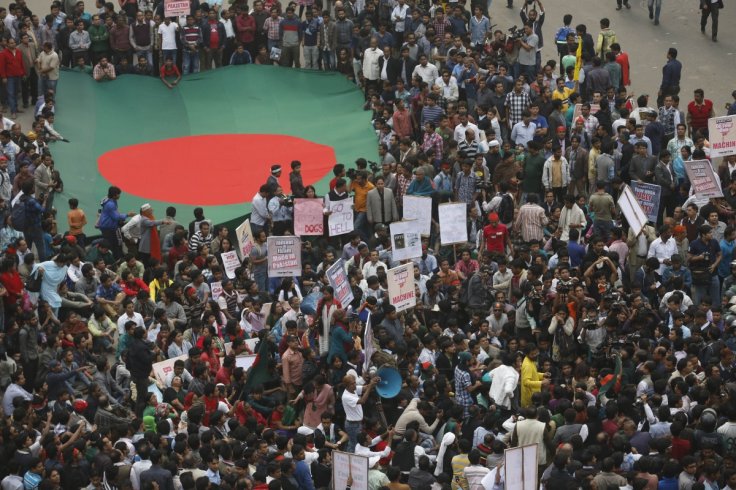
Under that light, it comes as no surprise when the protests in 2024 got weaponised into an orchestrated, large-scale anti-Hasina movement, with the demonstrators going heavy on chanting slogans decrying Indian "hegemony" and "interference." In effect, India's blind trust ignored the undercurrents while they were at play, assuming Hasina's stability would suffice, only to find its image tarnished as a meddlesome power.
Loss of Ground to ISI and Rising Islamism
India's myopic focus on Hasina also facilitated the resurgence of Pakistani influence, particularly through the Inter-Services Intelligence (ISI), and the ascent of Islamist forces. Under Hasina, Bangladesh cracked down on Islamist groups like Jamaat-e-Islami (JeI), which opposed the 1971 war and maintained ties to Pakistan. However, post-ouster, the political vacuum enabled JeI's revival, with the interim government under Muhammad Yunus lifting bans and actively facilitating the Islamist alliances to gain electoral traction. As a result, other than the frequent rape-murder of Hindu minorities in post-Hasina Bangladesh, by early 2025, JeI and allies like the Islami Andolan emerged as key players, advocating Sharia-influenced policies and anti-secular reforms.
India's trust in Hasina overlooked JeI's underground networks, allowing Pakistan to nurture anti-India sentiments through propaganda and funding. Hasina's era indeed saw India-assisted progress in counterterrorism, but the Yunus phase underscores the folly of equating government stability with enduring influence, especially if one considers the relative ease with which ISI secured an overt foothold in the region immediately afterwards.
Reports indicate Pakistan established a "Dhaka Cell" within its High Commission, coordinating with local militants and funding radical youth groups.
This includes forming the "National Armed Reserve" with over 8,000 JeI-affiliated members, aimed at imposing Sharia and countering Indian influence.
Yunus, seeking to diversify ties, warmed relations with Islamabad, inviting Pakistani military officials and allowing ISI operatives greater leeway.
This shift exploited India's absence, as Delhi's estrangement from the interim government left a void for anti-India actors. As a result, there is a fair chance today of a return of insurgency in the Northeastern Indian sector, because Islamism in the Indian subcontinent has but one goal: to break India.
Chaos Resulting from Hasina's Ouster
The ouster of Hasina unleashed immediate chaos, exposing the fragility of India's strategy. Protests escalated into violence, with over 1,400 deaths, mob attacks on Awami League symbols, and widespread looting. The interim government's unwillingness to restore order emboldened the Islamists, which led to a spike in extrajudicial killings, lynching, a large number of rapes, and a surge in unidentified bodies, as documented by rights groups.
Other than refusing to rein in the Islamist elements, Yunus also actively orchestrated political polarisation. He got the Awami League banned and facilitated the Islamist factions' filling the resultant void. This behaviour directly impacted India. Border tensions rose along Tripura, West Bengal, and Assam. The large-scale atrocities on religious minorities (Hindus and Buddhists) inside Bangladesh sparked protests in India. This further strained relations. New Delhi reacted with visa suspensions in December 2025, halted connectivity projects, and reduced aid.
Today, a bird's eye view of the chaos highlights India's over-investment in one leader, which left it unprepared for a succession plan or regime change.
Toward a Calculative Approach
With the BNP's victory under Tarique Rahman, Bangladesh has extended olive branches in an effort to resume visa services by pledging cooperation. India has reciprocated, with Prime Minister Modi congratulating Rahman and dispatching envoys to Dhaka. This moment offers a chance of a reset. However, "a soft-power initiative that does not manage to yield a tangible, usable result from a recipient nation is not soft-power projection but a futile exercise driven by self-righteousness." So, it is time India eschewed sentimental "friendship" for a pragmatic framework.
What could New Delhi do? Leverage economic interdependence: Bangladesh relies on Indian energy and transit. Pressurise minority protection and safety, alongside running a passive de-Islamization project to counter ISI gains. New Delhi, as a regional power, also needs to diversify its engagement with the different stakeholders, including the opposition, and perhaps facilitate an active civil society to mitigate anti-India biases.
In international relations, alliances are tools for mutual gain, not bonds of affection; India should prioritise leverage to safeguard its interests amid Bangladesh's (dormant and now active) affinity with Islamism.
[Disclaimer: This is an authored article by Arindam Mukherjee, who is the author of Contours of the Greater Game – Access, Control, and Geopolitical Orders (BluOne Ink); A Matter of Greed (IED Press); and JourneyDog Tales (Zero Degree Publishing).]