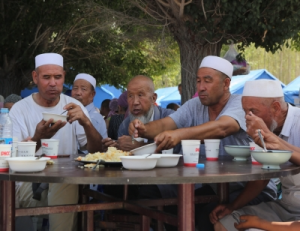
- Report says Chinese police detained over 500 Uyghurs during Ramadan.
- Arrests linked to fasting, gatherings and possession of religious materials.
- Security intensified around mosques and Uyghur residential areas.
- Rights groups say crackdown continues broader Xinjiang surveillance policies.
The Chinese police have detained over 500 Uyghurs in the Hotan province of Xinjiang during the Islamic holy month of Ramadan on the excuse of illegal religious practices, said the report, which was released on Saturday.
According to the report released by the Impact International, the arrests were associated with activities such as individual fasting and its congregations as security was increased around mosques and residential districts.
Citizens have been claimed to be randomly searched on halal food and religious literature and there has been a rise in security levels within communities, a situation which observers termed as an atmosphere of increased surveillance and fear.
The report labelled the measures as a Holy Month Siege in which the religious practices that had been related to Ramadan were treated as punishable offences.
Global Alarm rises over Uyghur arrests in the Holy month Siege in China. To prompt a surge of criticism, intensified crackdowns on Uyghur Muslims in Xinjiang, China have raised alarm during Ramadan, expanding on a religious-suppression and mass-arrest policy, the report received.
These actions, which are taken in the context of the overall state policy, change the sacred month into the month of the increased surveillance and coercion, events that cast a terrible figure of the human rights violations on a massive scale.
Policies in Xinjiang since Sheng
As per the report, policy of the Chinese government on the region has encompassed wholesome security precautions since 2017, such as the establishment of mega-detention facilities formally outlined by the state as the so called vocational training centres.
Over the years, human rights organisations have estimated that over one million Uyghurs and other Muslim minorities had been detained in such facilities.
The report on these camps stated that they appeared as a solution to glimpses of violence in the area but critics have claimed that these camps are used as a tool of cultural assimilation, in place of security.
The policy system has extended to a massive surveillance system that is allegedly surveilling a great majority of the Uyghur population with facial recognition, artificial intelligence surveillance systems and police checkpoints.
The report indicated that these systems can be used to recognize religious behaviours or appearance.
The ban becomes tighter during the time of Ramadan
Authorities are also accused of tightening the nets whenever it is Ramadan and other religious holidays by prohibiting practising Islamic faiths such as fasting, seizing prayer materials and surveying mosques with drones.
The report said that this escalation was consistent with a long-term state policy of arresting what Beijing terms as extremism.
Independent researchers and advocacy groups, however, write that these policies do not allow religious expression and influence cultural trends in Uyghur.
The report further stated that approximately 16,000 mosques have been converted or destroyed since the commencement of the policy, which, the report claimed, is a major blow to the Uyghur religious and architectural heritage.
The report noted that such measures are not one-time events; instead, they are supported with several years of infrastructure building, such as AI-supported efforts that will identify a religious outfit or behaviour.
The consequence is, as it is described, the community under siege, in which even the silent prayer is dangerous enough to be arrested, representing a state policy according to which the religious expression is a danger to the unity.
Human rights activists have also expressed a grievance on the Xinjiang situation pointing out that the restrictions destroy the community life and practice of the religion at times when traditionally known to reflect and bring people together.