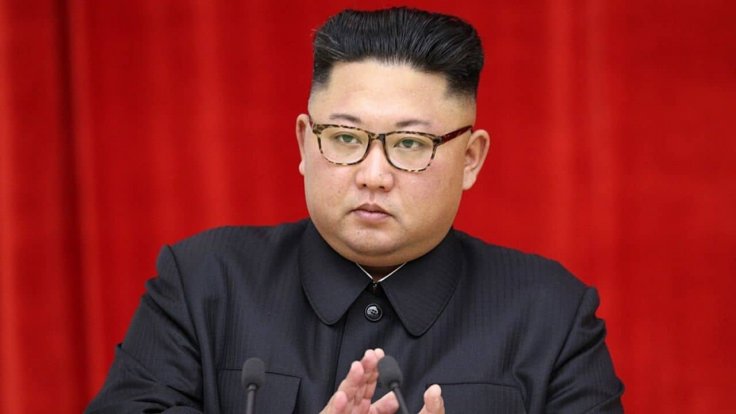
North Korea's declaration that its nuclear arsenal is "irreversible" is more than a policy stance—it is a direct challenge to the global non-proliferation order. Backed by the ongoing Iran conflict, Kim Jong Un is effectively arguing that the Treaty on the Non-Proliferation of Nuclear Weapons (NPT) no longer offers security, only vulnerability.
The broader strategic context cuts to the core of a problem American policymakers have largely avoided stating plainly. The Treaty on the Non-Proliferation of Nuclear Weapons, a 1968 international agreement designed to prevent the spread of nuclear weapons and promote disarmament, was built on an assumption that nuclear-armed states would move toward disarmament while non-nuclear states would not seek the weapons. That framework is under visible strain.
North Korea withdrew from the NPT in 2003. Since then, it has conducted six confirmed nuclear tests and developed intercontinental ballistic missiles capable of reaching the continental United States. The international community, including the United Nations Security Council (UNSC), has imposed successive rounds of sanctions. None have produced denuclearization.
What Kim has done, with unusual directness, is point to Iran and Ukraine as the counter-examples that validate his strategy. The implicit argument, now made explicit in his public statements, is that the NPT provides no meaningful security guarantee to states that comply with it. A country that gave up its nuclear program, or never developed one, is a country that can be bombed. North Korea will not be that country.
"Kim Jong-un's claim that North Korea's nuclear status is 'irreversible' is troubling but not surprising. From India's long-standing perspective, it underscores the fundamental weakness of the NPT, which institutionalised nuclear inequality and apartheid. The recognised nuclear-weapon states have moved far too slowly toward genuine disarmament. In many ways, North Korea's nuclear trajectory also reflects the strategic lessons drawn from interventions and regime changes in West Asia, reinforcing the belief among some regimes that nuclear weapons are the ultimate guarantee of survival," Amitabh Mattoo, Dean, School of International Studies, JNU, told International Business Times, Singapore.
The interpretation sharpens the broader concern: that the NPT's foundational bargain, security in exchange for restraint, is no longer credible in a geopolitical environment shaped by selective intervention and uneven deterrence.
Kim compounded the regional tension by formally declaring South Korea the "most hostile nation" and warning of severe consequences for any provocative actions, as per reports. Seoul has not issued a formal public response to that specific designation.
North Korea has also recently showcased its weapons capabilities through cruise missile launches and nuclear-capable rocket barrages, keeping the military dimension of its posture visible alongside the rhetorical campaign.
What It Means for Trump's Diplomatic Overture
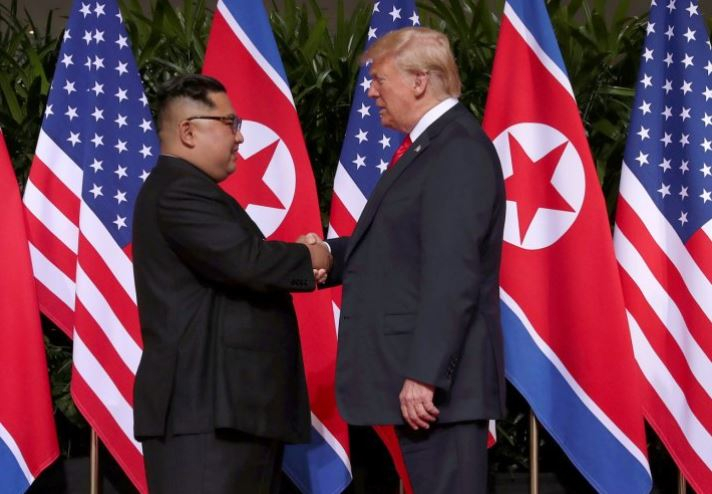
Trump's second-term outreach toward Pyongyang faces a fundamentally different environment than the first. In 2018 and 2019, the diplomatic process operated on at least a theoretical premise that denuclearization was a possible endpoint. Kim's current statements foreclose that premise. His nuclear status is "absolutely irreversible", in his own words, and the Iran war has given him a real-time justification that plays well beyond North Korea's borders.
North Korea has simultaneously deepened its strategic alignment with both China and Russia, according to LMT Online, complicating any scenario involving U.S. military pressure in Northeast Asia. Pyongyang has also significantly increased weapons transfers and troop support to Russia in the Ukraine conflict, earning what Russia Matters described as billions in sensitive military technology in return. That technology acquisition makes the nuclear and conventional deterrence picture more complex, not less.
North Korea and Iran are "highly likely" to revive missile and nuclear cooperation in the wake of the current conflict, a development that would extend the strategic consequences of the Iran war further into the Indo-Pacific.
Trump has not detailed what, if anything, he would offer Kim to return to the table. Kim, for his part, has publicly answered the question of whether he would trade his arsenal away. He has said no, framed it as wisdom, and pointed to a live war to make the case.
North Korean leader Kim Jong Un has drawn a direct line between the U.S. conflict with Iran and his country's refusal to give up nuclear weapons. He is calling it proof. The timing could not be more damaging for American diplomacy on the Korean Peninsula.
Iran Conflict Handed Kim a Ready-Made Argument
Kim framed the conflict as a case study in what happens to states that cannot deter a superpower by force. His position: nations without nuclear capabilities are vulnerable to external intervention, and his country will not become one of them. Kim described North Korea's nuclear status as "absolutely irreversible," signaling that denuclearization is not a subject open for negotiation.
The remarks arrive at a particularly charged moment. President Donald Trump has recently signaled openness to restarting talks with Kim, reviving a diplomatic track that collapsed in 2019 after the Hanoi summit between the two leaders produced no agreement. Trump's renewed overture has not been met with reciprocal flexibility from Pyongyang. Instead, Kim appears to be using the current regional instability to consolidate his nuclear posture publicly and on the record.
The logic Kim is deploying is rooted in a pattern that analysts have tracked across multiple U.S.-led military engagements: states that pursued nuclear weapons but did not yet possess them faced intervention, while North Korea, which has openly tested nuclear devices and ballistic missiles, has not faced comparable military action.
Iran and Ukraine both experienced devastating consequences in part because they were perceived as either developing or considering nuclear capabilities without yet holding them. North Korea draws a different lesson from those trajectories. Kim has argued explicitly that nuclear weapons have freed up resources for economic development inside the country, reframing what the outside world treats as a security threat into a domestic stability tool.
Kim also accused the United States of carrying out "state terror and acts of aggression all over the world," using that characterization as the rhetorical foundation for why Pyongyang views its arsenal as a defensive necessity rather than an offensive posture. The Trump administration has not publicly responded to those specific characterizations.
The Iran conflict itself has provided Kim with fresh material almost by the week. Trump issued a deadline to Tehran demanding agreement to reopen the Strait of Hormuz, a critical global shipping lane, or face strikes on power plants and energy infrastructure. That kind of ultimatum, directed at a non-nuclear state, fits precisely into the narrative Kim has been constructing for his domestic audience and for any country watching from the sidelines.


