- Rubio says US has plan to curb oil spike.
- US targeting Iran missiles and naval assets.
- Operation aims to protect Strait of Hormuz shipping.
- Rubio says no ground troops or regime change.
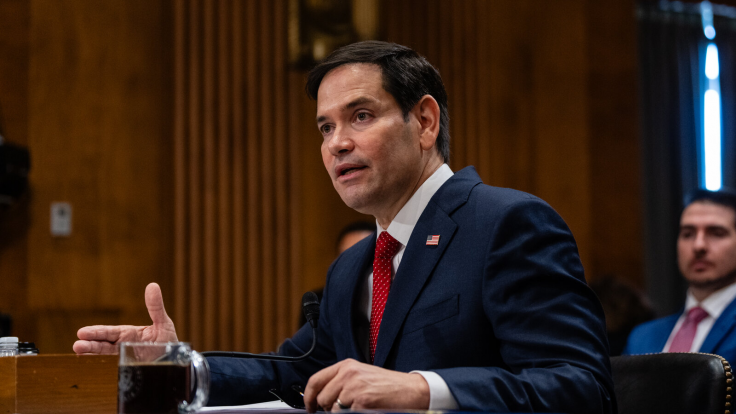
The United States has a plan to curb rising oil prices and safeguard global shipping routes as it continues strikes targeting Iran's missile arsenal and naval forces, Secretary of State Marco Rubio said at the US Capitol.
Rubio acknowledged that energy markets were reacting to escalating tensions but said the administration had anticipated the impact. "Yes, and we, we've, we knew that going in would be a factor," he told reporters when asked about spiking oil prices. "There is a plan in place. We anticipated this could be an issue."
He said Energy Secretary Chris Wright and Treasury Secretary Scott Bessent would begin "rolling out those steps starting tomorrow to mitigate, to mitigate against the impact that could happen."
Focus on Iran's Navy and Missile Capabilities
Rubio warned that Iran's naval power posed a significant risk to global trade, particularly through the Strait of Hormuz, a critical maritime chokepoint that carries a substantial share of the world's oil and liquefied natural gas.
"This terroristic regime led by radical clerics has the ability potentially to shut off 20 per cent of global energy. That's the kind of leverage they have because of their navy. We're gonna destroy their navy," Rubio said.
He described the operation as targeted and urgent. "The United States is conducting an operation to eliminate the threat of Iran's short-range ballistic missiles and the threat posed by their navy, particularly to naval assets," he said.
Rubio said intelligence assessments pointed to an "imminent threat" if Iran came under attack. "There absolutely was an imminent threat," he said, arguing that delaying action would have led to "more casualties and more deaths."
The objective, he said, is to dismantle Iran's missile launch capabilities, manufacturing base, drone stockpiles and naval assets that threaten shipping lanes.
No Ground Troops, No Regime-Change Mission
Rubio stressed that the campaign is not intended as a regime-change effort. "We would love for there to be an Iran that's not governed by radical Shia clerics," he said, but added that the mission is focused strictly on weapons systems.
He ruled out deploying ground forces for now. "We believe the objective that we have set for this mission, which is the destruction of the ballistic missile capabilities... can be achieved without ground forces," Rubio said, adding that the administration is "not postured for ground forces."
On reports of civilian casualties, including claims of a strike on a school, Rubio said he lacked details but insisted the US "would not deliberately target a school."
Also Read: US Stocks Close Mixed as Iran Crisis Lifts Oil, Yields Rise
"We will do this as long as it takes to achieve those objectives, and we will achieve those objectives," he said.
Opening Gates for Russian Oil Flow Again?
The US should also release its oil-related sanctions, the secondary tariffs, and restrictions on third-country oil consumers such as India, and in a few months, Russian oil would flow back to both India and Europe.
Current restrictive US actions such as the sanction on Rosneft and Lukoil, the punitive tariff of 25% of Indian sales, and the pressure on the Feb 2026 US-India trade pact have reduced Indian imports of about 2025 at over 2 million barrels per day (mbd), to about 1-1.2 million bbd.
Liberalizing these curbs, directly or indirectly, would remove both legal and financial risks to Indian refiners so they can resume buying Urals at discounts (which could be as low as 1.5-2 million bpd) not only non-sanctioned Indian refiners but also would reduce the Indian import bill in the face of complications, such as the Strait of Hormuz strains over Iran.
In the case of Europe, whereby only direct imports of Russian crude oil are prohibited and imports of refined products into the country by third countries (e.g., diesel processed in India) are fully prohibited as of January 2026, a weakening of US authority over the operation of shadow fleets, insurance, and price-cap compliance would alleviate global shipping bottlenecks, indirectly reopening unmonitored supplies that have been repackaged into more expensive options.
All this would increase the export revenues of Russia, which are now reduced 27% compared to the time before the war, to move the discounted barrels to price sensitive Asian and European markets without the burden of secondary sanctions.