- Senate rejects war powers resolution seeking to limit Trump Iran strikes
- Israel launches new attacks on Tehran as regional conflict intensifies
- U.S. Central Command reports destruction of Iranian ships and military targets
- Air travel disrupted and energy shipments affected across Middle East
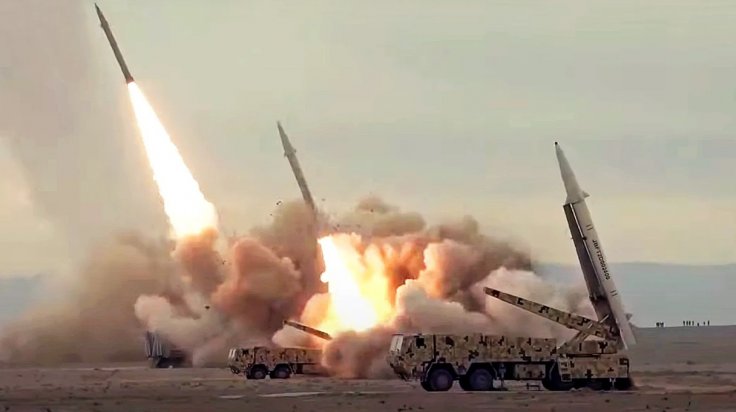
The U.S. Senate failed to pass a War Powers resolution that would have restricted military action against Iran, allowing President Donald Trump to continue strikes alongside Israel as the conflict entered its fifth day.
Lawmakers debated the resolution amid intensifying fighting in the Middle East, but the measure did not receive sufficient support in the Senate. The vote effectively allows the White House to maintain ongoing military operations against Iranian targets without immediate congressional limits.
According to Reuters-reported data referenced in market and geopolitical updates, the escalating conflict has already drawn regional and global attention due to its potential impact on energy supply routes and regional stability. The failure of the vote underscores divisions in Congress over the scope of presidential war powers and the United States' role in the widening conflict.
The fighting intensified as Israel launched another round of strikes on Tehran, with the country's defense leadership stating that the campaign was aimed at dismantling Iran's military capabilities.
U.S. officials said American forces continue to participate in operations targeting Iranian assets across the region.
Military Operations Expand Across The Region
During a briefing with reporters, U.S. Defense Secretary Pete Hegseth said the campaign had significantly weakened Iran's defenses and maritime capabilities.
According to the United States Central Command, U.S. forces destroyed 17 Iranian ships and struck nearly 2,000 military targets during the opening phase of the campaign.
Hegseth said a U.S. submarine had also sunk an Iranian warship using a torpedo during recent operations.
"America is winning decisively," Hegseth said, adding that additional forces were being deployed to the region.
The military operations follow the killing of Iranian Supreme Leader Ali Khamenei during the opening phase of the U.S.-Israeli strikes late last week. Iranian authorities have since begun preparations for a three-day funeral ceremony to mark his death.
Meanwhile, reports from Tehran indicate that senior clerics responsible for selecting Iran's next supreme leader are considering appointing Mojtaba Khamenei to the position.
Iran has continued launching drone and missile strikes toward neighboring countries as the conflict has expanded beyond its initial flashpoints.
Global Economic And Security Concerns Rise
The escalating conflict has triggered disruptions across several sectors, particularly aviation and global energy markets.
Air travel across parts of the Middle East has been heavily affected, with airlines rerouting flights to avoid conflict zones. Several carriers have suspended routes passing through regional airspace amid ongoing missile and drone exchanges.
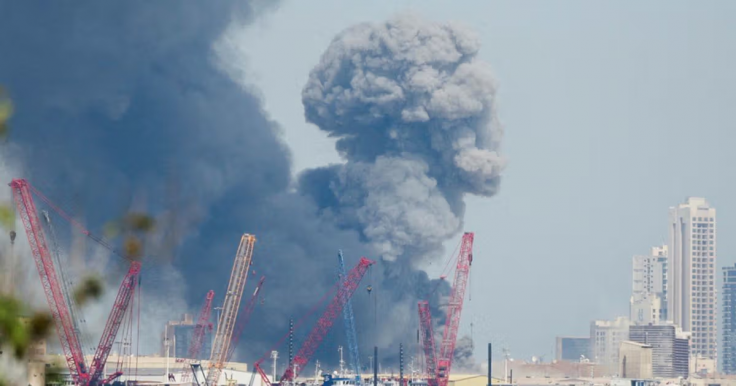
Energy markets are also closely monitoring the situation. One liquefied natural gas tanker bound for Europe reversed course and diverted toward Asia during the latest price surge, marking the first such diversion since the conflict began.
The U.S. government has said it is preparing measures to stabilize oil shipments moving through the Gulf, a key corridor for global energy trade.
U.S. Treasury Secretary Scott Bessent said the administration would soon announce additional steps to ensure safe transport of energy supplies through the region.
Speaking on CNBC's "Squawk Box," Bessent said Washington is working with regional partners to maintain stability in shipping lanes despite the ongoing conflict.
The Gulf region accounts for a significant share of global crude oil and liquefied natural gas exports, making disruptions there a major concern for international markets.
Defense Industry And Allies Respond
As military operations intensify, U.S. defense contractors are preparing to increase production of key weapons systems.
Executives from Lockheed Martin and RTX are expected to meet White House officials to discuss accelerating weapons manufacturing in response to growing demand.
The meeting follows comments by President Trump suggesting that the United States possesses a "virtually unlimited supply" of certain weapons systems despite reports that anti-drone defenses had been heavily used during the conflict.
Regional allies have also sought to reassure markets about their defensive capabilities.
Officials from the United Arab Emirates and Qatar denied reports suggesting their stocks of Patriot interceptor missiles were running low after repeated interceptions of Iranian projectiles.
The conflict has also prompted international responses from Western allies.
Canadian Prime Minister Mark Carney said Canada could not completely rule out military involvement if the situation escalated further, although he emphasized that the strikes carried out by the United States and Israel were "inconsistent with international law."
Carney made the remarks during a joint appearance with Australian Prime Minister Anthony Albanese, highlighting the growing diplomatic debate surrounding the conflict.
The Pentagon also confirmed the identities of two U.S. Army Reserve soldiers killed during an earlier drone attack in Kuwait.
They were Robert M. Marzan, 54, of Sacramento, California, and Jeffrey R. O'Brien, 45, of Indianola, Iowa.
O'Brien died on March 1 during an unmanned aircraft system attack at Port Shuaiba in Kuwait, while Marzan is believed to have died at the same location during the incident.
The continuing exchanges between U.S., Israeli and Iranian forces have raised concerns about the potential for a broader regional conflict as military activity spreads across multiple countries in the Middle East.