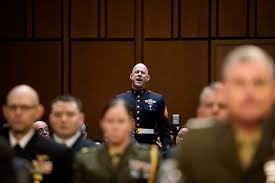
- Protester Brian McGinnis removed from Senate hearing during military readiness testimony
- Senator Tim Sheehy assists Capitol Police in removing resisting protester
- McGinnis hospitalized after arm injury; later taken into custody
- Authorities charge McGinnis with assaulting officers and resisting arrest
A confrontation at a U.S. Senate Armed Services Subcommittee hearing escalated on Wednesday when Senator Tim Sheehy joined United States Capitol Police officers in removing a protester identified as Brian McGinnis from the hearing room. The incident occurred during testimony from senior military officials examining the readiness of the U.S. armed forces.
Video from the hearing room showed McGinnis, dressed in what appeared to be a U.S. Marine Corps dress uniform, shouting while being escorted toward the exit. Witnesses said the situation intensified when he held onto the door frame as officers attempted to remove him. His hand appeared to become trapped in the door during the scuffle, prompting shouts from people in the room warning that he had been injured.
In a statement posted on X after the incident, Sheehy said McGinnis had initiated the confrontation. "Capitol Police were attempting to remove an unhinged protestor from the Armed Services hearing. He was fighting back. I decided to help out and deescalate the situation. This gentleman came to the Capitol looking for a confrontation, and he got one. I hope he gets the help he needs without causing further violence," the senator wrote.
The United States Capitol Police also released a statement defending their actions, saying the protester had resisted removal and created a potentially dangerous situation inside the congressional building. The agency emphasized that demonstrations are not permitted inside congressional hearing rooms and that protesters must remain in designated areas outside.
Protester Identified As Veteran And Political Candidate
The protester was identified as Brian McGinnis, an ex-Marine who is also running as a Green Party candidate for the U.S. Senate in North Carolina. According to Alan He, McGinnis attended the hearing as a protest against U.S. military policy and the country's involvement in conflicts abroad.
Footage circulating online showed McGinnis shouting "no one wants to fight for Israel" as officers escorted him out of the room. As he held onto the door with his left hand, witnesses began shouting that his hand had become trapped between the door and the frame. Officers were heard repeatedly instructing him to release his grip.
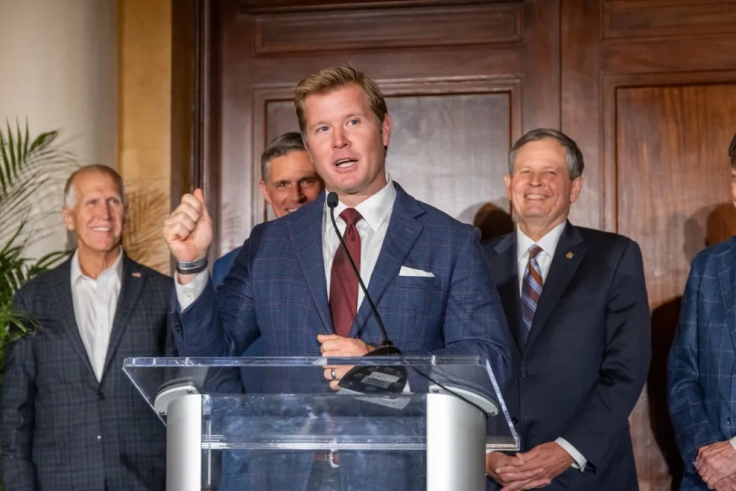
People in the room accused Senator Sheehy of causing the injury during the removal. Some shouted that the senator had broken the protester's hand. Sheehy left the area shortly after the confrontation, and video showed him exchanging heated remarks with an audience member who appeared to be criticizing him.
McGinnis later said his arm had been broken during the incident. Authorities confirmed that he was taken into custody following the confrontation.
Charges Filed After Arrest And Hospitalization
According to officials, McGinnis was transported to George Washington University Hospital after being removed from the hearing. Campaign manager Mark Elbourno said the protester had attended the session with him to hear testimony from military officials.
Elbourno said McGinnis had become frustrated while listening to the discussion about military readiness and spoke out against U.S. funding for the war with Iran. He said the protester believed lawmakers were ignoring the human and financial costs of the conflict.
Capitol Police said McGinnis now faces multiple charges related to the incident. Authorities listed three counts of assaulting a police officer, three counts of resisting arrest and one count of crowding, obstructing and incommoding - a legal term used when someone blocks an entrance or passageway.
Elbourno disputed the allegations, claiming McGinnis had not assaulted anyone and had simply attempted to speak out during the hearing. "He wasn't assaulting anybody. ... He just wanted to be heard [and was] speaking loud and clear. He was assaulted, actually. They broke his arm," Elbourno said.
The confrontation quickly drew attention online after video clips of the incident circulated widely on social media platforms.
Growing Debate Over U.S. Military Commitments
The protest occurred during a Senate Armed Services Subcommittee hearing examining the readiness of the U.S. military at a time when tensions have escalated globally, particularly in the Middle East.
Criticism of U.S. foreign policy and military involvement overseas has intensified in recent years, particularly among activists and younger political groups. Some critics argue that Washington's financial and military support for Israel places a significant burden on U.S. taxpayers while domestic economic challenges persist.
Opponents of current policy frequently point to billions of dollars in annual U.S. military assistance to Israel and question whether those resources should instead be directed toward domestic priorities such as infrastructure, healthcare and economic support programs.
The debate has also broadened to include concerns about the deployment of American troops in conflicts driven by broader geopolitical objectives. Critics say U.S. soldiers are often drawn into military operations linked to global strategic alliances rather than direct threats to the United States.
Supporters of U.S. military aid to Israel, however, argue that the alliance is a cornerstone of Washington's security strategy in the Middle East and serves as a deterrent against regional instability.
The altercation involving McGinnis reflects the growing intensity of these debates, which have increasingly spilled into public demonstrations and political activism.
The Senate hearing continued after the disruption, with lawmakers returning to discussions about military readiness and strategic challenges facing the U.S. armed forces.