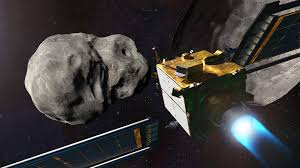
- NASA DART spacecraft impact altered orbit of asteroid Dimorphos.
- Study shows binary asteroid system orbit shortened by under one second.
- Debris ejected from impact amplified momentum change on asteroid.
- Findings support kinetic impact technique for planetary defense.
Recent observations of the post-launch NASA Double Asteroid Redirection Test (DART) mission have shown that the collision of the space vessel with the asteroid, Dimorphos, in 2022, resulted in permanent alterations to the orbit of its binary neighbour Didymos, which is additional evidence that kinetic impact technology can be applied in protecting Earth against potentially deadly space rocks.
The impact changed the movement of the Didymos-Dimorphos asteroid system in travelling round the Sun by a slight margin and this proved that the slightest change of course of a heavenly body can build up over time and alter its course dramatically. It was published in a journal article of Science Advances. The DART mission was the first occasion when manmade spacecraft was artificially altered to alter the movement of a celestial object.
The experiment was a study on planetary defense, which was meant to establish whether a spaceship could deflect an asteroid that could pose a threat to the earth. The two asteroids contain a binary system, that is, Dimorphos revolves around the larger Didymos whereas both of them revolve around the Sun together.
Their motions are connected so that what occurs to any other object affects the behavior of the entire system with respect to the orbit. According to the new measurements the orbital period of the binary system of the Sun that would normally take approximately 770 days reduced marginally following the impact.
"The orbital speed of change of the binary system was approximately 11.7 microns per second or 1.7 inches per hour" as denoted by Dr. Rahil Makadia, a planetary defense scientist who worked on the DART mission in the past and later finished his doctoral degree in aerospace engineering at the University of Illinois Urbana- Champaign. "Such a minute shift in the movement of an asteroid over time," Makadia said, "can become the difference between the dangerous object striking our planet or flying past it."
Impact Caused Huge Cloud of Debris
On Sept. 26, 2022, the NASA spacecraft hit Dimorphos and caused an enormous plume of debris which blasted into space. Dimorphos, the size of a rubble pile, about 560 feet (170 meters) in diameter, is thought to be a "rubble pile" asteroid, or loosely bound piles of rocks and dust, united by gravity. Its bigger partner, Didymos, is similarly arranged, and has something of the appearance of a spinning top.
Scientists say the quantity of material that was shed by Dimorphos was approximately 35.3 million pounds (16 million kilograms) of material during the impact. The asteroid itself did not lose much mass, only approximately 0.5 per cent, but the released debris did contribute to the changes of the system movement. Scientists discovered that the push that the debris cloud had increased the impact of the spacecraft, which gave it an extra impetus that assisted in altering the trajectories of the asteroids.
Previously reports had established that the orbit of Dimorphos around Didymos which initially was approximately 12 hours was reduced by an average of 33 minutes after the collision. The findings of the new studies are that the overall orbital period of the two was also off by about 0.15 seconds, more so the shared orbit of the pair was increased at a slight pace because of the new event. Although the change looks insignificant, according to the scientists, even minor changes may dramatically change the position of an asteroid over a long period of time.
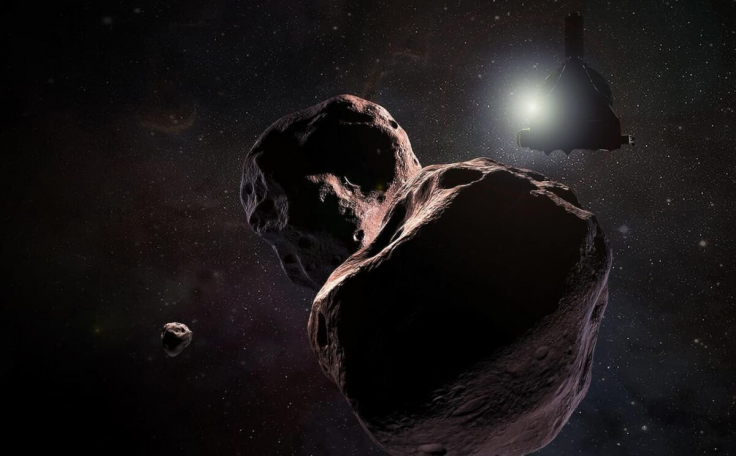
Observations in Space Assist in the Detection of minute removal. The astronomers of the world needed years to record such a minute change. Scientists used telescopes on earth and a method called stellar occultation, when an asteroid comes before a bright star thus temporarily deflecting its light. Through these happenings, scientists are able to determine the location and movement of the asteroid with a great accuracy.
Nevertheless, it is very difficult to observe when a star fades away in only a fraction of a second unless the observers are very precise and coordinated. In the study, there were 22 stellar occultations that occurred between any date of October 2022 and March 2025. The observations were conducted by volunteer astronomers most of whom had to travel to far away places in order to record the short events.
These stellar occultation observations, combined with years of ground-based observations, transformed into a crucial part of our Calculating how DART had shifted Didymos orbit, bringing together our Spacecraft and senior research scientist teams, said Steve Chesley of the NASA Jet Propulsion Laboratory and co-lead author of the work.
Chesley said that "this was a job that is extremely weather dependent, and can necessitate travelling to distant areas, without any certainty of success". Without the commitment of dozens of volunteer occultation observers all over the globe, this result would not have been achieved.
The observations also affirmed the fact that the impact generated plume of the debris acted in complicated manners. NASA Hubble Space telescope had taken images two comet-like tails of dust tail to flow out of the asteroid system after the collision and this offered new insights on how the debris spread and developed in space.
Impact Site Will Be Researched in Future
Follow-up details into what happened to the DART mission will be made later in the year, when the Hera spacecraft of the European Space Agency will reach the Didymos-Dimorphos system. In 2024, Hera will carry out an extensive survey of the location of impact and will serve as the first close-up shots of the Dimorphos following the impact.
The mission will determine the crater, structure and mass of the asteroid to enable the scientists to understand more on the influence of kinetic impacts on rubble piles asteroids. Hera mission principal investigator Patrick Michel, noted that the observation of the tiny change course that was noted in the study was an exciting feat.
"This is because we were aware that such a small change can happen and it is not a danger to the planet, yet figuring it out was another issue that the team undertook to do with great success," according to Michel. He observed that the world system of observers played a key role in ensuring measurements that were that precise.
Planetary Efforts Defense Plods on. The DART experiment is a significant step in planetary defense, which is an emerging field of study aiming at safeguarding the earth against possible asteroid strikes. NASA and other space agencies are still working on the development of technologies that will help to identify and deflect dangerous objects before they hit the earth.
The NASA Near-Earth Object Surveyor is one of the future missions which would be trying to detect dark asteroids that can hardly be seen using the ground telescopes. Thomas Statler, a NASA scientist who is the head of the small-body section of the solar system, said that the recent discoveries have bolstered the belief on the kinetic impact method illustrated by DART.


