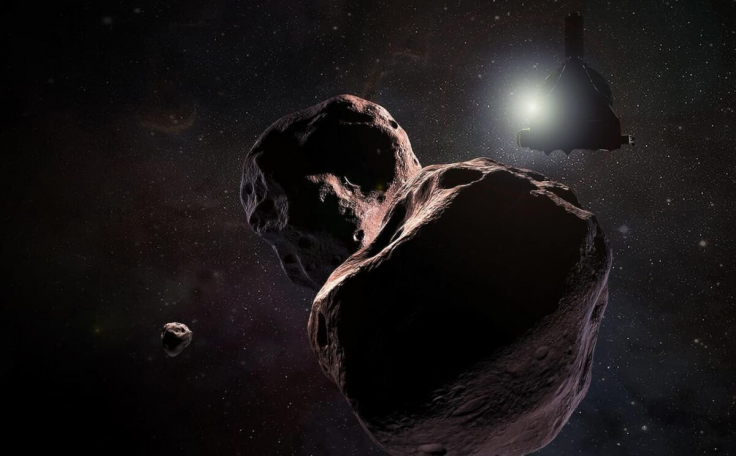
- Michigan State study models formation of Kuiper Belt contact binaries.
- Simulation shows gravitational collapse forms two-lobed bodies.
- Findings published in Monthly Notices of the Royal Astronomical Society.
- New Horizons images of Arrokoth support contact binary prevalence.
Astronomers are perhaps one step nearer to the explanation of why so many icy bodies in outer solar system resemble snowmen, after researchers at Michigan State University came up with a computer simulation which demonstrated how snowmen-like shapes can be formed naturally due to gravitational collapse.
These objects are the contact binaries consisting of the bodies composed of 2 lobes that are usually located in the Kuiper Belt after Neptune. The two-lobed form is common to about 10 per cent of the known planetesimals in this distant area, and long-standing speculations have been posed regarding how they could produce such a structure, and why they were not blasted to pieces by collisions.
The research was headed by a graduate student of Michigan State University, Jackson Barnes and it was published in the Monthly Notices of the Royal Astronomical Society. His model is the first to actually model the snowman like form by way of gravitational collapse and still maintain the structural integrity of the bodies used.
The Kuiper belt refers to a wide band of ice debris which remained in the forming up of the solar system. It includes dwarf planets like Pluto, a large number of comets and vast number of tiny planetesimals that have remained practically undisturbed over a billion years.
Beyond Dust Clouds to Bodies of Two Lobes.
Planetesimals are some of the oldest building blocks of planets which form when clouds of hand-size material and dust collapse due to its own gravity. When these rotating clouds collapse, the material may get torn apart into two distinct bodies that are it gravitationally attached and orbit about each other in binary systems.
In the simulation by Barnes, the two matching objects slowly rotate into each other, ending up into soft contact. Rather than combining to form one spherical body, as the earlier fluid-based models would have predicted, the two components remain rounded and come together, forming a contact binary.
Considering that planetesimal objects are thought to contain 10 percent contact binaries, the phenomenon that produces them cannot be rare, Earth and Environmental Science Professor Seth Jacobson, a senior author on the paper said. Gravitational collapse would go very well with our observations.
[Also Read: 40-ft Spinosaurus Fossil Found Inland Challenges Theory That Species Was Fully Aquatic]
Previous computational models considered colliding objects as fluid masses that melted into a single sphere, which could not be used to recover the two-lobed shapes that were observed. Barnes used high-performance computing resources at the Institute of Cyber-Enabled Research at MSU to enable more realistic physical properties, which ensured the structural strength of objects.
The outcome underscores the theory that gravitational collapse and not rare and exotic processes might be a regular process in the formation of bodies in outer space solar systems.
Evidence From New Horizons
The attention to contact binaries has been increased following the New Horizons spaceship by NASA passing the Kuiper Belt object, Arrokoth, in January 2019. Pictures showed an easy differentiable two-lobed structure which looked like flattened snowman.
Later observations of the other Kuiper Belt indicated that these shapes are not abnormal. Rather, the apparent fraction of planetesimals in the area is an appreciable percentage of the contact binaries.
The occurrence of the Kuiper Belt creates an empty space that is important in maintaining such exquisite shapes. The collisions in the Kuiper Belt are not common as compared to those between Mars and Jupiter in the thick asteroid belt. Barnes observed that the fused binaries would not be ripped off unless they have significant impacts away before the solar system is aged.
Early on in the history of the Milky Way, gas and dust was being rotated around the young Sun by the rotating disc. The Kuiper Belt has been left behind with remnants of that primeval material. The study of the planetesimals formation and development in this setting may provide an insight into the planetary formation process as a whole.
Also Read: NASA Ends Artemis II Wet Dress Rehearsal at T-29 Seconds
"The hypothesis could be experimented on in a legitimate manner, the first time," said Barnes. Scientists believe that the novel framework of simulations would be useful in explaining more complicated systems involving three or more gravitationally bound bodies.
The team is working on other models in order to perfect the behavior of collapsing pebble clouds in diverse environments. Since future missions will have a greater exploration of the outer solar system, scientists anticipate even more contact binaries with every new discovery.
FAQs Recommended:
What causes snowman-shaped objects in the Kuiper Belt?
Researchers at Michigan State University found that gravitational collapse of rotating pebble clouds can naturally form two-lobed contact binaries. Their simulation shows the objects can merge gently without breaking apart.
What is a contact binary in the outer solar system?
A contact binary is a small planetary body made of two lobes joined together. These objects are commonly found in the Kuiper Belt beyond Neptune.
How did New Horizons change understanding of contact binaries?
NASA's New Horizons mission captured images of Arrokoth in 2019, revealing a distinct two-lobed shape. The discovery increased scientific interest in how such structures form and survive.
Why don't Kuiper Belt contact binaries break apart?
Collisions are relatively rare in the Kuiper Belt compared to denser regions like the asteroid belt. This low-impact environment helps preserve delicate two-lobed structures over billions of years.
Who led the new study on contact binary formation?
The research was led by Michigan State University graduate student Jackson Barnes. The findings were published in the Monthly Notices of the Royal Astronomical Society.


