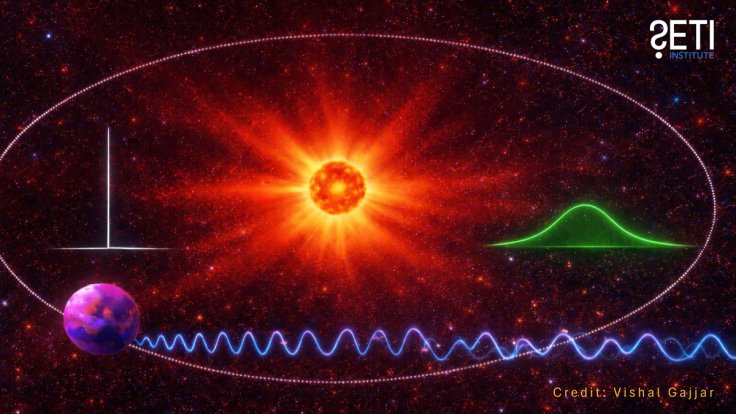
Recent work by scientists at the SETI Institute proposes that space weather around the stars can increase the difficulty of detecting radio waves in alien civilizations. They found that radio signals can be distorted prior to their exit of a planetary system by turbulent plasma and heavy stellar activity around the star of the planet.
As depicted in the illustration above: a planet can send a very sharp signal in the form of a radio signal (the white spike). However, plasma winds around the star are allowed to disperse the signal over a broader spectrum of frequencies, transforming it into a broader and weaker signal (in green). The pattern, according to the researchers, is an implication that the current searches may overlook the possibility of detecting potential signals available since they generally seek the sharp, narrow spikes.
The SETI Institute, established in 1984, has been attempting to comprehend the origin and the abundance of life and intelligence in the universe for over four decades. The institute integrates the fields of astronomy, data analytics, machine learning and superior signal detection methods to find potential technological signals, also known as technosignatures, left by other civilizations.
Why alien signals get weaker?
One of the core issues, raised in the new research, is that an even smaller radio signal can propagate to the plasma around a star and fill a wide range of frequencies because of turbulence even in an alien civilization. Once this occurs, the signal is weaker and more difficult to detect in normal ways of narrowband search.
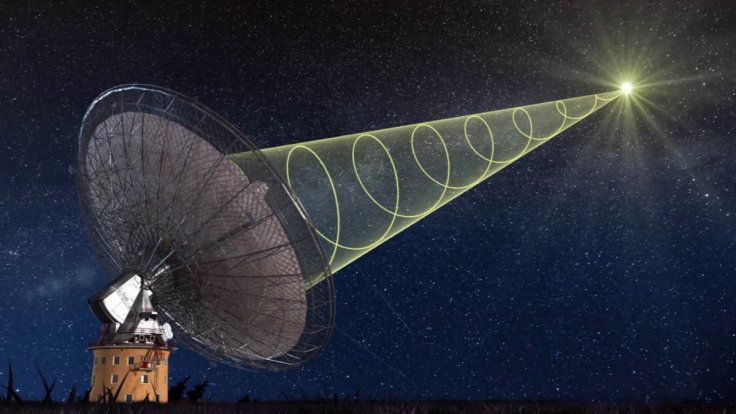
Several SETI experiments over decades have been aimed at locating sharp spikes in frequency, which cannot be expected to be generated by natural astrophysical processes. The study, however, notes that one important aspect the scientists might have failed to consider is that the signals do not necessarily remain narrow since their departure out of the home system.
"SETI searches are often optimized for extremely narrow signals. If a signal gets broadened by its own star's environment, it can slip below our detection thresholds, even if it's there, potentially helping explain some of the radio silence we've seen in technosignature searches," explains Vishal Gajjar, Astronomer at the SETI Institute and lead author of the paper, published in IOP Science.
Vishal Gujjar told IB Times SG in an exclusive that the research by SETI "shows that a signal originating near a red dwarf could lose up to 94% of its detectable power just passing through the stellar medium, before it even begins its interstellar journey."
To measure this effect, the researchers started with something that can directly be observed: radio signals sent by spacecraft in our solar system. They used real data from these space probes to see how turbulent plasma spreads or widens narrow radio signals. After understanding this effect using nearby spacecraft measurements, they extended their calculations to estimate how the same process would behave around many different types of stars.
The result is a practical method to estimate how much a signal may spread out for different types of stars and observation frequencies, especially under the "space weather" conditions found around very active stars.
The study also has an important implication for choosing targets and designing searches. M-dwarf stars, which make up about 75% of the stars in the Milky Way, are the most likely places where narrow radio signals could become broadened before they even leave the star system.
Does this mean that the 75% of stars in the Milky Way most likely to host habitable planets are also the 75%, whose civilizations we are most structurally blind to?
To this query, Gujjar responded: "In SETI, we typically search for narrowband signals — spike-like signals where the energy is concentrated at a single radio frequency. Our results suggest that for roughly 30 percent of stars, including Sun-like stars and red dwarfs, signals originating from planets can become spectrally broadened by about 10 Hz as they pass through the turbulent plasma around their host star before leaving the system. This distortion spreads the signal's energy across frequency and can reduce its detectable intensity by as much as 94 percent."
Are alien civilizations invisible to us?
On this, Gujjar clarifies saying, "It does mean their signals might not appear as the sharp spikes our traditional algorithms look for. Instead, they could appear as weaker, more spread-out signals. The situation may be even more challenging for red dwarfs, which make up about 75% of the stars in the Milky Way, because their space weather is often more active and their planets orbit much closer to the star. This suggests that historically, radio SETI searches may have missed some signals from such systems. But now that we understand this effect better, we can adapt our search strategies to also look for signals that have been broadened or distorted by the stellar environment."
Does it imply, ever since it was founded in 1984, SETI's frequency assumptions have essentially remained a search in the wrong direction?
Refuting the assumption, Gujjar insisted, "I wouldn't say SETI has been looking in the wrong direction. Narrowband signals are still one of the clearest ways to distinguish artificial transmitters from natural astrophysical sources. What our work suggests is that we should broaden our search strategies, not only looking for extremely sharp signals but also for signals that may have been distorted by the space weather around their host stars."
Grayce C. Brown, co-author of the study and research assistant at the SETI Institute adds: "By quantifying how stellar activity can reshape narrowband signals, we can design searches that are better matched to what actually arrives at Earth, not just what might be transmitted."
After their findings, the researchers say future alien signal search strategies should be designed in a way that can still detect signals even if they are not extremely narrow or perfectly sharp.


