
On the day before Palm Sunday, Pope Leo XIV stood in Monaco and warned that "the wars that stain it with blood are the fruit of the idolatry of power and money." The following day, before tens of thousands in St. Peter's Square, he went further.
"Brothers and sisters, this is our God: Jesus, King of Peace, who rejects war, whom no one can use to justify war," Leo said in his Palm Sunday homily. "He does not listen to the prayers of those who wage war, but rejects them."
On Good Friday, he made his most theatrical statement yet.
Leo became the first pope since Pope John Paul II to personally carry a cross through all 14 Stations of the Cross during the traditional rite at Rome's Colosseum, framing the gesture as an invitation for "all people of goodwill to be bearers of peace." A Vatican transcript for the evening event included the passage: "Every person in authority will have to answer to God for the way they exercise their power: the power to judge; the power to start or end a war; the power to instill violence or peace."

The three acts form a pattern. A senior Vatican official, who asked not to be named, said the Trump administration's invocations of God amount to "an exploitation of faith." "The Pope made it very clear when he said you can't invoke God to justify wars," the official said. "It's one thing if you pray like the Ukrainian soldiers do, to stop the Russians invading them, but it's quite another if you invoke divine support while you go launching missiles at another country unprovoked."
What The Administration Has Said
The theological confrontation has a specific target. At a Pentagon prayer service in December, Trump ally Franklin Graham declared: "We think about God as a god of love. But did you know that God also hates? Do you know that God also is a god of war?"
At a recent news conference, Pete Hegseth asked God to give U.S. troops fighting Iran "overwhelming violence of action against those who deserve no mercy."
On March 6, Christian leaders laid hands on Donald Trump and spoke of God "lifting up the arms of our president," an image that circulated globally days after Trump had launched preemptive strikes on Iran. On Wednesday, spiritual adviser Paula White-Cain appeared at a White House Easter lunch and drew accusations of heresy from some theologians by appearing to compare Trump to Jesus. "Because he was victorious, you are victorious," White-Cain said. "And I believe that the Lord said to tell you this: Because of his victory, you will be victorious in all you put your hands to."
The Vatican's Position
The Rev. Antonio Spadaro, undersecretary of the Vatican's Dicastery for Culture and Education, placed Leo's remarks in a historical frame. "From the Nazi era onward, and even before then, 'Gott Mit Uns' has always been a way to justify war, bloodshed and conflict by raising the conflict to a metaphysical, theological level," Spadaro said. "What the pope was meaning to do is undermine this logic in which God with his heavenly army aligns with one side. That's a way of owning the divine."

Spadaro added that Leo's remarks were not aimed exclusively at Washington. "The pope is not only addressing the president of the United States, though this expression is becoming quite common in communications from the administration."
Jerusalem Cardinal Pierbattista Pizzaballa, who was blocked by Israeli police from entering the Church of the Holy Sepulchre on Palm Sunday, has also condemned war theology in explicit terms. "The abuse and manipulation of God's name to justify this and any other war is the gravest sin we can commit at this time," Pizzaballa said at a webinar on the Middle East conflict. "War is first and foremost political and has very material interests, like most wars. We must do everything we can to leave no room for this pseudo religious language."
A Debate With Deep Roots
Leo's position is not without dissent, including from within American Catholicism. Monsignor Charles Pope, a Washington pastor who has led worship groups at the White House and in Congress, said Hegseth and Graham misused scripture but also suggested Leo's formulation went too far. "If war cannot be avoided, it is due to human sinfulness and we should never call in God as a reason to go to war," he said, while adding that it was "too extreme or unnuanced to say God does not listen to the prayers of those who wage war."
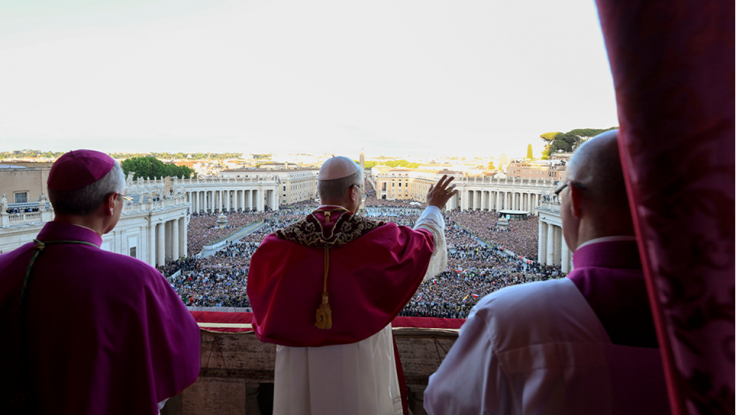
Archbishop Timothy Broglio offered a careful distinction. "I would hesitate to say God takes sides in the infighting of his children," Broglio said. "Just war theory would justify the actions in defense of a country, or responding to defending allies. I'd never take it beyond that."
The Catholic just war tradition, rooted in the teachings of Augustine of Hippo and Thomas Aquinas, holds that war must be avoided at all costs but may be justified if specific moral criteria are met, including that it be defensive in nature. Whether the U.S. strikes on Iran, launched as a preemptive action on February 28, meet those criteria is a question Leo has not addressed directly. His critique has focused on theology, not legality.
Conservative commentators have pushed back publicly. Allie Beth Stuckey wrote on X that the idea that God is against war per se is false. Commentator Buzz Patterson responded to Leo's Palm Sunday message by saying it is not Biblical.
Leo, approaching the first anniversary of his selection to lead the Catholic Church, has left more explicit policy criticism of the administration to American bishops. What he is doing, a senior Vatican official said, is expressing his own way of living Christianity, one centred on a God who does not take sides in wars.
(With inputs from agencies)


