
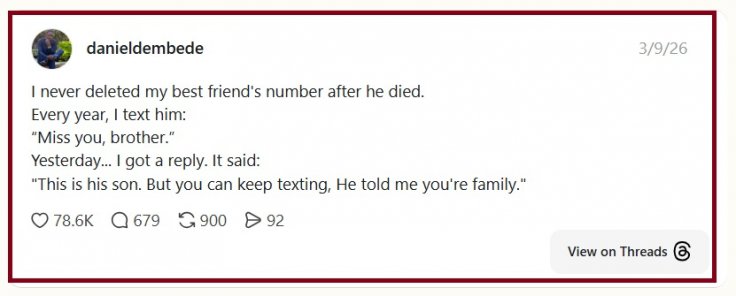
For years, Daniel Dembede sent the same message on the same day to a number he never deleted. "Every year, I text him: 'Miss you, brother,'" Dembede wrote in a March 10 post on Threads. "Yesterday...I got a reply."
The reply was not from a stranger. "This is his son," it read. "But you can keep texting. He told me you're family."
The post has drawn nearly 700,000 views. The hundreds of people who shared their own versions of this ritual in response point to something grief researchers have been saying for years, but that hospitals and workplaces have largely ignored: losing a close friend is one of the most overlooked forms of loss in modern life.
When Numbers Disappear Before Grief Does
What Dembede's post doesn't mention, and what most people sending similar texts probably don't realize, is how close they are to having those messages land with a complete stranger.
There is no minimum time a carrier must hold a number before giving it to someone else. Numbers can be reassigned just days after being disconnected, so it is nearly impossible to stop calls from going to recycled numbers. The Federal Communications Commission, the U.S. regulator that oversees telecommunications, put it bluntly in a formal ruling: "a number used by one consumer today can be reassigned to another consumer almost immediately."
In practice, telecom providers usually wait about 90 days before putting a recycled number back into use. But in high-demand area codes, that can happen much faster. Nearly 100,000 mobile phone numbers are reassigned every single day.
The FCC created a reassigned number database in 2018 to help businesses avoid contacting people who had inherited someone else's old number. That database was built to protect companies from lawsuits, not to help grieving people. No regulation requires carriers to tell families that a dead person's number is about to be recycled. No policy gives next of kin the right to keep that number unless they take over the account and keep paying the bill.
Dembede's ritual worked because someone in his friend's family kept the line active. Most families don't.
The Science Behind the Ritual
Some people might call texting a dead friend morbid. But grief researchers see it differently. They call it continuing bonds, a therapeutic idea that keeping symbolic connections with the dead can actually help, not hurt, the mourning process.
The real social failure isn't that people text dead friends. It's that when those friends die, the loss gets brushed aside by institutions designed to support other kinds of grief.
A 2019 study in PLOS One looked at data from 26,515 Australians. Of those, 9,586 had lost a close friend. The findings were striking. Losing a close friend damaged physical health, mental health, emotional stability, and social functioning for up to four years after the death. Earlier studies had put that window at about 12 months.
Lead author Dr. Wai-Man Liu of the Australian National University explained why those people weren't getting help. "The death of a friend is a form of disenfranchised grief," he said, "one not taken so seriously or afforded such significance."
"Since death of friends is a universal phenomenon, we conclude the paper by reflecting on the need to recognise the death of a close friend as a substantial experience, and to offer support and services to address this disenfranchised grief. Recognising bereaved friends as a group experiencing adverse outcomes can be used internationally to prompt health and psychological services," wrote authors of the study in their abstract.
The study found women had a harder time than men. They showed sharper declines in energy, greater deterioration in mental health, and worse social functioning for up to four years after the loss. People who were already less socially active suffered the most. For them, the negative health effects hadn't gone away even after four years. The death of a close friend, the study noted, often shrank a person's social circle at the exact moment they needed it most.
The Ritual That Preceded the App
Tech companies have noticed the gap. A growing number of services now promise to preserve a dead person's digital presence, using artificial intelligence trained on their texts, emails, and recorded voice. They market these products as a way to stay connected after death.
Dembede's story is the human version of that product, without the monthly fee, and delivered by the son of the man he was grieving.
The response on Threads showed how many people are already doing this quietly, without any commercial platform.

User @lizg4ever22 wrote about her grandson, who keeps texting his late father. "He told me that he will always text him with updates in his life," she said. "When he was in high school he'd text my son before and after each football game. He says he won't ever stop."
User @mlm130409 described texting her mother three years after her death, on birthdays, Mother's Day, and most mornings. One time, the number had been reassigned. The stranger who got the message chose kindness. "The person said, 'I know she's watching over you and replying to you without you even realizing it,'" she wrote. "I'm still crying."
Liu's advice to policymakers was straightforward: "We need to recognise the death of a close friend takes a serious toll, and to offer health and psychological services to assist these people over an adequate period of time."
The telecom industry has nothing like that in its rulebook.


