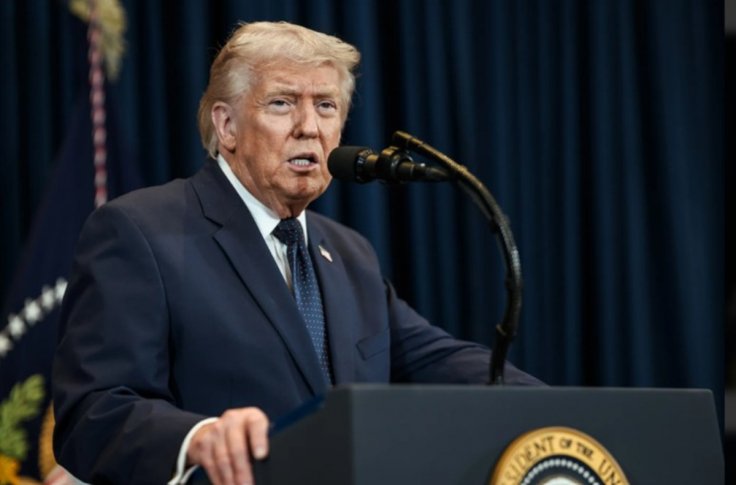
President Trump told the nation on April 1, 2026, that the United States is close to winning its war against Iran. He said American forces would "finish the job" soon. He also threatened to bomb Iran's energy infrastructure harder if diplomacy fails.
Those two positions, active deal negotiations and escalation threats arrived in the same primetime address, delivered roughly one month into Operation Epic Fury, the U.S.-led military campaign launched against Iran. Trump declared that core strategic objectives were nearing completion, calling Iran a "terrorist nation bully" that would "no longer" pose a threat.
Trump's Shifting Rationale for the War
The speech marked a notable shift in how the administration has framed the conflict. Earlier messaging had centered on resource acquisition as a driver of U.S. involvement. By April 1, Trump's stated rationale had moved toward defending allies and protecting regional stability.
Trump claimed Iran's military capabilities had been "practically destroyed" by the joint campaign. He also acknowledged American casualties, while describing the military results as unprecedented. The Associated Press reported Trump told the nation U.S. forces would "finish the job" in Iran soon, a formulation he repeated across the address.
Trump predicted the mission would conclude "very shortly," though he offered no specific timeline, benchmarks, or conditions that would define completion. He also called on other nations to take primary responsibility for securing the Strait of Hormuz, the narrow waterway connecting the Persian Gulf to the Arabian Sea through which roughly 20 percent of the world's traded oil passes, rather than relying on the U.S. Navy to police it indefinitely.
The threat attached to the diplomatic track was direct. If no deal materializes, Trump promised to escalate bombing campaigns targeting Iran's energy infrastructure, according to the Los Angeles Times. U.S. and Israeli forces have continued coordinated strikes across Iranian territory throughout the negotiating period.
Pakistan-Led Diplomacy Running Alongside the Bombs
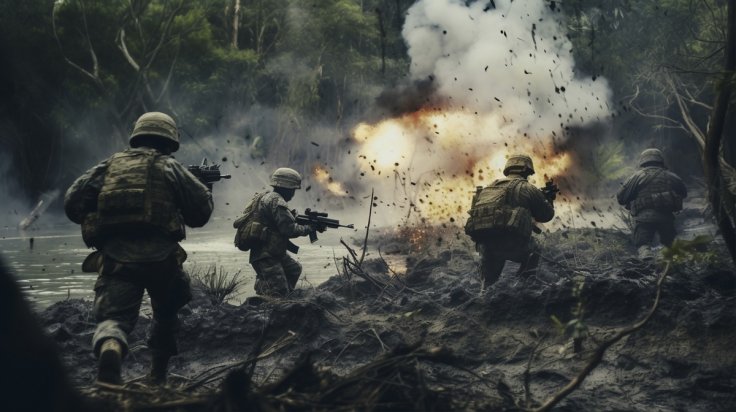
While Trump was threatening deeper strikes from the podium, a parallel diplomatic channel was already open. Pakistan is facilitating direct talks between the U.S. and Iran as part of a four-nation initiative aimed at ending the conflict. Trump had previously said he was "pretty sure" a deal could be reached through that process, though no agreement has been announced.
The coexistence of active military strikes and active diplomatic talks places the administration in an unusual posture: conducting war and negotiating its end simultaneously, with escalation threats serving as the stated lever to accelerate a settlement.
NATO allies have grown increasingly resistant to that approach. The North Atlantic Treaty Organization's (NATO) European members are pushing back against Trump's requests for direct military support and burden-sharing in the Iran campaign. The alliance, formed in 1949 as a collective defense pact among Western democracies, has not formally endorsed the Iran operation, and internal disagreements over the legal and strategic basis for U.S. involvement have complicated Washington's attempts to build a coalition.
On the domestic front, the administration has faced little legislative constraint. The U.S. Senate rejected a Democratic-led effort to invoke the War Powers Resolution of 1973, a law requiring congressional authorization for sustained military engagements, to rein in Trump's Iran campaign. The vote handed the White House continued operational latitude.
The war has also begun registering in the domestic economy. The Center for American Progress, a Washington-based progressive policy institute, published an analysis arguing the conflict is disrupting supply chains and making it harder for U.S. manufacturers to source components and produce goods. The claim has not been independently verified against a second institutional source.
Skepticism at Home after the Primetime Address
Trump's address drew a skeptical public response. The disconnect between declarations of imminent victory and an active bombing campaign with no announced end date informed much of that reaction.
Trump has now declared the U.S. has "won" the war on at least one prior occasion. The April 1 address did not use that specific formulation, but the framing of objectives "nearing completion" carried similar implications.
Iran has not publicly responded to the terms Trump outlined in the address. No Iranian government statement on the speech was available at the time of publication.
Disclaimer: This article was produced with the assistance of artificial intelligence tool but vetted by human editor.


