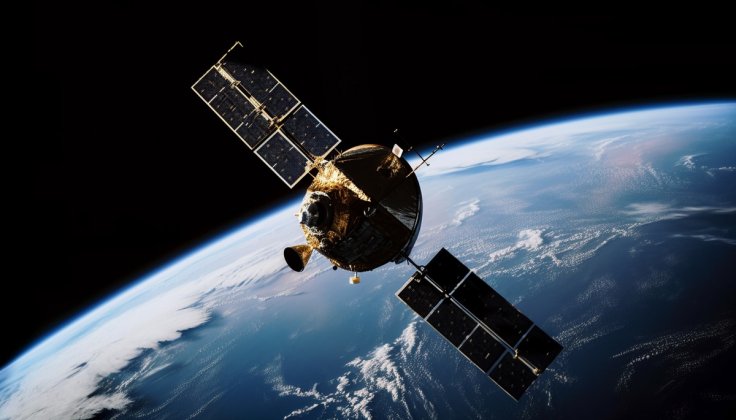
In March 2026, BlackSky Technology, a geospatial intelligence company based in Virginia, received a $99 million sole-source, multi-year indefinite-delivery/indefinite-quantity (IDIQ) contract from a U.S. government customer to develop AI-enabled space intelligence satellites with advanced optical payloads.
The award was sole-source, meaning no competitive bidding process applied, a designation reserved for capabilities the government considers uniquely critical. A separate report corroborated a $99 million figure tied to BlackSky's Earth observation work, reinforcing the scale of federal appetite for orbital intelligence platforms.
That contract sits inside a much larger build-out. The global autonomous defense platforms market, which encompasses AI-driven space and ground systems, is projected to grow from $69.8 billion in 2026 to nearly $198.9 billion by 2034, according to data reported by Morningstar. The U.S. is not a passive observer of that growth. It is, by available evidence, the primary driver.
How the Pentagon Is Using AI from Space Right Now
The most operationally significant American system is Project Maven, the AI targeting platform developed by Palantir Technologies, the data analytics firm co-founded by Peter Thiel. What began as a controversial 2017 Department of Defense initiative, partly abandoned after employee protests at Google, has since become core Pentagon infrastructure.
Maven transitioned from a pilot program to program-of-record status, a formal designation meaning it is now permanent, funded military infrastructure rather than an experiment.
The scale of Maven's current throughput is striking. The Pentagon uses AI, partly through Maven, to process approximately 1,000 potential targets daily, with strike turnaround times under four hours. AI warfare capabilities now enable real-time analysis of thousands of sensors simultaneously, compressing decision-making timelines from hours to seconds.
The company has also secured a core role in the $185 billion Golden Dome space-based missile defense program alongside Anduril Industries, a defense technology firm founded by Palmer Luckey. Golden Dome, which draws its name from Israel's Iron Dome air defense system, is designed to intercept ballistic and hypersonic missiles using a network of space-based sensors and interceptors. Palantir's participation signals that AI-driven data fusion, not just hardware, is considered central to that architecture.
Smaller contracts are filling out the ecosystem beneath those flagship programs. Vantor, a space technology firm, won a $2.3 million contract from the National Geospatial-Intelligence Agency (NGA) under the LUNO-B program to deliver automated orbital intelligence using high-resolution space imagery.
The NGA, the federal body responsible for geospatial intelligence collection and analysis, awarded the contract to automate the tracking of objects in orbit, a function that is growing in strategic importance as low Earth orbit becomes congested. NVIDIA, the semiconductor company whose graphics processing units underpin most large-scale AI workloads, has launched advanced space computing platforms specifically designed for AI applications in orbital environments.

The Constellation Race and Where China Fits
On the commercial side, the architecture is expanding vertically as well as horizontally. Starcloud, a startup building orbital computing infrastructure, reached a $1.1 billion valuation after announcing plans to develop an 88,000-satellite AI data center constellation in space.
The figure has not been independently confirmed by a second source and should be treated as a single-source claim. If the constellation proceeds at anything close to that scale, it would represent a fundamental shift in where AI computation physically occurs, moving it from terrestrial data centers to orbit.
Novi Space, a European-linked satellite technology firm, is advancing AI-driven satellite technology with on-board edge computing capabilities, allowing satellites to process data autonomously rather than relay raw sensor feeds to ground stations.
China's position in this race is harder to quantify from open sources. Beijing has publicly committed to becoming the world's leading AI power by 2030, a goal outlined in its 2017 New Generation Artificial Intelligence Development Plan. Chinese state media and defense analysts have described active investment in AI-enabled reconnaissance satellites, autonomous space systems, and orbital strike capabilities.
The specifics of contract values, system throughput, and operational status remain largely undisclosed by Chinese authorities, and no independently verified figures comparable to the U.S. contract disclosures examined here could be confirmed from the available insight packages.
What is documented is the competitive framing within the U.S. defense establishment. The Pentagon's acceleration of Maven, Golden Dome, and sole-source orbital intelligence contracts reflects an institutional judgment that space-based AI is a domain where operational speed confers strategic advantage.
The report did not attribute the bombing to Maven directly, and the Pentagon has not publicly confirmed the specifics of any individual strike processed through the system.
The commercial and military investment lines are converging. NVIDIA's orbital computing hardware, BlackSky's AI-enabled optical satellites, Palantir's targeting and data fusion software, and emerging constellation-scale infrastructure from firms like Starcloud represent a layered American ecosystem that spans chip design, launch, sensing, and decision support.
China's equivalent build-out is proceeding in parallel, but its integration across those same layers, from silicon to software to operational military doctrine, is not yet publicly visible at comparable resolution.
The gap in public transparency between the two programs is itself a data point. American firms disclose contracts, valuations, and system capabilities through regulatory filings, government procurement announcements, and investor communications. China's space-AI integration advances through state channels with limited external verification.
Disclaimer: This article was produced with the assistance of artificial intelligence.
Also Read: Fusion Rocket as Power Plant: The Dual-Use Energy Angle Kicks Off With UK Startup Igniting Plasma