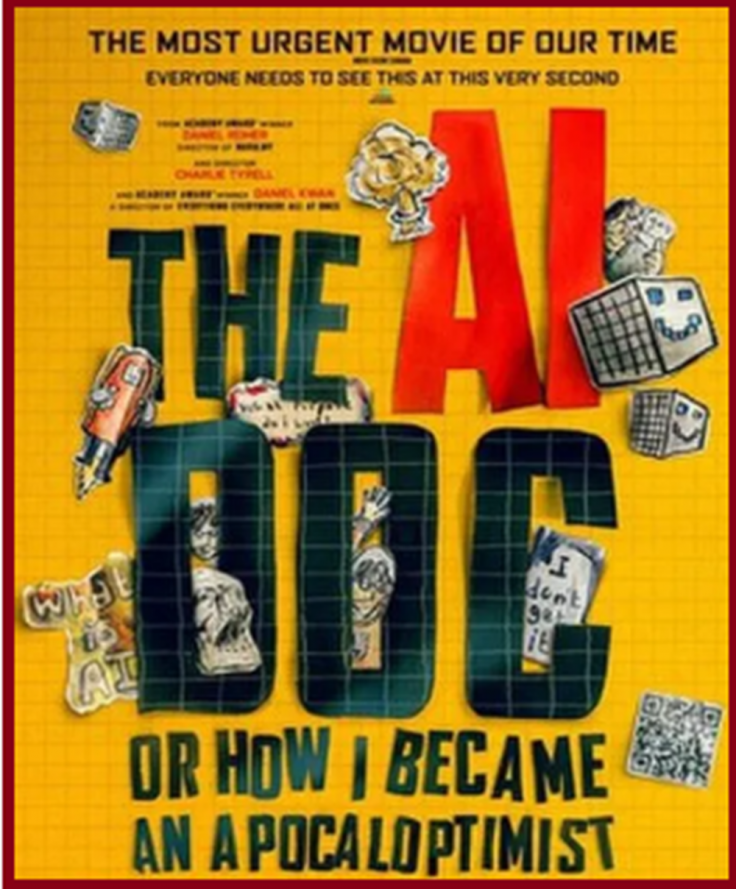
"The AI Doc: Or How I Became an Apocaloptimist," distributed by Focus Features, opens in theaters on March 27, 2026, and features interviews with the chief executives of OpenAI, Anthropic, and DeepMind.
Directors Daniel Roher and Charlie Tyrell, who spent months inside the AI industry's inner circle, are calling its investment climate a speculative bubble driven by hype rather than proven returns. The film's central argument is that consumers, not executives, must determine how the technology develops.
The most striking thing Daniel Roher says about the artificial intelligence industry does not appear in his new documentary. It comes when the conversation turns to Wall Street. "This is all smoke and mirrors," Roher told Vanity Fair, ahead of the film's release. "The entire economy of AI is being propped up by a Ponzi scheme. The hype of this technology is unlike any hype we've seen."
The statement carries weight precisely because of where Roher has spent the past year. "The AI Doc: Or How I Became an Apocaloptimist," opening March 27 through Focus Features, puts him and codirector Charlie Tyrell in the room with nearly every significant figure shaping the technology: Sam Altman, chief executive of OpenAI; Dario and Daniela Amodei, the siblings who founded and run Anthropic; and Demis Hassabis, the head of DeepMind, the artificial intelligence research division of Google.
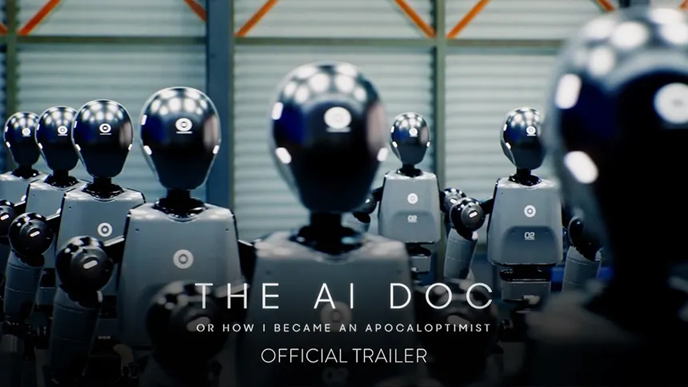
Two names are missing. Elon Musk, the owner of AI company xAI and a co-founder of OpenAI before a public falling-out with its leadership, initially agreed to participate. "Musk said yes initially, but it was right when he was doing all the stuff with Trump, and we just got ghosted after a while," Tyrell said. Mark Zuckerberg, chief executive of Meta Platforms, which operates its own large-scale AI research division, did not make the cut either. Roher's explanation was terse: "Have you seen that guy speak? He's like a lizard man."
Sam Altman on Camera
Altman, who as OpenAI's public face has become arguably the most recognizable individual in artificial intelligence, features prominently in the film. Roher was not persuaded by what he found. "That guy doesn't know what genuine means," the director said. "Every single thing he says and does is calculated. He is a machine. He's like AI, and it's in the service of growth, growth, growth. You can be disingenuous and media savvy."
OpenAI, which Altman co-founded in 2015 and has since restructured from a nonprofit into a for-profit company, has raised tens of billions of dollars from investors including Microsoft and has become a central subject in debates about how quickly AI should be developed and who should govern its use.
The Apocaloptimist Argument
The film's title encodes its thesis. Roher framed the worldview that he and Tyrell are advocating as a deliberate rejection of the binary that dominates public discourse. "We are preaching a worldview in a world that's asking you to either see this as the apocalypse or embrace it with this unbridled optimism," he said.
The directors are staking out the space between those positions. "It's both at the same time. We have to try and embrace a middle ground so this technology doesn't consume us, so we can stay in the driver's seat," Roher said.
The film covers artificial general intelligence (AGI), a theoretical future state in which AI systems would independently perform complex reasoning tasks without step-by-step human instruction. Unlike current AI tools, which are purpose-built for specific functions, AGI would represent a machine capable of autonomous decision-making across domains, a development that researchers and policymakers treat as a critical inflection point.
Consumer Disclosure as Resistance
The documentary's call to action is aimed at ordinary people rather than regulators. Tyrell put it in concrete terms: "You have to speak up. Things like AI should disclose themselves. If your doctor's office is using an AI bot, you have to say, I don't like that."
That position is shared by the film's producer, Daniel Kwan, who won the Academy Award for Best Picture in 2023 for co-directing "Everything Everywhere All at Once" and has been a vocal participant in debates over AI's role in the entertainment industry. Writers and actors have pushed back against studios and streaming platforms over the technology's use in script development, casting tools, and synthetic performance generation.
Roher and Tyrell acknowledge using AI in their own daily work. Their argument is not that the technology should be rejected outright but that adoption should be deliberate and consent-based.
The Gold Rush Economy
Roher's sharpest criticism targets the investment environment. He reached for a 19th-century analogy: "These people are prospectors, and they are going up to the Yukon because it's the gold rush."
He grounded the claim in a pointed hypothetical. "I feel like I could announce in a press release that Academy Award winner Daniel Roher is starting an AI film company, and I could sell it the next day for $20 million," he said.
The argument reflects a concern held by a growing number of economists and market analysts: that AI company valuations have outrun demonstrated revenue, and that institutional investment is pricing in transformative outcomes that remain unproven at scale. Several AI ventures that attracted 9- and 10-figure funding rounds in 2023 and 2024 have since faced questions about sustainable business models and return timelines.
"The AI Doc: Or How I Became an Apocaloptimist" opens in theaters on March 27, 2026, through Focus Features.