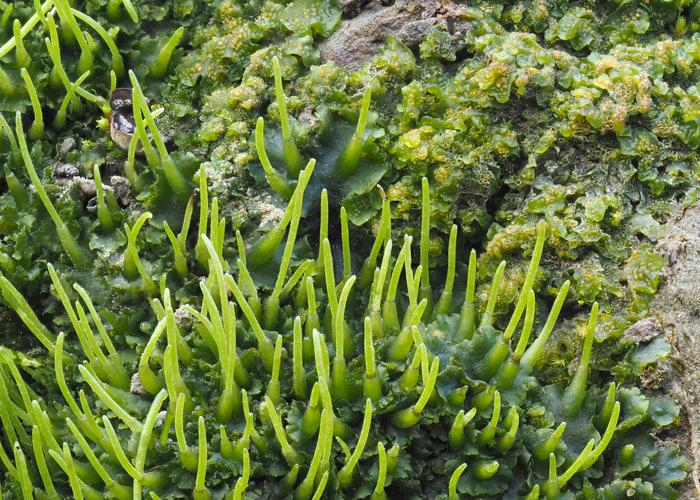
One of the most marginalized and in fact understudied plant groups, hornworts, has the potential to provide a long-awaited breakthrough in crop science the ability to make plants more efficient in converting sunlight and carbon dioxide into food.
In their work, scientists at Boyce Thompson Institute, Cornell University and the University of Edinburgh have shown that in a distinct mechanism of reorganising a key photosynthesis enzyme, hornworts, have a special form of molecular machinery that enables plants to pack tightly into discrete spots. Scientists say that the discovery may come in handy in the future to help increase the yields of staple crops like wheat and rice.
The most fascinating discovery is in the middle of the photosynthetic carbon dioxide capture enzyme, Rubisco. Even though it is vital to the existence of life on this planet, Rubisco is notoriously inefficient.
"Rubisco is arguably the most important enzyme on the planet because it's the entry point for nearly all carbon in the food we eat," said Fay-Wei Li, associate professor at the Boyce Thompson Institute and a co-leader of the study. "But it's slow and easily distracted by oxygen, which wastes energy and limits how efficiently plants can grow."
Decades of Research Goes Into New Findings
Over decades, plant scientists have been trying to find ways of making Rubisco more productive. In algae, the enzyme is bundled into microscopic structures known as pyrenoids which pull the carbon dioxide around the enzyme enabling photosynthesis to be faster. It has been challenging to reproduce this mechanism in crop plants since the equipment that algae can use is complicated and hard to move.
The new work postulates a less complex strategy used by the hornworts, an ancient group of terrestrial plants.
Scientists undertook the study of Phaeoceros laevis which is popularly referred to as smooth hornwort. Carbon-concentrating compartments within the cells are also produced by hornworts, unlike the case with most terrestrial plants. Scientists were afraid that they would use more crop-compatible molecular tools.
The team found out that hornworms adjust the enzyme, rather than using other proteins to form clusters of Rubisco.
"We even tried attaching just the STAR tail to Arabidopsis's native Rubisco, and it triggered the same clustering effect," said Alistair McCormick, professor at the University of Edinburgh and co-leader of the research. "That tells us STAR is truly the driving force. It's a modular tool that can work across different plant systems."
STAR Region in Hornworts Clumps Molecules Together
The researchers found a mutated protein component named as RbcS-STAR. Rubisco is comprised of big and small protein subunits as a rule. In hornworts, a single copy of the small subunit has an additional tail, called the STAR region, which serves as molecular Velcro making Rubisco molecules clump together.
It was demonstrated in experiments the extent to which the modification could be powerful. Rubisco was rearranged into dense pyrenoid-like structures when RbcS-STAR was introduced in a related hornwort species that lacked these compartments by scientists.
Small Advance, Tremendous Benefits Later
This was also observed in the case of the introduction of the gene to the model plant Arabidopsis thaliana whereby Rubisco similarly formed localized masses within the chloroplasts.
"We assumed hornworts would use something similar to what algae use—a separate protein that gathers Rubisco together," said Tanner Robison, a graduate researcher and co-first author of the paper. "Instead, we discovered they've modified Rubisco itself to do the job."
The research gives hope that a comparable genetic modification can one day be used to enhance crop photosynthesis.
Researchers, however, warn that clustering Rubisco is just one of the steps towards forming a fully functioning carbon-concentrating system. It is possible that even small advances in photosynthesis might pose tremendous agricultural consequences.
Earlier Milestones In Improving Photosynthesis
| Year | Study / Discovery | Significance |
|---|---|---|
| 1980s | Identification of Rubisco's oxygenation problem | Scientists found that Rubisco often reacts with oxygen, lowering photosynthetic efficiency. |
| 2002 | Early work on algal pyrenoids | Researchers found algae concentrate CO₂ around Rubisco inside pyrenoids. |
| 2016 | Synthetic biology attempts to engineer pyrenoids in plants | Experiments suggested it might be possible to transfer algal components into crops. |
| 2020 | Structural studies of Rubisco organization in algae | Provided insight into how protein interactions form carbon-concentrating compartments. |
| 2026 | Hornwort RbcS-STAR discovery | Revealed a simpler mechanism that clusters Rubisco directly within plant cells. |


