
Last summer, a secret British Army experiment that involved one of the Land Rover models leaking into a net and the stenciled net becoming a print out 3D-printed the battlefield, but now, it was suddenly looking like a timely game-changer in the US-Israel conflict with Iran.
Technicians at Royal Electrical and Mechanical Engineers were able to print first-person-view attack drones using a portable 3D printer in only 3.5 hours of printing and an hour of assembly using a field generator.
Five full units, plus spares, were flown to the simulated skies, striking targets at 190mph and being virtually impossible to intercept in tests, led by Major Steve Watts of 3 RIFLES. He told the media that he could not be 100 percent sure but he thought it was the first time someone in the army had done so. "I can't be 100 per cent certain but I believe it's the first time anyone in the army has done this," he said.
It was possible only thanks to special clearance of the Military Aviation Authority, which previously it was restricted to safe inside-the-wire racing or off-the-shelf aircraft.
Why does this matter now?
When US and Israeli bombing of Iranian infrastructure saw Tehran's response with waves of Shahed-style drones, logistics and cost pervaded the analysts around the globe. Supply lines in a large-scale war over the Strait of Hormuz to Lebanon are lengthy and exposed. It is costly and time-consuming to ship thousands of manufactured drones.
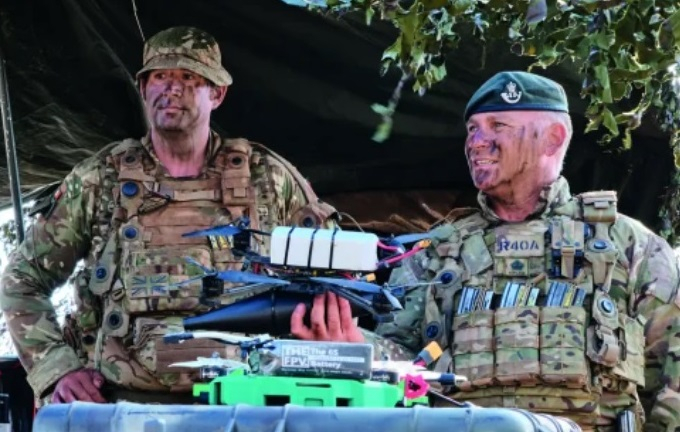
However, when printed on-demand and being near the action, it all looks different, where a single off-the-shelf FPV drone will be in the range of £2,000 each, assembling them for about £400 a unit, may make the economic argument for mass production very strong. The British field versions may come at about £400 each.
More to the point, they could be customised on-site by the troops to fit the mission - longer range on one, heavier payload on the other, or wire-guided to overcome jamming. In the Iran theatre, where inexpensive Iranian drones have caused multi-million dollar interceptors to fly every night, such volume production would allow allied forces to compete with or even surpass the swarm. No waiting until the European or American container brought theirs, a truck loaded with printers, filament, batteries and simple electronics streaming on behind the reload of ammunition.
Major Watts is already thinking of going big with the next Bull Storm exercise in 2026, seeing tens of thousands of home-built drones forming a formation that would be highly deadly.
The concept was not an impetus. Watts freely gave credit to the frontline innovators of Ukraine who have been printing and fine-tuning drones to the specifications of missions since years, in factories, and directly at the trenches. "In Ukraine they are printing and building them on the front line as well as back in their factories and they'll design and assemble them to a spec determined by the type of mission that's required."
The trial conducted by the British is quite remarkable since it demonstrated that the idea of printing is not in the factory or the rear where it is safe, but in the open field conditions dust, temperature variations and everything. Whether this makes it into the possession of platoon commanders in the current Iran conflict in the form of an endless supply of precision strike capability tool will depend on the technology of the UK or its equivalents finding their way into the arms of allies.
"By Exercise Bull Storm 26 I'd like to have tens – if not hundreds – of self-built FPVs flying, which will make the formation extremely lethal... If we go larger in future we could have just one truck full of 3D printers, generators, parts, cameras and small ordnance and our build capacity would be huge," Watts said on the potential of 3-D drones' production right in the battlefield.
Above all, the morale is obvious in the current wars where drones are cheap and expendable, the most successful will not only live longer, but it will also be able to set the pace. And that margin can not arrive in time, now that the tensions continue to simmer throughout the Middle East.


