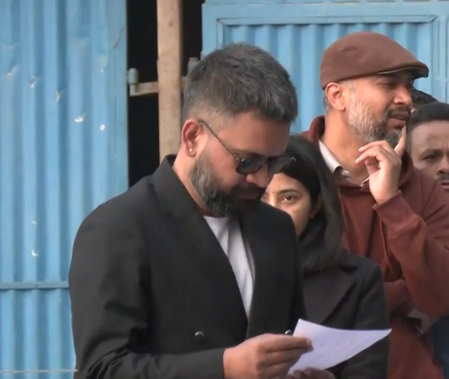
- Nepal parliamentary elections begin Thursday; voters queue at nationwide polling centres
- Top leaders including Prachanda, Lamichhane and Ghising cast early votes
- Election will choose 275 House members through FPTP and proportional systems
- Nearly 18.9 million voters eligible; strong Gen Z participation expected
Parliamentary voting started in Nepal on Thursday morning as citizens stood in lines at polling points all over the country to elect members of the House of Representatives, and this way, the country started to vote in earnest, an election influenced by the political turmoil in time and the uprising of youth who had increasingly become voters.
Voting began at 7 a.m. local countrywide in thousands of voting sites and election officials projected a steady stream of voters all day long. The elections will decide who to represent the lower house of parliament of 275 lawmakers, 165 will be elected with the First-Past-the-Post (FPTP) system with the rest 110 elected using the proportional representation system.
As per the statistics of Nepal Election Commission, over 18.90 million voters are eligible to cast their votes including over 915,000 newly registered voters. Older political leaders vote in the early morning when voting commenced. They included the Rastriya Swatantra Party (RSP) President Rabi Lamichhane and senior party leader Balen Shah who cast their votes in Kathmandu.
Dahal also voted himself in his hometown of Bharatpur in the Chitwan district, a former Prime Minister Pushpa Kamal Dahal, also known as Prachanda. According to Lamichhane, the election was a chance of voters to influence the political future of the country. It is a chance to make your future and your children, he said when he cast his vote.
According to political experts, his party that has turned out to be the fourth-largest party in the dissolved parliament can take advantage of the anger that people have with the usual political parties. Shah, the Prime Minister candidate in the RSP, is running the Jhapa-5 in the eastern region of Nepal where he is run against by the former Prime Minister KP Sharma Oli in a hotly contested election. Although he was a candidate, Shah voted in Kathmandu as Nepali voting laws dictate the citizens to cast votes at the places of their former residence.
Leading Activists Present Noisy Political Stories During Early Voting
Former Prime Minister Pushpa Kamal Dahal also took part in early voting at Bharatpur, where her daughter Renu Dahal is also running a House of Representatives. Her past as the mayor of the city, she is considered to be a strong candidate by people, as she has shown her ability to implement municipal development initiatives in the city. Prachanda is even contesting election in the Rukum East-1 in the west of Nepal which is a region that has long been a constituency belonging to his party.
When making an appeal to the reporters after voting, he claimed that the political discussion in the country was past the point where elections were pitched as a fight between the outdated and the newest political movements. Rather, he claimed that voters need to assess the ability of candidates and parties into providing effective governance.
The elections have been the center of attraction due to the increasing dissatisfaction with the old institutions of politics including the Nepali Congress and the Communist Party of Nepal (Unified Marxist-Leninist) commonly abbreviated as CPN (UML). Critics opine that these parties have over the decades monopolized politics in Nepal, and have caused coalition dilemma and policy stalemates.
Kul Man Ghising who is the president of the party Ujyalo Nepal Party was another major personality that cast his vote. Ghising earned national acclaim in his time serving as the managing director of the Nepal Electricity Authority where he is said to have ended decades of power outages that the country had experienced.
According to the political observers, his track record as an administrator had assisted him to garner people behind his vision even before he formed his political party. His own electoral politics have further brought in the aspect of competition to an already crowded race between the old and the new.
Young Surge And Fast Forward Election Elicits Competitive Race
The recent parliamentary elections in Nepal are held almost two years before they were due according to the initial scheduling due to the significant political transformation occasioned by a national-youth based protest movement that took place last year. The protests, or as they are also known as the Gen Z movement, broke out in September and eventually caused the government of the former Prime Minister, KP Sharma Oli, to collapse.
The political upheaval led to the establishment of an interim government under Sushila Karki the government that took charge of presiding over a transition into new elections. This resulted in the dissolution of lower house after negotiations between political leaders and youth activists and the government was left with the responsibility of holding national polls in the next six months.
According to election officials, voter turnout by the youth may have a critical outcome in deciding. Going by the numbers provided by Reuters on the Election Commission of Nepal, over two thirds of new voters this year have formed part of the Generation Z category. The analysts claim that this change can alter the campaign policies and the voting trends since younger users have been keen on governance movements, economic prospects and political openness.
Their rise as an electoral force is likely to transform the Nepal political debate and add more rivalry to the parties that aim to gain more support. Suffrage is underway in 23,112 voting stations of the Himalayan country. According to the election officials, there are 3,406 contenders for seats utilizing FPTP system and 3,135 contenders utilizing the proportional representation system. Handing over of election officials was supported by deploying security forces to keep order in polling stations all over the country.
The officials have advised people to turn out in large numbers to vote in a peaceful manner and undergo election procedures to promote integrity of the votes. The outcome of the election will change the way the next government of Nepal will be composed and may redefine the relationship(s) between political parties as the nation continues to face economic difficulties and insists on the governmental change at the institutional level. Election counting of votes should commence after a closure of polls later in the day.