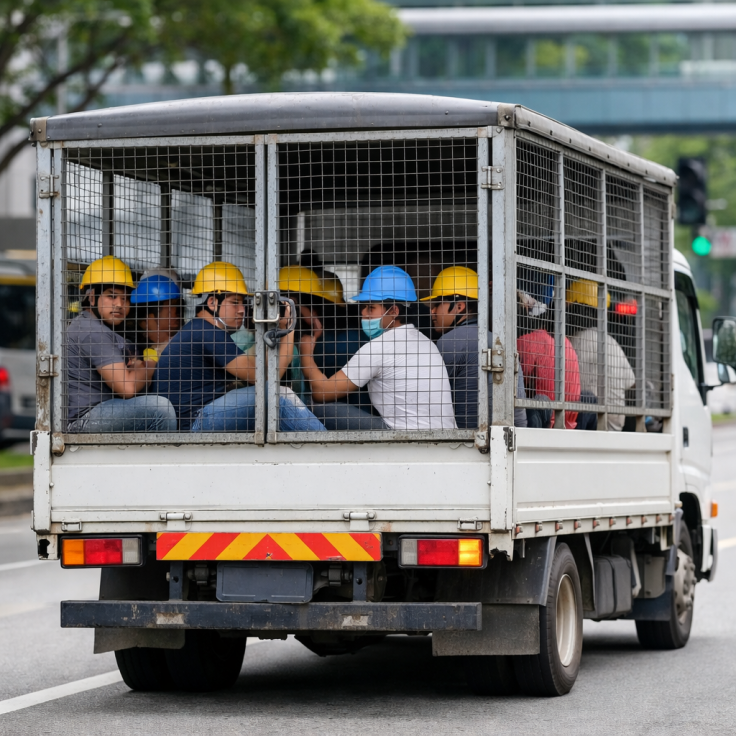
Singapore is all set to ban the use of lorries with caged decks to transport workers from next year, marking a significant change to long-standing practices in the construction and logistics sectors.
Senior Minister of State for Transport Sun Xueling announced this move in parliament on Wednesday, March 4, during the debate on the Ministry of Transport's budget.
Sun said that the decision was driven primarily by safety concerns. She noted that in some cases, the cage doors on these lorries are latched or locked from the outside. If such a vehicle were involved in an accident or caught fire, workers inside the rear deck could find it difficult or even impossible to escape quickly.
While caged lorries have been a familiar sight on Singapore's roads for years, only a small proportion of the country's commercial fleet uses them to transport workers.
Out of roughly 50,000 lorries in Singapore, about 500 to 1,000 have caged decks. These vehicles will still be allowed to carry goods, but they can no longer be used to ferry workers once the rule takes effect.
In a joint statement, the Ministry of Transport (MOT) and the Land Transport Authority (LTA) said that the companies that fail to comply with the upcoming ban will face penalties. More details about enforcement and fines will be released before the 2027 deadline.
During the transition period, companies must ensure workers can safely get on and off the rear decks of lorries. Firms that wish to continue using these vehicles to transport workers will need to modify them. One option is to convert the caged deck into a structure with a canopy and side railings, which allows workers easier access and exit.
The authorities added that they will continue to work closely with businesses, industry groups and non-governmental organisations to strengthen safety standards for worker transport.
The Migrant Workers' Centre (MWC), which is affiliated with the National Trades Union Congress, welcomed the policy change and described it as a step forward in improving road safety for migrant workers.
In a Facebook post, the organisation said the ban on using caged lorries to transport both workers and equipment addresses long-standing concerns about the safety of workers travelling on open lorry decks. The group added that it has long advocated for safer transport arrangements, particularly for migrant workers who rely on company vehicles to get to and from worksites.
"Safety must always come first. Every worker deserves to travel safely to and from work," the MWC said.
The issue of transporting workers on lorries has been debated in Singapore for years. Advocacy groups have repeatedly called for a complete ban, arguing that the practice exposes workers to unnecessary risks in the event of accidents.
Last year, the migrant worker rights group Humanitarian Organisation for Migration Economics (HOME) urged the government to phase out the practice entirely. The group also suggested providing subsidies to help companies charter buses for their workers instead.
In response to earlier calls for a ban, then-Transport Minister Chee Hong Tat had said such a move would be difficult to implement across all industries.
In a written parliamentary reply, he had said that banning lorry transport outright could place heavy financial and operational burdens on small and medium-sized enterprises, potentially leading to job losses, project delays and higher costs for consumers.
Statistics from the past decade highlight both safety concerns and gradual improvements.
Chee said there has been an average of one worker fatality each year over the past 10 years involving lorry transport. At the same time, the average number of workers injured while being transported in lorries has declined by more than 25%, falling from 215 cases between 2015 and 2019 to 161 cases between 2020 and 2024.
Despite this improvement, several recent incidents have kept the issue in the spotlight. In January this year, a collision between a car and a lorry along Orchard Road resulted in 13 people being taken to hospital, including 12 workers who were travelling in the lorry.
In another case in December, a 33-year-old driver was sentenced to 27 months in jail after he sped at up to twice the speed limit and crashed into a lorry carrying migrant workers in 2023. Nine workers from India were seriously injured in the crash, and four required surgery.
With the new ban on caged lorries, authorities hope to reduce risks for workers on Singapore's roads while continuing to work with industries on safer transport solutions.