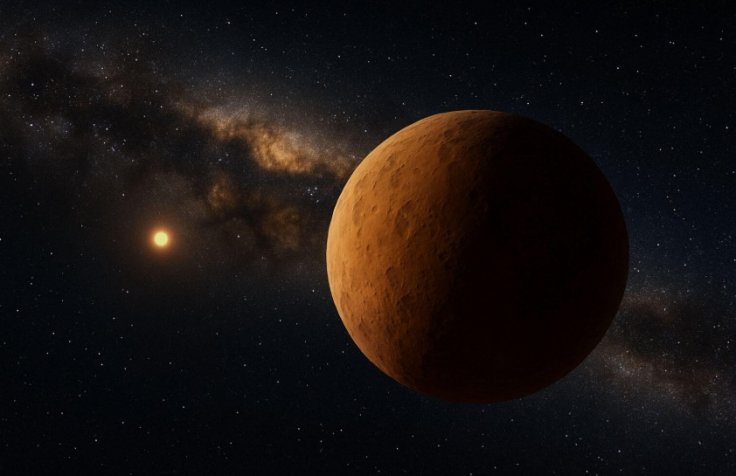
Astronomers have identified a rare and distant object at the fringes of the solar system, underscoring how much remains unknown about the region beyond Neptune.
The object, designated 2023 KQ14 and nicknamed "Ammonite", was first spotted in 2023 by the Subaru Telescope in Hawaii during observations carried out under an international research effort.
Ammonite was identified as part of the FOSSIL project, short for Formation of the Outer Solar System: An Icy Legacy. Researchers say it is neither a planet nor a dwarf planet but instead belongs to an extremely rare class of trans-Neptunian objects known as sednoids. These icy bodies follow distant and unusual orbits that keep them far from the gravitational influence of the known planets.
At its closest approach to the Sun, Ammonite lies about 66 astronomical units away — more than twice Neptune's distance. On average, it remains around 252 astronomical units from the Sun, or roughly 23.4 billion miles. Based on the sunlight it reflects, astronomers estimate its diameter to be between 137 and 236 miles, making it much smaller than Pluto.
Because of its extreme distance and elongated, tilted orbit, Ammonite takes about 4,000 Earth years to complete a single orbit around the Sun. It is only the fourth sednoid ever discovered in the outermost reaches of the solar system, following the discoveries of Sedna in 2003, 2012 VP113, and 541132 Leleākūhonua.
The discovery adds to scientific interest in the Planet Nine hypothesis, which proposes that the clustered orbits of distant icy objects may be influenced by the gravity of an undiscovered planet far beyond Neptune. Sednoids have been central to this theory because of their similar orbital orientations and detachment from the rest of the solar system.
However, Ammonite appears to deviate from this pattern. Its orbit points in a different direction compared to the other known sednoids, raising questions about whether a hidden planet is responsible for shaping their paths. According to simulations conducted by Yukun Huang, cited in a Subaru Telescope press release, the object's unusual orbit reduces the likelihood that Planet Nine is currently influencing these distant bodies.
Despite this, Huang has suggested that a ninth planet may have existed in the early solar system but was later ejected. Such an event, or the gravitational pull of a passing star around 4.2 billion years ago, could have displaced small icy bodies into the detached and unusual orbits seen today.
Scientists say studying objects like Ammonite, despite their immense distance, offers valuable insight into the solar system's formation and early evolution. While the newly discovered sednoid represents only a small piece of the puzzle, researchers believe further discoveries could help unravel the complex history of our cosmic neighbourhood.


