
- Vietnam telecom Mobifone holds talks with Chinese firms over 5G deals
- Potential contracts follow earlier Huawei and ZTE agreements in Vietnam
- United States warns Chinese 5G technology poses security risks
- Talks occur ahead of possible China visit by leader To Lam
People close to talks by the government reveal that Vietnam is considering new deals with Chinese technology firms to extend its 5G telecommunications network, raising the possibility of the country changing its attitude towards critical digital infrastructure despite the warnings of Washington about the security risks.
It was reported by the Reuters that Mobifone, the largest telecommunications company in the possession of the Vietnamese ministry of the public security, is negotiating with Chinese suppliers to provide it with equipment to use in some portion of its future 5G network. The talks follow previous deals that were signed in the previous year by the main telecom companies in Vietnam, Viettel and VNPT, granting contracts on 5G equipment to Chinese vendors.
As reported by sources used by Reuters, Mobifone is ready to issue a tender to install advanced antennas and base stations that would constitute a significant part of its 5G infrastructure deployment. The developed contracts might enable the Chinese technology firms to construct a significant part of the network, even though the sources did not clarify what suppliers would be granted the job finally.
Though, it was also reported that the discussions touched upon the Chinese telecom giant Huawei, and its significant local competitor ZTE. Huawei, ZTE, Mobifone representatives and the foreign ministry in Vietnam did not answer questions on whether they were going to comment.
Tender Could Spread Network Not Within Big Cities
The proposed tender by Mobifone will concentrate on offering and building 5G networks in areas beyond the major urban centers, rather than providing coverage to the largest urban areas based on two of the sources who have been privy to the situation. Albeit the operator still has a rather limited 5G coverage, strategically located tower in strategic locations is already present in the network. Mobifone does not publicly reveal the entire location of their 5G locations.
But on a trip to Ho Chi Minh City on a rooftop recently, there was a Huawei base station perched on a tower with the company logo next to a number of other foreign embassies, including the United States Consulate General building in Ho Chi Minh City.
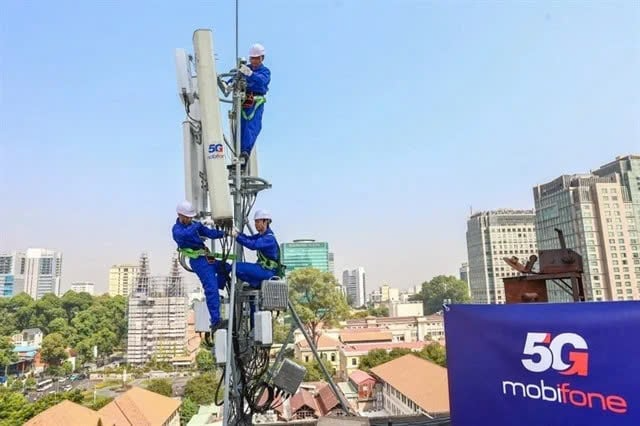
The analysts claim that 5G network expansion is one of the pillars of the digital transformation plan of Vietnam, which is intended to support the high-tech technologies, including artificial intelligence, smart manufacturing, and autonomous system. The negotiation is also accompanied by an impending possible visit to China by the top leader of Vietnam To Lam which can also enhance economic relations between the two neighboring nations.
According to observers it will imply that political relations between the two Communist oriented states have warmed due to closer technology cooperation between Hanoi and Beijing in the recent years.
U.S. Security Concerns China 5G Equipment
The possible arrangements have also caused alarm in Washington where leaders have on several occasions cautioned partners against depending on Chinese vendors in provision of essential telecommunications database. In 2020, Vietnam became part of the U.S.-led Clean Network who aimed to disintegrate the participation of Chinese technology providers in 5G networks in countries of participation.
The representative of the United States Department of State informed Reuters that nations must consider national security when engaging vendors in the purchase of important digital infrastructure. The spokesperson stated that Chinese intelligence and security services are authorized to force Chinese citizens and firms to disclose sensitive information or illegal access to the system of their customers.
After being listed as a threat to the U.S. national security, both Huawei and ZTE are restricted to the telecommunications of the U.S. In a meeting with a Vietnamese delegation that visited Washington earlier this year, U.S. officials was reported to have warned that future American investment in Vietnam would be corrupted in case of increased dependence on non-trusted network players. The western governments have also expressed concern on the application of Chinese technology in other communication infrastructure projects like undersea internet cable.
Striking A Balance Between Technology Costs and Security Concerns
The Vietnamese authorities have vindicated their telecoms acquisition choices on the basis that Chinese equipment is both cost-effective and dependable as opposed to other equipment. According to analysts, Chinese suppliers tend to be much cheaper as compared to Western suppliers and so will be appealing to developing markets that need to expand digital infrastructure fast.
Much of the current 5G network deployment in Vietnam up to this point has been constructed based on the European vendor Ericsson and Nokia devices with U.S. chip-maker Qualcomm having a part in the deployment as well. Professionals working in telecommunication observe that the 5G networks are more security conscious compared to the previous generations of mobile technology because the antennas are involved in processing and handling extensive information and not just relaying of signals.
This presents a higher possibility of them falling prey to any form of surveillance or cyber incursions should network equipment be hit. Nevertheless, the debate notwithstanding, Vietnam still aims at using multi-vendor approach to construct its next generation telecommunications infrastructure.
Starlink also gained approval of the Hanoi pilot programme in February 2021 to begin using satellite internet service in the country under a pilot programme aimed at increasing connectivity in the country. According to industry analysts, Vietnam is acting like this to balance its economic interests, and access to technology and geopolitical ties as it expands the deployment of advanced digital infrastructure at a faster pace.


