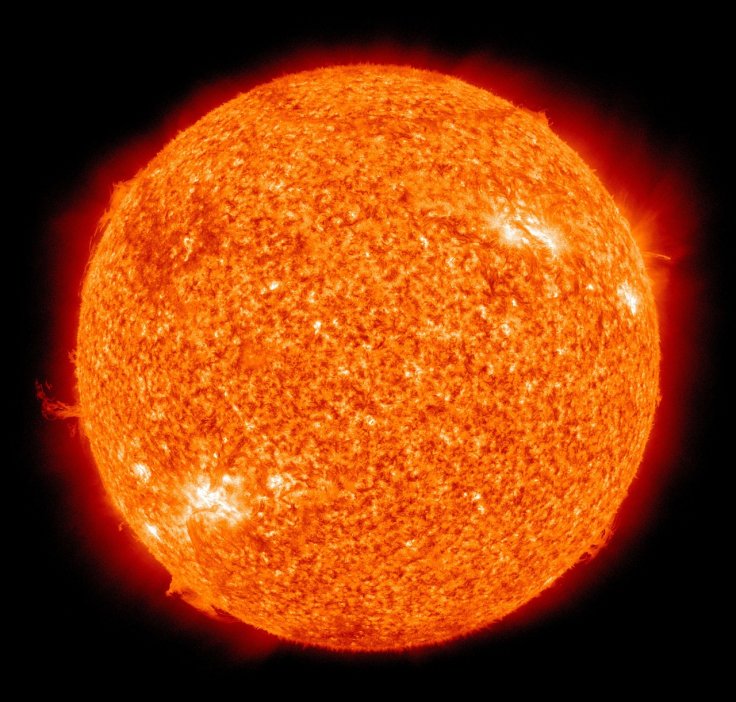
Scientists at the University of Hawaiʻi Institute for Astronomy (IfA) have identified the cause of the Sun's rain.
Solar rain happens inside the Sun's corona, a region of extremely hot plasma that extends above its surface, in contrast to the water droplets that fall on Earth. Cooler, denser clusters of plasma condense high in the corona and then return to the Sun in this phenomenon. How this process could occur so quickly during solar flares was a mystery to researchers for years.
For years, scientists battled to comprehend how this mechanism could occur so quickly during solar flares.
Luke Benavitz, a first-year PhD student at IfA, and astronomer Jeffrey Reep have finally solved this long-standing puzzle. Their findings, published in the Astrophysical Journal, offer an important update to solar models that have perplexed scientists for decades.
Benavitz said, "At present, models assume that the distribution of various elements in the corona is constant throughout space and time, which clearly isn't the case."
"It's exciting to see that when we allow elements like iron to change with time, the models finally match what we actually observe on the Sun. It makes the physics come alive in a way that feels real," the researcher added.
The new discovery allows solar scientists to better model how the Sun behaves during flares, which may one day assist anticipate space weather that affects our daily lives.
Earlier models required hours or days of heating to explain coronal rain, whereas solar flares can occur in minutes. The IfA team's research demonstrates that altering elemental abundances can explain how rain forms swiftly.
"This discovery matters because it helps us understand how the Sun really works," said Reep. "We can't directly see the heating process, so we use cooling as a proxy. But if our models haven't treated abundances properly, the cooling time has likely been overestimated. We might need to go back to the drawing board on coronal heating, so there's a lot of new and exciting work to be done."
A far greater variety of questions are raised by this research. Long-held models that assumed elemental abundances in the Sun's atmosphere were fixed are now challenged by the knowledge that they should vary over time.
This indicates that the discovery goes well beyond coronal rain and forces scientists to reconsider the behavior of the Sun's outer layers and the flow of energy through its atmosphere.


