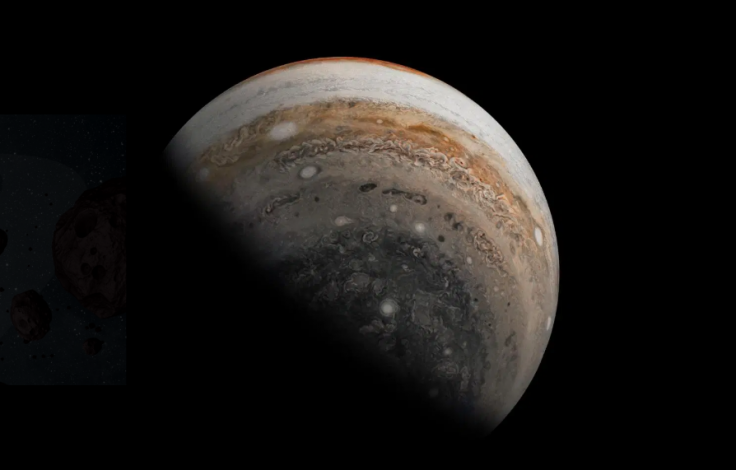
Scientists have uncovered fresh insights into the formation of the solar system by looking deep beneath Jupiter's turbulent cloud tops, where a hidden chemical signature may explain how the giant planet and others like it came into being.
A new study, published in The Planetary Science Journal, suggests that Jupiter contains about 1.5 times more oxygen than the sun, shedding light on the planet's origins and the early environment of the solar system.
The research, led by Jeehyun Yang, a postdoctoral researcher at the University of Chicago, relied on advanced computer simulations to explore regions of Jupiter's atmosphere that are impossible to observe directly. While Jupiter's dramatic storms, including the centuries-old Great Red Spot, have been studied for generations, measuring the planet's deep atmosphere has remained a major scientific challenge.
"Oxygen on Jupiter is mostly bound in water, which condenses far below the visible clouds," Yang said in a statement. This places it beyond the reach of spacecraft instruments, including those aboard NASA's Juno mission, which can only infer conditions indirectly by studying gravity and magnetic fields.
To overcome this limitation, researchers from the University of Chicago and NASA's Jet Propulsion Laboratory developed the most detailed models to date of Jupiter's interior atmosphere.
Unlike earlier studies, which often examined chemistry and atmospheric motion separately, the new simulations combined both. This allowed scientists to track how gases, clouds and chemical reactions evolve together as material circulates between Jupiter's deep, hot layers and its cooler upper atmosphere.
The integrated approach helped resolve long-standing uncertainties over Jupiter's water and oxygen content.
The models indicate that Jupiter is significantly enriched in oxygen compared with the sun, supporting theories that the planet formed by accumulating large amounts of icy material early in the solar system's history.
Scientists believe this process likely occurred near or beyond the "snow line" — a region far enough from the sun for water to freeze — enabling Jupiter to gather oxygen-rich ice as it grew.
The simulations also suggest that Jupiter's internal atmospheric circulation is slower than previously thought, with gases taking weeks rather than hours to move between layers. This finding could change how scientists understand the interaction between heat, storms and chemistry within the planet.
Researchers say the results have implications beyond Jupiter. Because planets retain chemical traces of the environments in which they formed, studying these signatures can help scientists reconstruct the solar system's past and refine models of planet formation. The findings may also guide future efforts to understand distant exoplanets and assess their potential habitability.


