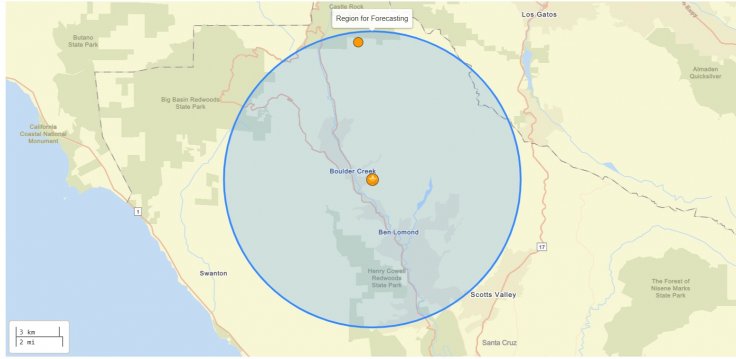
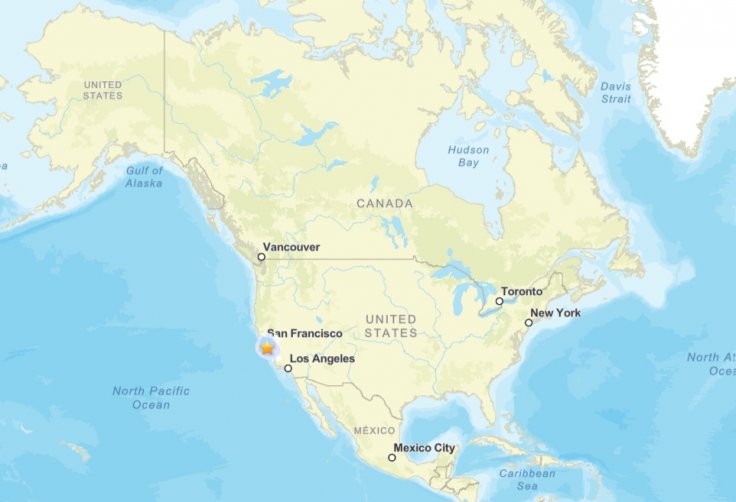
A magnitude 4.6 earthquake struck the Brookdale region in California on Thursday, the United States Geological Survey (USGS) said, with its epicentre located at a depth of 9 km (5.59 miles) near Boulder Creek in the Santa Cruz Mountains.
The earthquake shook residents awake across the Bay Area at 1:41 a.m. early Thursday morning and the shaking of a few seconds was felt in Oakland and San Francisco, with some people reporting a sharp jolt. Residents as far north as Petaluma felt the quake. At a home near the epicenter, a book was knocked off the shelf. Residents in that area generally reported little damage aside from scared pets and, for some, broken dishes, according to social media groups.
Seismologists initially recorded the event at magnitudes between 5.0 and 5.1 before revising the figure down to 4.6 as additional seismic network data came in, a routine refinement that follows most significant events in the region. The USGS Prompt Assessment of Global Earthquakes for Response (PAGER) system indicated a low likelihood of casualties or structural damage. CBS News San Francisco reported no immediate injuries or serious damage.
More than 25,000 impact reports flooded in from across the region, with residents as far north as Petaluma describing strong shaking that jolted them awake before dawn. Many received warnings on their phones through California's ShakeAlert early-warning system seconds before the shaking arrived.
The Zayante Fault: What Seismologists Are Watching
Most coverage of Bay Area seismic risk defaults to the San Andreas Fault, the 800-mile fracture zone running the length of California that ruptured catastrophically in the 1906 San Francisco earthquake. Thursday's event placed the epicenter squarely near the Zayante Fault, a secondary but geologically significant structure that runs through Santa Cruz County and carries its own serious shaking potential for nearby communities.
The Zayante Fault sits in the densely forested terrain of the Santa Cruz Mountains, close to communities including Boulder Creek, Ben Lomond and Scotts Valley. It is not as widely studied or publicly discussed as the San Andreas, yet seismic hazard assessments have flagged it as a credible source of damaging ground motion for Santa Cruz County residents. California experiences roughly 50 earthquakes per day across its fault network, but events near the Zayante Fault carry outsized concern for local officials given the proximity to populated foothill communities.
The USGS put the probability of at least one magnitude 3.0 or greater aftershock within the following week at 60%, with a 14% chance of a magnitude 4.0 or stronger event. Those forecasts apply to the immediate fault zone around Boulder Creek, meaning Santa Cruz County residents face continued low-level seismic activity in the near term.
One Santa Cruz County resident, posting on Reddit's r/bayarea thread covering the quake, captured the disorientation common to pre-dawn events: "Woke up to my phone screaming and then the whole house moved," wrote user u/redwoodridge_sc. "First time the alert actually beat the shaking for me."
The quake arrived days after a magnitude 7.4 earthquake struck off the coast of Indonesia, which triggered regional tsunami warnings, according to media reports. The California event has no confirmed causal link to the Indonesia quake.
Monitoring Seismic Movements in Bay Area
California's seismic monitoring infrastructure has improved substantially over the past decade. ShakeAlert, operated by the USGS and deployed statewide through a partnership with California's Office of Emergency Services, now reaches most smartphone users and demonstrated its utility again as alerts preceded shaking for many residents. Even so, the Zayante Fault's relatively low public profile means many in Santa Cruz County may be unaware of its hazard classification compared to the San Andreas Fault, which dominates earthquake preparedness messaging across the state.
Tectonically, the Caribbean region is complex, shaped by interactions among the North American, South American, Nazca and Cocos plates. Subduction zones, trenches and volcanic arcs dominate Central America and the Lesser Antilles, while transform faults control regions like Guatemala, Venezuela and the Cayman Trench. Plate motion averages about 20 mm per year along several boundaries.
The Puerto Rico Trench and Lesser Antilles arc remain seismically active, with potential for major earthquakes. Historic events, including Haiti (2010) and Samana (1946), highlight regional risk. Convergence zones and fracture systems such as the Panama Fracture Zone further contribute to frequent seismic activity.
🚨QUAKE ALERT: A 4.7-magnitude earthquake struck near Malibu, California, with tremors felt in surrounding areas, including Thousand Oaks, Ventura, Orange County, and Los Angeles. #earthquake pic.twitter.com/LIUbYXb77Z
— Beats in Brief ðŸ—žï¸ (@beatsinbrief) September 12, 2024


