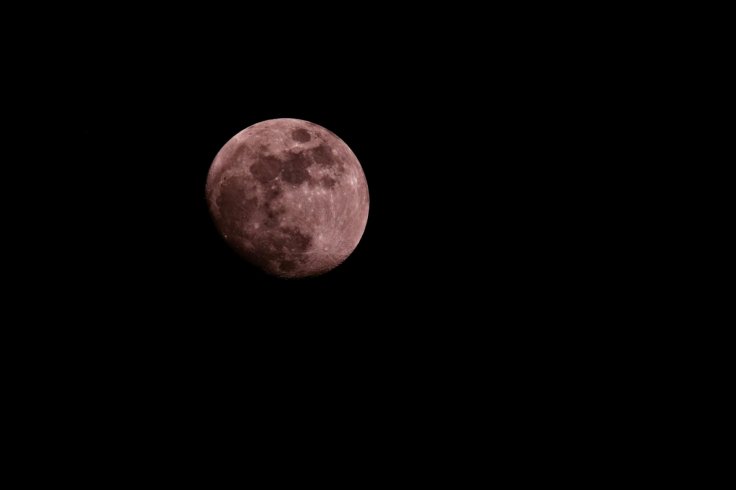
Skywatchers are in for a treat this week as April's full moon will light up the night on Wednesday, April 1, 2026, reaching its brightest at 10:12 pm EDT. Adding to the spectacle, a comet will also be visible in the same stretch of sky.
The Pink Moon, as April's full moon is traditionally called, has nothing to do with its color. The name traces to pink phlox wildflowers (Phlox subulata), a low-growing perennial native to North America that blooms in early spring, according to timeanddate.com.
The moon itself will display its familiar pearly-white or golden glow, depending on its position above the horizon. The name was carried into popular use by the Old Farmer's Almanac tradition of attaching seasonal markers to each month's full moon.
What Makes the 2026 Pink Moon Unusual
Three things stack up this year. First, the 2026 Pink Moon is classified as a supermoon, meaning the moon reaches full phase near its closest orbital approach to Earth. According to sortiraparis.com, it will appear up to 14% larger and 30% brighter than an average full moon, though that figure has not been confirmed by a second source.
Second, the moon sits in close visual proximity to the brightest star in the constellation Virgo, producing a striking two-object pairing low in the southeastern sky. Third, a comet is tracked in the same broad region of sky, giving observers a rare opportunity to catch a full moon, a first-magnitude star, and a comet in a single viewing session, according to the Economic Times.
The Pink Moon also carries a calendrical function that predates modern astronomy. It serves as the Paschal Moon, the ecclesiastical full moon used by Western Christian churches to calculate Easter. Because the Pink Moon falls on April 1, Easter Sunday lands on April 5, 2026, according to the Old Farmer's Almanac. The Paschal Moon is defined as the first full moon occurring on or after the spring equinox, a rule codified at the First Council of Nicaea in 325 CE.
For US observers, Space.com confirms peak illumination at 10:12 pm EDT on April 1, while Star Walk places the global peak at 02:11 UTC on April 2, which converts to 10:11 pm ET on April 1. The one-minute variance reflects rounding differences between sources. For most observers, the practical viewing window runs from moonrise on the evening of April 1 through the pre-dawn hours of April 2.

No special equipment is needed to see the full moon or Spica. Binoculars will sharpen the contrast between the moon's bright disk and the star's blue-white light. Observers hoping to spot the comet should move away from urban light pollution, allow roughly 20 minutes for their eyes to dark-adapt, and scan the sky with binoculars or a small telescope rather than the naked eye.
Also Read: Iran Missile Barrage Rocks Gulf — Markets, Water Supply, and Shipping Hit Hard
One Reddit user writing on r/space referred to the convergence as "genuinely rare—a supermoon, a named star, and a comet in the same night". The post drew significant community engagement, though the comment could not be independently verified against a specific upvote threshold at publication time.
The Royal Museums Greenwich, the home of the Prime Meridian in London, notes that 2026 carries 13 full moons across the calendar year, making it a slightly denser year for lunar events than the standard 12.
Disclaimer: This article was produced with the assistance of artificial intelligence.


