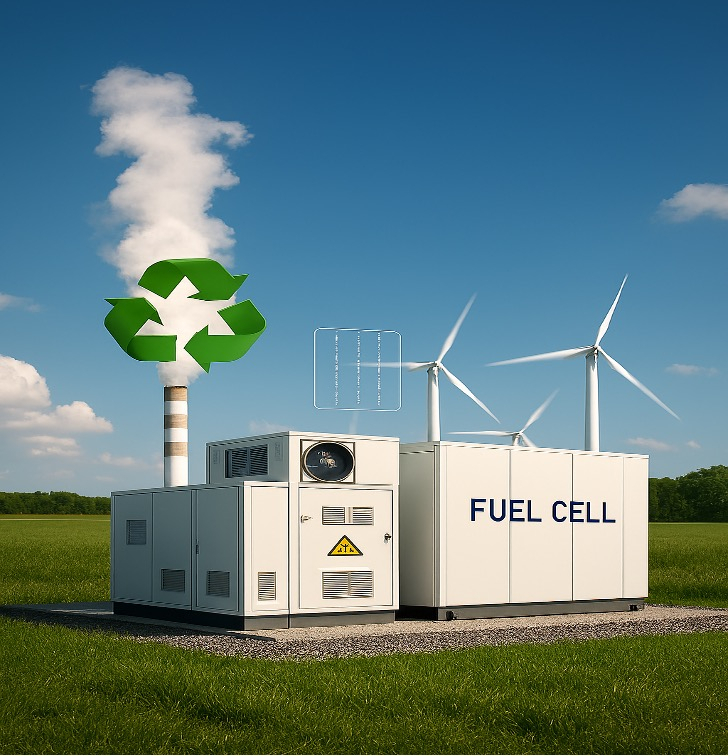
Ever thought of a world where energy production doesn't affect the environment with emissions, but instead recycles waste gases into power that is useful? And all this is guided by smart systems that learn and adapt on their own. This is not a distant dream, but is now happening in the fuel cell sector globally where new technologies are turning old inefficiencies into opportunities for a better future. Central to these transformations are practical solutions that forecast problems, cut waste and make renewable energy more reliable for people from manufacturing units to homes. These changes come along with mounting global pressures. The energy-related CO2 emissions reached 37.4 billion tonnes in 2023, a 1.1% increase from previous year, mostly due to fossil fuel use in industry and transportation.
Meanwhile, the fuel cell market, which offers a low-emission substitute, is estimated to grow from USD 5.66 billion in 2025 to USD 18.16 billion by 2030, as per market analysis. Yet, supply chains in this scenario lag behind, where only 23% of organizations have a formal AI strategy, even as 74% see AI as a key element for transformation, according to a Gartner survey. These numbers highlight the gap. While the world needs faster and greener energy, obsolete manual processes and fragile supplier networks hold back progress.
Spearheading solutions in this volatile landscape is Irshadullah Asim Mohammed, whose hands-on initiatives in blending AI with fuel cell operations overcomes these very barriers. His works focus on the anode exhaust recovery skid (AERS), a setup that takes up and reuses gases from fuel cells, preventing them from going to waste or adding to pollution. In one key project, he built an AI-optimized manufacturing structure that utilises reinforcement learning and predictive analytics to monitor sensor data like gas flows, temperatures, and pressures in real time. This facilitates quick adjustments that keep things running smoothly, addressing common industry issues like unexpected downtime or material losses.
What makes this approach stand out is the way it confronts long-standing crises in energy manufacturing. For years, the sector has faced problems with manual oversight, where human checks often miss subtle shifts, leading to considerable wastage in materials and energy. Supply chains add to another layer of concern, where single-supplier dependencies can stop production if one link breaks, particularly in a landscape hit by trade tensions or shortages. These new system changes enable just-in-time adjustments, which in practice means shorter production cycles and less energy use. "The real challenge was making AI work in niche areas like gas recovery, where emissions rules are strict and variables change constantly," Irshadullah Asim explains. "We trained models on specific datasets to spot anomalies early, letting potential failures turn into preventive steps."
Beyond the tech-side, Irshadullah Asim introduced a hybrid AI setup that combines convolutional neural networks for crunching sensor data with generative adversarial networks for simulating scenarios. This duo predicts issues like exhaust anomalies, which aren't well-covered in existing fuel cell guides. It is a step away from generic AI tools used in retail, like demand forecasting for online stores. This instead, tailors to energy's unique demands, such as aligning with sustainability standards for carbon tracking. It results in operations that recycle gases at an 85% rate, directly cutting down on emissions that affects industries worldwide.
Then there's the Exhaust Circularity Index (ECI), a metric Irshadullah Asim created to measure the recovered gas that gets looped back into production. This tool embeds AI to adjust based on factors like energy costs or regulations, making it adaptable for broader use. In emission-heavy sectors, where governments push for cuts under agreements like the Paris Accord, such metrics help track progress without guesswork.
His initiatives extend to helping supply chains on a larger scale, solving problems arising in the commercial and retail spaces. Consider the vulnerabilities in sourcing mechanical parts for energy systems, where dependence on one supplier can spike costs and delay deliveries, disturbing everything from power plants to the stable electricity that keeps stores and warehouses running. In a U.S.-focused effort, he led the diversification of suppliers for balance-of-plant components, assessing over 50 manufacturers and onboarding five new ones. This cut lead times considerably and improved on-time deliveries, making clean energy infrastructures more affordable and quicker to deploy. Similar methods in South Korea localized electrical gear sourcing, bringing down import delays by 90% and cutting costs as well. "Localizing isn't just about saving money, but about building networks that withstand shocks like pandemics or trade barriers," Irshadullah Asim notes.
By lowering waste and emissions, equivalent to removing 1,200 metric tons of CO2 yearly in one application, these strategies help reduce operational costs, which can result in cheaper energy for businesses. Retailers, for instance, benefit from more reliable power grids, avoiding disruptions that hamper sales or spoil goods. Societally, this supports cleaner air and job creation in emerging markets, as seen in projects qualifying suppliers in India and Saudi Arabia. In India, Irshadullah Asim oversaw inspections across sub-suppliers in places like Chennai and Mumbai, along with partners in Thailand and China, assuring components for a 200 MW power plant met standards. This not only strengthened supply lines but also enhanced local manufacturing, aligning with goals for energy access in regions where millions lack reliable power. In Saudi Arabia, qualifying battery and excitation compartments in Dammam and beyond helped localize procurement, tying into national drives for self-sufficiency and slashing import expenses.
Irshadullah Asim offers clear advice, "Don't overhaul everything at once. Pick one problem area, like forecasting delays, and layer in AI with clean data to see real benefits." This mindset underscores the key aspects of his approaches, that is promoting resilience, supporting industries dealing with global outages while pushing toward sustainability.
These efforts improved internal operations while extending broader industry influence through widely disseminated publications and recognition. Irshadullah Asim's work on sustainable energy transition is reflected in Strategies for Transition to Clean Energy Supply Chains and Sustainable Supply Chain Management: Practices for a Greener Future, both of which outline practical approaches to reducing environmental impact and have contributed to ongoing discussions around sustainable logistics.
In AI, his AI-Driven Predictive Supply Chain Optimization System examines machine learning applications for demand forecasting and inventory control, while Artificial Intelligence Handbook for Supplier Quality Professionals supports the integration of AI into quality management practices. Together with a patent-pending AI-based system for real-time supplier quality evaluation and carbon emission management, these approaches demonstrate an early integration of AI with sustainability in fuel cell–related supply chains. His impact is further reinforced by a recent peer-reviewed article, cited multiple times and recognized with a best paper award, along with collaborations influencing U.S. Department of Energy–related projects.
Today, as fuel cell technology advances, Irshadullah Asim Mohammed's AI tools and metrics could inspire similar setups in wind or solar supply chains, where waste recovery and predictive maintenance are just as important. With markets growing and emission targets looming, these innovations lead towards a more interconnected energy world, one that is efficient, less polluting, and accessible to everyone. By making recovery measures smarter and chains more diverse, they help ensure future generations inherit systems that aid rather than affect the planet.


