Artificial intelligence, often linked to scams and deepfakes, is now being put to use for a far more meaningful purpose — uncovering hidden truths from history. A German historian has used AI technology to identify a notorious Nazi executioner captured in a World War II photograph, solving a mystery that has remained unsolved for more than 80 years.
"The match, from everything I hear from the technical experts, is unusually high in terms of the percentage the algorithm throws out there," German historian Jürgen Matthäus, the sleuth who solved the mystery, told the Guardian. So, who is the Nazi general who executed so many during World War II, yet remained unknown?
Face of Evil Unveiled
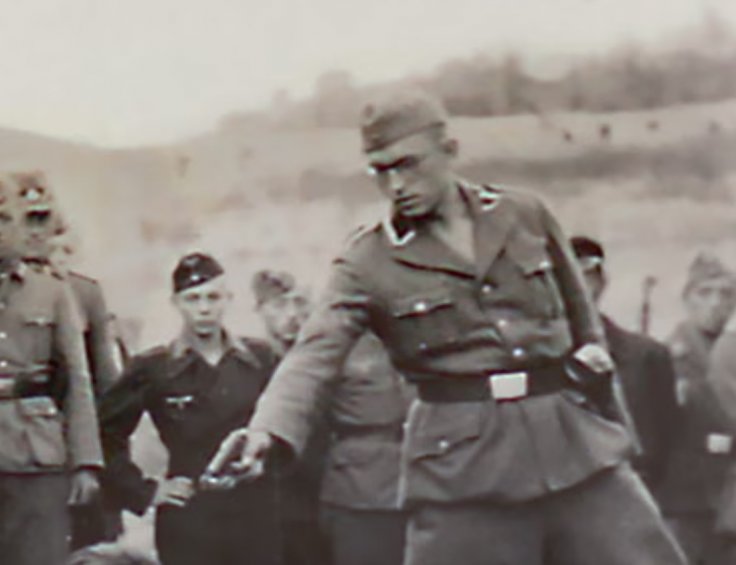
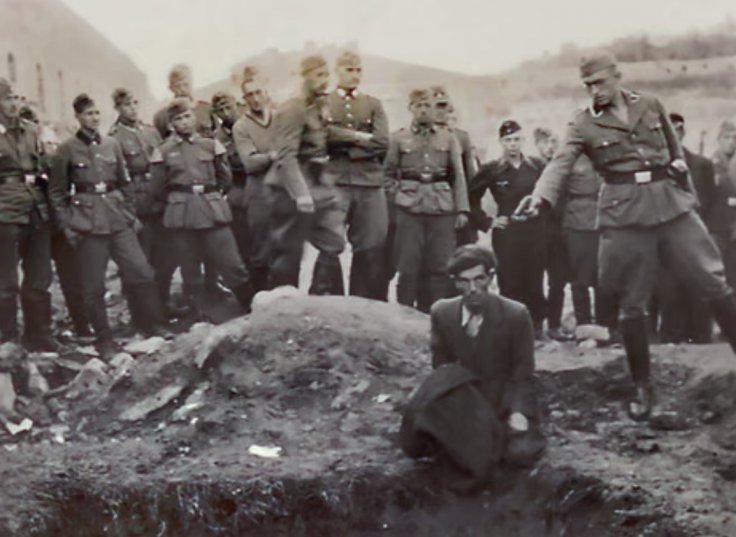
The haunting photograph, taken in what is now Ukraine, shows a Nazi soldier wearing glasses pointing a pistol at a man kneeling beside a mass grave, while several SS officers stand nearby watching the execution.
The photograph, long known as "The Last Jew of Vinnitsa," had puzzled historians for decades. But researcher Jürgen Matthäus finally solved the mystery with the help of AI, historical documents, and eyewitness accounts.
The massacre actually took place on July 28, 1941, in the citadel of Berdychiv — not in Vinnitsa, as previously believed, according to a study published in the Journal of Historical Studies. The atrocity was carried out by Einsatzgruppe C, a Nazi regiment tasked with eliminating "Jews and partisans" in the newly occupied Soviet territories before Adolf Hitler's planned visit.
The executioner in the photo is now believed to be Jakobus Onnen — a former teacher of French, English, and gymnastics, born in 1906 in Tichelwarf, Germany. He had joined the Nazi Party in 1931.
Matthäus made the breakthrough partly due to a stroke of luck. After news reports in Germany last year revealed new details about the massacre's true location, date, and military unit, a reader came forward with crucial information that helped confirm the discovery.
A Devil But Not in Disguise
Matthäus said the breakthrough came when a man reached out after recognizing a familiar face. Using letters and records from his family's collection, he said the gunman in the photo looked remarkably like his wife's uncle, Jakobus Onnen, and shared key biographical details that matched the suspected executioner.
The images were then sent to volunteers at the open-source journalism group Bellingcat, who used AI tools to conduct a forensic analysis. Combined with the physical resemblance and other strong evidence, Matthäus said the findings were convincing enough to publish.
While AI played a key role in solving the decades-old mystery, Matthäus insisted that technology alone wasn't enough. "It's not a silver bullet," he said. "It's one tool among many — the human factor remains essential."
Onnen's path to radicalization is unclear, but records show he was a committed Nazi. In August 1939, just before World War II began, he joined the SS Death's Head Unit at the Dachau concentration camp. By 1940, he was working with the Nazi "Order Police" in occupied Poland.
Next year, after the invasion of the Soviet Union, he became part of Einsatzgruppe C — the same unit seen in the photograph. That group is believed to have killed nearly all of the 20,000 Jews living in the area at the time, leaving only about 15 survivors.
"These mass executions continued until the very last days of German occupation in the East," Matthäus said. "I believe this image is as important as the gate at Auschwitz — it captures the direct, horrifying confrontation between the killer and his victim."


