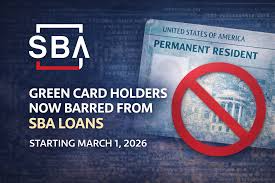
- US restricts SBA loans to citizens and nationals under new rule.
- Green card holders no longer eligible for SBA-backed business loans.
- Rule affects programs including 7(a), 504, Microloan, Surety Bond.
- Policy change implemented March 1 under Trump administration.
The U.S has also carried out a significant reform to its lending to small businesses policy hence limiting the provision of federal small business loans only to companies owned entirely by U.S citizens or nationals an act that denies access to the same to green card holders or other foreign nationals. The announcement of the policy change by the U.S. Small Business Administration (SBA) became effective March 1 and was therefore a great tightening of the guidelines that businesses would require in accessing government-sponsored financing.
The change in the rule applies to all SBA lending programmes, such as the popular 7(a), 504 programmes, and other Microloan programmes and Surety Bond programmes. The new policy outlined by SBA states that all direct and indirect owners of a firm seeking an SBA-backed loan must have a 100 percent percentage of being U.S. citizens or nationals of the United States whose main residence is in that country.
Until recently, businesses were able to get loans under SBA provided that at least 51 percent of the business belonged to the U.S. citizens or permanent U.S. residents. That implied that green card holders were regarded as qualified owners as per past instructions. The new regulation waives such flexibility, essentially denying lawful permanent residents and any other foreign nationals the opportunity to borrow using SBA-guaranteed funding under ownership interests in applicant firms.
"The change should have focused on domestic entrepreneurs and decreased fraud risks, with the domestic entrepreneurs being secured due to this change, SBA Administrator Kelly Loeffler stated". "The citizenship checking has already been enacted by SBA to prevent illegal aliens to take small business loans. Today, we are putting a complete ban on any foreign nationals who would like to fund us", Loeffler said when he announced the policy.
Impacted Major Lending Programmes
The updated eligibility policy extends to the core financing programmes of the SBA, which overall extend billions of dollars in credit annually to small businesses all over the United States. Some of the programmes that have been hit include the flagship 7(a) loan programme of SBA which provides banks with government guarantees to lend to small business entities. The new requirement also applies to the 504 programme that assists in the domain of commercial real estate and large capital investments. Smaller projects like Microloan and Surety Bond plans are also fallible to the new ownership provisions.
The SBA asserted that the updated guidance needs full compliance with citizenship throughout the ownership arrangement of an applying firm, both the majority and minority shareholders. In February 2026, the agency revised its policy framework to mandate that all direct or indirect owners of a business that wished to obtain SBA financing be a U.S. citizen or national, replacing prior measures that had permitted foreign involvement to a sensible degree.
New regulation implies that any minor percentage of ownership, even that belonging to a non-citizen, would bar a business to SBA-sponsored financing. The most significant implication of the new policy is the exclusion of lawful permanent residents, the so-called the holders of green card status, who were once considered under the rules of SBA, as a fully legitimate business owners.
As per new regulations, an operating company or eligible passive company or any borrower seeking SBA support can no longer make an inclusion of green card holders in its ownership structure. The change can be seen as one of the most important changes in federal lending eligibility to small businesses in years. Loeffler presented the policy in the context of trying to focus on domestic entrepreneurship. She said "American job makers first".
Policy Benefits Fraud-Related Problems
The SBA has also associated the tougher requirements to the issues of abuse of government lending programmes. Based on government declarations, an examination of lending programmes in the pandemic era revealed that billions of dollars in questionable lending to businesses based on foreign owning models were suspected of fraud.
In a post on the social media site X, journalist Nick Sortor wrote about the policy change, claiming that the transfer would bring back ownership of specific business back to the U.S. citizens. AMERICAN hands will soon take independent gas stations and hotels back as the foreigners will no longer receive a leg up on the Americans in loans to buy them, Sortor wrote.
The comment was preceded by the release that the SBA had determined that there was approximately $8.8 billion of the suspected pandemic-related borrower loan fraud in California alone.
Federal emergency assistance programmes, such as the Paycheck Protection Programme (PPP) and Economic Injury Disaster Loans (EIDL), were criticised over lax oversight and potential fraud during initial phases of the COVID-19 pandemic. The SBA has since introduced stricter dobelief procedures and monitoring systems through its lending programmes. The new rule of ownership is regarded by the officials as another move towards the increased protection of those securities.
Possible Effect on Immigrant Entrepreneurs
Immigrant entrepreneurs who previously used SBA programmes to obtain capital to start small businesses may be faced with considerable consequences by the policy change. Green card owners and partners were long eligible to join in SBA-financed financing as owners or partners in any business that qualified, as long as they satisfied citizenship criteria at the majority ownership.
This new rule can restrict the financing of certain businesses founded by immigrants because newcomers might lose their eligibility by being entirely removed as permanent residents. Small businesses are the key players in the U.S. economy. The data provided by SBA shows that over 33 million small companies exist in the country and that they provide employment to almost half of the privately working people.
The loan schemes would be supported by the government and would be used by these companies to access capital in case the traditional bank financing is not available or hard to access. In the new policy structure, the businesses that are coming forward to be issued with the SBA loans now have to make sure that all the stakeholders in the list of company owners meet the citizenship criteria.
According to information from the agency, the new policy indicated that the change would be made to make sure that financing supported by taxpayers is given to all companies that are fully owned by U.S. citizens or nationals.
The updated regulations are currently in place and they will be applied in all the SBA loan applications on or after March 1, 2026. The discussion underlines the influence of evolution in federal policy that has the potential to transform the outlook of small business financing in the United States, especially to entrepreneurs held up by the emerging regulatory demands.


