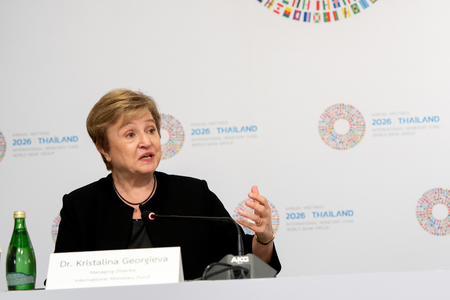
- IMF chief urges Asian economies to stay agile amid global shocks
- Georgieva warns Middle East conflict could affect energy prices
- IMF highlights Asia's improved financial stability over past decades
- IMF urges investment in AI, infrastructure and productivity improvements
Asia Should remain nimble as the world shocks increase, IMF Chief Warns. Businesses and policymakers straddling the Asian region need to be more lucrative and flexible because the global shocks are happening more and more, and are increasingly becoming unpredictable, the head of the International Monetary fund messaged on Thursday that the global economy is moving into a more uncertain state.
IMF Managing Director, Kristalina The IMF managing director, Kristalina Georgieva said in a conference in Bangkok that "programmes must focus on bolstering domestic economic fundamentals as the global environment is changing due to geopolitical tensions, shifts in technology and demographic changes".
Georgieva stated that the world is in the midst of significant demographic, technological, trade and geopolitical shifts. The continuous interpretations of world shocks together with these transformations are making the economic climate a more unpredictable place. Reuters economic data indicates that Asia is also among the fastest growing regions in the world, with a big portion of the economic growth in the world.
Still the policymakers have to deal with external shocks that are increasingly challenging due to the impact caused by the supply chain shocks, energy volatility, as well as the geopolitical tension. Georgieva added that, governments should aim at re-establishing resilience instead of fighting against the unforeseen international events.
Policymakers are Concerned with Geopolitical Risks And Energy Volatility
The IMF chief singled out increasing geopolitical strains as one of the major dangers to global economic stability, and used the current conflict in the Middle East as evidence of how crises in the region can easily be transmitted to the financial markets. It can mean that a long-term conflict can affect the prices of energy in the world, the mood on the market, the development and inflation of the economy creating further pressure on the world policymakers, Georgieva said.
Energy security is one such sensitive topic that has been of great concern to most of the Asian economies, who rely largely on imported oil and natural gas to power their industrial affairs and economies.
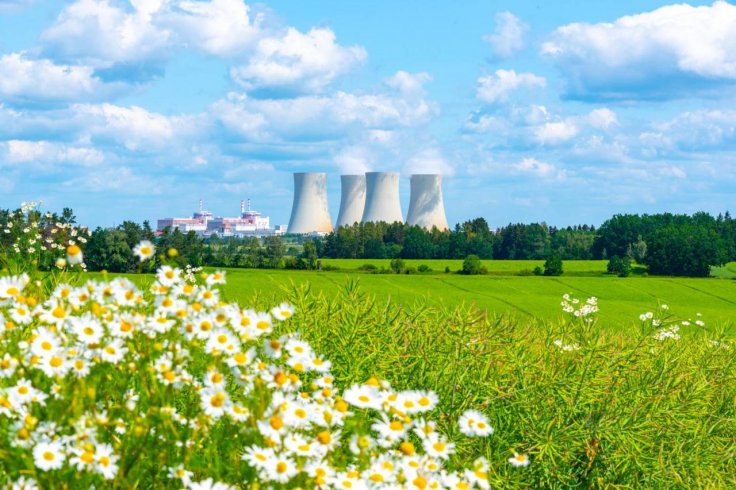
The recent geopolitical events have already led to stock market instability in some of the Asian regions as investors establish the economic reality of the possible economic consequences of long-term military tensions and supply repercussions.
In one of the instances, as reported by Reuters quoting market sources, the volatility in crude oil prices and uncertainties with regards to the global shipping routes have helped develop a lukewarm response among the investors in some of the Asian financial markets. Georgieva said, "geopolitical disputes should be solved very quickly to bring about global economic stability". She added that "a swift solution to the situation would play well with the global economy".
The Economic Development of Asia is a Good Starting point
Regardless of the existing doubts, Georgieva emphasized the economic development of Asia in the last twenty years as the sign of the adaptation to crisis and recovery capacity of the region. Asia has enhanced its financial sector regulations, created better reserves and enhanced economic stability since the early years of 2000s when a number of countries in the region were reinventing after financial crisis.
Structural reforms in many Asian economies following the financial crisis of the late-1990s also saw the introduction of greater regulation of the banking system and a more transparent financial system and fiscal frameworks.
This contributed to establishing financial reserves and increasing the resilience of countries against external shocks. IMF has used improved macroeconomic management and superior financial institutions in Asia as the main factors that helped the region to grow in the recent years many times. Georgieva however cautioned that reforms and investments will be needed to sustain that momentum.
More Tech And AI
AI and its related fields are perceived as the major sources of growth. In prospect, the chief of the IMF stated that Asian economies need to focus on productivity increase and technological advancement in their potential to reach long-term growth. She has focused on the need to embrace emerging technologies, especially Artificial Intelligence which is taking over significant pieces of Singaporean industries and employment sector.
The advantage of AI, according to Georgieva, will necessitate huge investment in digital infrastructure, internet access and capacity building. Increasing broadband access, enhancing education systems and investing in workforce training will all be necessary to countries that would like to enjoy the economic benefits brought about by AI.
Georgieva also emphasized that the governments should come up with regulatory systems that are able to encourage innovation without jeopardizing financial stability. One additional key point she mentioned is the need to put the appropriate protective measures around AI because the technology will continue to penetrate economies.
She further advised policymakers to aim at creating an environment conducive to a private investment, such as eliminating regulations and supporting financial markets and competition. Georgieva came to the conclusion that the world economic environment is bound to stay unpredictable, but nations that have solid financial systems, invest in innovation to keep pace with the constantly changing environment will be in a better position to withstand future shocks.


