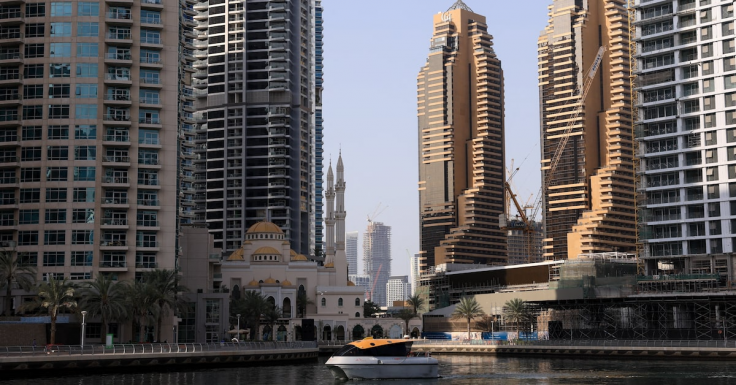
- Iranian missile strikes tested investor confidence in UAE property market.
- Developer shares Emaar and Aldar fell about 5%.
- Dubai off-plan projects accounted for roughly 65% of 2025 sales.
- Analysts say foreign buyers remain critical to market stability.
The years of real estate pollution the United Arab Emirates has experienced is now passing its first significant stress test due to Iranian missile strikes shaking the reputation of the Gulf as an international capital haven, shaking investors and exposing the extent to which Dubai and Abu Dhabi are economically dependent on foreign financial resources to fuel their construction booms.
The attacks that were aimed at airports, ports and homes in both cities have taken the shine off a narrative of stability that was once hitting the region and contributed to a boom in property investment within the last few years. The developers who used to sell off-plan projects in hours are now facing a more doubtful demand landscape amid the financial market shake-ups of the geopolitical tensions.
According to brokerage Betterhomes, there were almost 65 percent off-plan sales in the property transactions in Dubai in 2025, indicating the extent of development related to the projects under construction. Another problem is that the large pipeline will now be forced to operate within a more challenging market environment in case the international buyers retreat.
The stocks of big developers declined drastically after the strikes. On Wednesday, Aldar Properties and Emaar Properties fell by about 5% apiece, bond prices of a number of UAE builders had also fallen, however, according to Reuters data. The credit markets which were a significant source of funds to the property companies in the area have effectively closed down new issuances as the risk premium became wider.
Other developers attempted to assuage the market anxieties.
Luxury developer Dar Global asserts that things in this region begin fast and end fast and we overcome this because the basics in the GCC countries are good enough, and the outlook of Ziad El Chaar, CEO of Dar Global. Nothing is holding... everything is on track said the man.
Nevertheless, according to bankers, there is early indication of investor caution. This has already led to a property capital raising that was scheduled this week being postponed by a senior real-estate banker at Reuters.
The banker said that at this level of investing in the region, investors are not thinking and that risk premium of UAE property had already become much greater.
Twenty-Year Construction boom is volatile
Over 20 years of entrepreneurial development efforts to create the skyline of Dubai have brought the palm leaves in the form of the Palm Jumeirah tropical island as well as the Burj Khalifa skyscraper. Another palm real estate, Palm Jebel Ali, is currently emerging on the coast with cranes still replicating the city waterfront.
Also Read: Trump Brushes Aside Rising Gas Prices Due to Iran Operation: 'If They Rise, They Rise!'
Abu Dhabi has been undertaking a similar expansion, constructing residential and commercial areas to attract foreign business and other upmarket expats.
The COVID-19 pandemic improved the pace of the property boost and the UAE launched its visa reform and used its tax-free environment to draw international wealth. The real estate investment was flooded with Russians who moved there following the war in Ukraine, family offices, entrepreneurs and hedge funds.
According to the official statistics, the population of the country exceeded 11 million by 2025 with the role of expatriates occupy about 90 percent of the country inhabitants, which is among the biggest percentages in the world.
The accumulation of new inhabitants and foreign investments pushed the fast price increments. According to Fitch, Dubai residential property prices increased by approximately 60 per cent in the year 2022 until the first quarter of 2025. The prices continued to have an upward trend towards the end of last year, with property consultancy CBRE showing an increase of almost 13 percent annually in the fourth quarter. Dubai Residential values in Abu Dhabi were up by an average of 32 per cent in the same period.
According to the market players, the actual consequences of the recent strikes will be determined by whether the foreign demand will come back after geopolitical tensions have been calmed.
The actual impact on the real estate should be gauged on the demand level upon the cessation of the battle. This would be the real place where the impact will be experienced, quipped Mohammed Ali Yasin, the chief executive of Ghaf benefits, which is a Lunate company located in Abu Dhabi.
He further stated that the developer share drops were widely associated with the 5 percent corruption instantly in the Gulf equity markets due to the attacks.
The Foreign Buyers continue to be critical towards the market stability
Analysts had been issuing warnings of the rate of building construction versus increase in population even before the tensions in the region had peaked.
In a recent note, JPMorgan stated that Dubai population growth might not be able to accommodate 300,000 to 400,000 new housing units that are projected by 2028.
The purchase of property after the conflict will depend on foreign interest especially among economists in Abu Dhabi commercial bank where they wrote a research note. They said that expatriates and foreign investors form the key support of the real estate market demand in the country.
It is also predicted that a series of new housing supply will flood the market beginning the second half of this year and into the next two years, which is likely to provide greater competition among developers.
The supply wave that came in at the time of the strikes caused concerns that confidence of foreign buyers could be shaken in case geopolitical conflicts arise.
According to Neovision Wealth Management in Abu Dhabi, co-founder and CEO Ryan Lemand explained that in times of long-term period of geopolitical uncertainty, stability, visibility, and continued investor confidence are key to real estate investment and these are tendencies weaken.
Also Read: South Korea FTC Reviews Penalties on 4 Firms In Starch Sugar Price-Fixing Case
History has shown the property market in the UAE to be resistant in times of regional shocks, yet overreliance on foreign buyers and international money flows by the industry puts the mood of investors as an important component that would dictate the future course of the same in the coming months.


