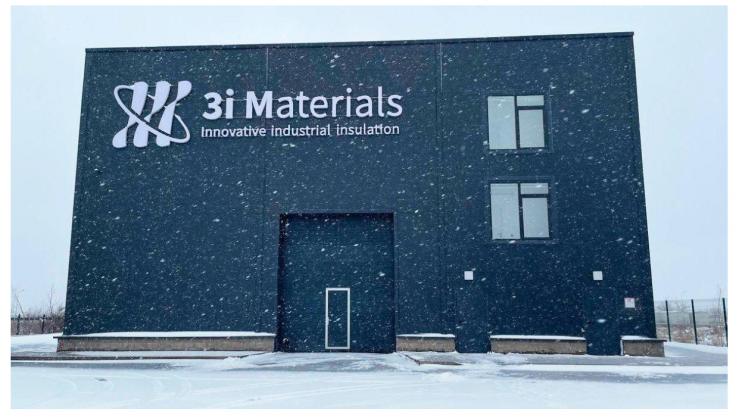
There's something uniquely energizing about sitting down with a business leader driving innovation and sustainability. Since the leader is building a breakthrough insulation product, the conversation takes on an added dimension. Today, we speak with Dmitry Delov, CEO of 3i Materials, a Karaganda native and graduate of the Moscow State Institute of International Relations.
What inspired you to launch this technology-driven venture?
I've always been drawn to innovative solutions and technologies that can solve real-world problems. In our ongoing search for new manufacturing concepts, my partners and I came across a high-performance thermal insulation material. The technology was originally developed in the United States for the aerospace industry. Over time, it expanded into construction, industrial applications, and even residential use. We saw an opportunity to localize and scale that technology for a broader market. That led us to found 3i Materials, a company focused on developing and producing energy-saving materials.
Who are your target customers?
Engineering and manufacturing companies, construction firms, and facility management organizations — it's hard to pin it down to a single market segment. Our core customer is essentially any operations-minded professional, in any industry, who understands the costs of energy loss, the value of sustainable materials, and cares about long-term durability.
Could you tell us more about the product?
It's a liquid thermal insulation coating developed using nanotechnology. The key to its extremely low thermal conductivity lies in the ceramic vacuum microspheres embedded throughout the applied material — they essentially repel heat from both sides of the surface. The result, for example, in an office building, is improved energy efficiency, lower heating and cooling costs, and reduced environmental impact. The coating is non-combustible and emits no toxic substances during operation, making it suitable for a wide range of industrial and commercial applications.
How does it compare to conventional insulation materials?
On just about every metric. 3iM PRO has exceptional adhesion to virtually any surface, so there's no fastening or gluing required — it bonds on its own. Because it goes on like paint, it works beautifully on complex structures, delivering seamless, flexible coverage that can accommodate surface movement and deformation. It also adds virtually no structural load to a building or industrial facility. There's no need for the layered sandwich approach — insulation, then a protective outer shell — that traditional materials require. The product is highly resistant to aggressive conditions: extreme heat and cold, acids and alkalis, saltwater and fresh water alike. Application is straightforward and requires no specialized training. Our coating has a proven service life of up to 30 years. Mineral wool, by comparison, typically lasts around five years before it begins to break down and must be replaced — along with all the mounting and protective infrastructure around it.
What are the main application areas?
Construction is a natural fit — foundations, walls, and roofing, as well as the protection of both industrial and residential buildings. In the automotive and transportation sectors, it works for vehicle insulation, noise reduction, and corrosion protection. Broadly speaking, it applies anywhere you need high-performance thermal insulation, waterproofing, anti-corrosion protection, noise dampening, or condensation control. It's particularly effective in environments prone to freeze damage, mold, or mildew. We're talking about everything from door frames and pipelines to shopping centers, stadiums, and manufacturing plants.
You've been in the market for a relatively short time. How do you see its prospects?
Introducing a new technology is never straightforward, and our product is still building its name in the market. But we invest in demonstrations and technical validation. The companies that have implemented 3iM PRO report measurable efficiency improvements, and those relationships continue to grow. Our production facility in Astana is running at full capacity, and our network of business partnerships continues to expand across the region.
What challenges did you face building the company?
Launching any new enterprise comes with challenges. We had to build production capabilities, tackle staffing questions, and search for startup capital. We engaged portfolio investors, angel investors, and venture funds. Ultimately, those efforts paid off — investors and venture entrepreneurs came to believe in the idea. One of them, for example, is Mukhamed Izbastin. I know him as a principled and highly capable businessman. He's a technocrat at heart, and for him, terms like energy efficiency, green agenda, and innovation carry real weight — which is exactly why I believe he chose to get behind this project.
What other competitive advantages would you highlight?
Innovation, versatility, and sustainability. Mineral wool and other conventional insulation materials are, to put it diplomatically, not particularly kind to the environment — they contaminate soil and water, break down very slowly, and ultimately take a toll on the natural world. Our product is entirely benign. 3iM PRO is non-combustible and produces no harmful fumes even at high temperatures.
What's next?
Our primary mission is to bring genuinely transformative technologies and innovations into Kazakhstan's industrial sector — making it more modern, more competitive, and better positioned for the future. Our plans are truly ambitious. Our near-term focus is on strengthening our position in Kazakhstan and expanding across Central Asia. In the long-term, we see strong potential in international markets where energy efficiency and infrastructure modernization are strategic priorities. As customers evaluate total lifecycle costs, I'm sure that they will recognize its value. And we'll turn these ambitions into achievements.


