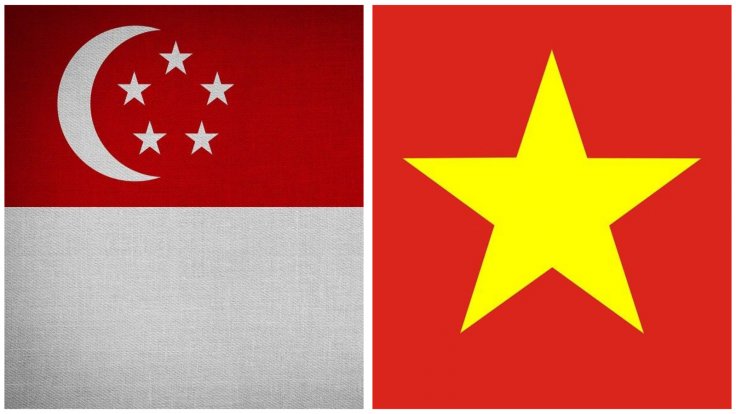
Prime Minister Pham Minh Chinh has urged Singapore to assist Vietnam's strategic sectors, such as innovation, the digital economy, semiconductors, and renewable energy, and to participate in the establishment of the nation's international financial hub.
Chinh made the comments on Monday, October 27, in Kuala Lumpur, Malaysia, during his second yearly meeting with Singaporean Prime Minister Lawrence Wong.
Both leaders praised the signing of a 2025–2030 Action Program to strengthen cooperation across six important pillars and expressed their happiness with the positive developments in bilateral relations since the two nations upgraded their ties to a Comprehensive Strategic Partnership.
They highlighted developments in clean energy connectivity and carbon credit cooperation while restating that economic cooperation is still a fundamental tenet of the partnership.
As part of their framework for economic connectivity, the two parties decided to work together to create yearly roadmaps for each cooperation pillar and promote the creation of smarter, greener Vietnam-Singapore Industrial Parks (VSIP 2.0).
Vietnam is one of Singapore's most significant regional partners, Prime Minister Wong reaffirmed, and the new Action Program will help to improve cooperation in key areas.
In order to guarantee food security, he expressed interest in extending agricultural cooperation and stated that Singapore is prepared to import processed fish, seafood, poultry, and pork from Vietnam. During the next APEC Summit, the two parties hope to sign a government-to-government rice trade agreement.
Additionally, the two leaders decided to strengthen their collaboration in the areas of culture, education and training, defense and security, and people-to-people interactions, especially in fostering innovative talent.
Prime Minister Chinh called for closer collaboration in science, technology, and innovation as new pillars of the partnership and urged Singapore to help Vietnam develop strategic sectors like semiconductors, renewable energy, innovation, and the digital economy. He extended an invitation to Singapore to take part in the establishment of Vietnam as an international financial center.
Vietnam is creating an international financial center in both Ho Chi Minh City and Danang, which are the country's central and southern economic centers, respectively.
PM Wong accepted Vietnam's proposal to link databases in areas like population, trade, and economy and stated that Singapore would continue to assist Vietnam in developing its human resources, particularly at the strategic leadership level. To make business operations easier, the two parties will also look into building data centers inside VSIPs.
Through bilateral or trilateral cooperation on infrastructure connectivity in maritime, rail, road, aviation, and digital networks, they decided to fortify ASEAN unity and concentrate on sustainable development in subregions, including the Mekong.
In order to achieve synergistic results, Vietnam and Singapore also promised to improve coordination before 2027, when Vietnam will host APEC and Singapore will chair ASEAN.
Both leaders reaffirmed their commitment to upholding the South China Sea, also referred to as the East Sea in Vietnam, as a sea of peace, cooperation, and development. They also committed to collaborating with ASEAN partners to develop a substantive and effective Code of Conduct (COC) that complies with international law, including the UNCLOS of 1982.
Following the meeting, the two prime ministers watched as the foreign ministries of both nations signed the Action Program for the Implementation of the Comprehensive Strategic Partnership (2025-2030).
According to data from 2023, Singapore was Vietnam's 14th-largest trading partner worldwide and its fourth-largest ASEAN trading partner (after Thailand, Indonesia, and Malaysia). On the other hand, Vietnam was ranked as the eleventh largest trading partner in the world and the fourth largest in ASEAN. Two-way trade increased 14.7% from 2023 to $10.3 billion in 2024.
With 3,915 approved projects totaling more than $83 billion, mostly in the manufacturing, real estate, and energy distribution sectors, Singapore is also Vietnam's largest ASEAN investor and its second-largest overall.
One example of effective bilateral economic cooperation is the Vietnam-Singapore Industrial Park (VSIP) model. In 13 Vietnamese provinces and cities, 18 parks have been created since the first VSIP was introduced in Binh Duong in 1996.


