 In the Milky Way alone, there are millions of stars and billions of planets, many of which are potentially habitable, meaning they could have the conditions right for life. With an estimated two trillion galaxies in the universe, the universe should be teeming with alien life. So where is it?
 An Angolan colobus monkey was born at Zoo Atlanta on July 15. The snow-white baby will grow the typical long black and white hair at three months old. Angolan colobus monkeys are threatened by hunting and habitat loss in central and east Africa.
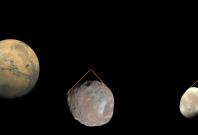 Appearing tiny and almost looking like a distant star, the moon Phobos has turned up unexpectedly in an image of Mars taken by Nasas Hubble Telescope.
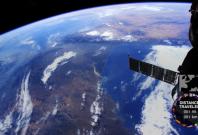 Newly released footage from NASA shows an ultra high definition view of Europe as the International Space Station orbited 250 miles above the Earth.
 Scientists have discovered mystery signals coming from a star 11 light years away. The very peculiar pulses appear to be unique to the red dwarf, scientists say, with observations of similar nearby stars showing no similar behavior.
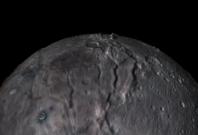 Two years after its New Horizons spacecraft sent the first images of Pluto, NASA has created two flyby videos by compiling data received from the mission. The videos were released July 7 to celebrate the second anniversary of the spacecraft flying within 7.800 miles of Pluto. It released two videos, one of Pluto itself and a second of Plutos largest moon, Charon.
 China has failed to fully launch on Sunday the Long March-5 Y2 rocket after its initial takeoff.
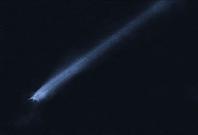 In the last four centuries, this latest would be asteroid 2014 JO25's closest approach to Earth made so far and it will remain the nearest one for around next five centuries.
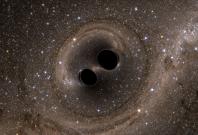 The Event Horizon Telescope is the product of a global collaboration between 13 institutes, representing 10 different nations.
 In this gallery, IBTimes Singapore looks back at the orbiter's best shots while Cassini prepares for its death dive.
 Though the planet will appear bright and very close to Earth, it is still 414 millions of miles away.
 Daphnis is one of Saturns known moons and was discovered on May 6, 2005 by the Cassini probe.
 Data sent by Huygens spacecraft shows the rugged landforms and the eerie orange sky of Titan.
 This is the first time that researchers have some kind of an idea about the origin of FRBs, which have baffled them since 2007.
2016 WF9 has been discovered on 27 November and predicted to be closest to earth on 25 February.


