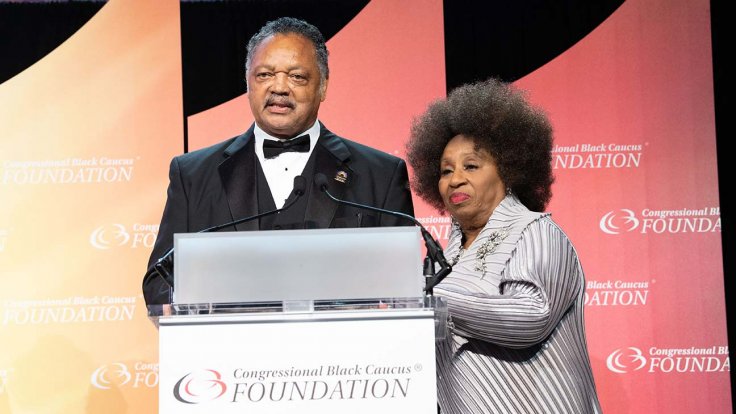
Rev. Jesse Jackson, who was the fiery civil rights icon, Baptist preacher, and also a two-time Democratic presidential hopeful, and virtually picked up the torch of the American Civil Rights Movement after Dr. Martin Luther King Jr.'s assassination, passed away on Tuesday. He was 84.
The family shared like a short statement, saying he died peacefully, surrounded by the loved ones. They did not mention the exact cause right away, but Jesse had been dealing with progressive supranuclear palsy, a pretty tough neurological condition that messes with body movement and speech, for more than a decade. And he went public with his Parkinson's diagnosis back in 2017.
"Our dad was a true servant leader, not just to us, but to the oppressed, the voiceless, and the forgotten all over the world," the family said, in a very moving comment.
For more than 50 years, Jackson was one of the most recognizable faces in civil rights; a leader with a voice that could shake rooms; nonstop energy for activism, and also big political dreams. He bridged the gap from the protest marches of King's time to the power plays of modern elections, too often stirring up controversy along the way, of course.
Jackson, born in 1941 in Greenville, South Carolina, was raised in the Jim Crow South. He came into his own as the Civil Rights Movement started gathering steam. He went to North Carolina A&T State University to study sociology, and then went on to Chicago Theological Seminary, where he got deeply involved with King's work, organizing students and other young people; and soon becoming one of King's main guys.
Jackson marched in Selma, participated in sit-ins in the South, and played a big role in Operation Breadbasket, which was the Southern Christian Leadership Conference's (SCLC) effort to get businesses to hire and give opportunities to Black employees.
King himself was very impressed with Jackson's capabilities, that he used to say that the young man far exceeded his expectations. Jackson found himself in Memphis in April 1968, when King was assassinated, an event that would stay with him permanently which greatly influenced him throughout his life.
Stepping Up After King's Death
Jackson was not among those to let the movement lose momentum after King's terrible death. In 1971, he launched People United to Save Humanity (PUSH), which focused on financial justice, education, and getting political weightage for the Blacks in the mainstream. In 1996, PUSH merged with the National Rainbow Coalition, creating the Rainbow PUSH Coalition, which is still active.
When Jackson entered into the 1984 Democratic presidential race, it surprised many people and nobody thought he might win, but he still changed the game getting over 18% of primary votes, forcing other candidates to pay more attention to Black voters. A piece run by the New York Times at the time hit the nail on the head: 'his run really flipped the dynamics in the race'.
His 1988 campaign went further as he won 11 primaries and caucuses and finished second in the delegate count though he never secured the nomination. Notably, his campaigns laid groundwork later built upon by Barack Obama, who became the first Black leader to become the US president.
However, not that his all campaigns were straight forward. In 1984, Jackson acknowledged using an antisemitic slur in a private conversation that became public, which he first denied but admitted and issued an apology. But the incident strained his relations with Jewish leaders.
A Global Negotiator
Beyond the domestic politics, Jackson took upon himself the role as an unofficial American diplomat, and negotiated the release of Americans held abroad over the decades. The most notable cases were the 1999 release of three U.S. soldiers captured in Yugoslavia, the freeing of a U.S. Navy pilot shot down over Syria in 1984, the release of Americans detained in Cuba, and of course, the negotiation to secure the freedom of hundreds of women and children in Iraq ahead of the Gulf War.
Later, President Bill Clinton awarded Jackson the Presidential Medal of Freedom in 2000, citing his humanitarian efforts and commitment to peace.
In later years, he remained outspoken, criticizing policies he believed undermined civil rights and warning that decades of progress were being eroded. He endorsed Senator Bernie Sanders in the 2020 presidential race, praising his economic justice agenda.
"It is one of the honors of my life," Sanders said at the time, "to be supported by a man who has put his life on the line for the last 50 years fighting for justice."
Tributes Pour In
Tributes following his death poured in from across the political divide. Civil rights leader Rev. Al Sharpton called Jackson "one of our nation's greatest moral voices," saying he "carried history in his footsteps and hope in his voice."
House Democratic leader Hakeem Jeffries described him as "a legendary voice for the voiceless," while Senate Majority Leader Chuck Schumer called him "one of the most powerful forces for positive change in our country and our world."
Former President Joe Biden remembered Jackson as "a man of God and of the people." Bill and Hillary Clinton said he "never stopped working for a better America with brighter tomorrows." Former President Donald Trump offered condolences as well, describing Jackson as a man of "personality, grit and street smarts."
Legacy Befitting A Moral Crusader
Jackson is survived by his wife of more than six decades, Jacqueline Brown Jackson, and their five children, including former Congressman Jesse Jackson Jr.
His legacy is expansive and he remained a moral crusader and a political operator, a unifier and a provocateur, a man capable of deep empathy and sharp-edged confrontation. Above all, he ensured that the Civil Rights Movement did not end with King, but evolved, adapted and transformed into every new arena of power that it enters.
Public memorial services will be held in Chicago, with additional celebrations of life to be announced by the Rainbow PUSH Coalition later today.
(With inputs from Agencies)


