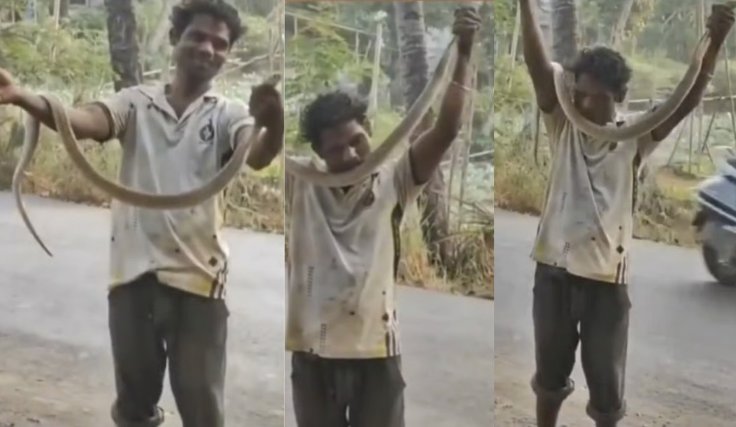
A stunt with a snake took a tragic turn for an intoxicated man who paid for it with his life in the Indian city of Virar, which is located just 76 miles from Mumbai.
A video clip showing the 40-year-old man holding and kissing a snake in the Navapur area of Virar is now being widely circulated on social media.
In the video shared on X, the man, identified as Raju Chandu Barad, is seen placing the snake on both his hands while gripping its mouth with one hand. At one point in the video, he is also seen kissing the snake multiple times.
According to local news report, Raju was reportedly drunk when he caught the snake. The video further shows people standing nearby warning him to be careful. However, currently it is not known as which species of snake it was.
According to the report, the snake bit his hand, and Raju was taken to a nearby hospital, where doctors declared him dead before any treatment could be administered. A case of accidental death has been registered at the local police station.
As social media platforms become flooded with videos of high-risk activities, local authorities are urging the public to refrain from such life-threatening acts. The police have emphasized that "entertainment" should never involve the exploitation of dangerous wildlife or the violation of safety laws.
"Performing stunts for likes and views can have permanent and tragic consequences," a police spokesperson noted. Officials are expected to take stricter measures against individuals who post or perform such stunts to deter others from following this lethal trend.
Dangerous Human Bravado Turns Tragedy
The incident illustrates how dangerous human bravado, the wilderness and the desire to gain viral fame or heroism end up in tragedy because of the venomous snake bites. Snakebites claim tens of thousands of lives every year with different regions such as India facing the issue in disproportionate numbers due to quick access to prompt medical care.
In one of the cases last year, a 20-year old Shivaraj of the village of Desaipet in the Kamareddy district of Telangana died of snakebite. A snake hunter like his father, Shivaraj took the head of a giant cobra into his mouth to record a reel, for social media fame but the snake stung him in his mouth, so he fell into unconsciousness; he was pronounced dead when he was rushed to the hospital.
In Uttar Pradesh, a 24-year-old man died of being bitten twice on the hand in August 2024, when he was doing snake tricks before a crowd of people recording his deeds on their phones.
Moving to the US, a hiker on the Savage Gulf State Park in Tennessee died after picking up a timber rattlesnake in the middle of the trail approximately half a mile past the south trailhead on August 8, 2025.
The bite on his hand led to a serious allergic reaction and CPR and hospital transportation could not help him get through complications. Majority of the rattlesnake bites are during handling or accidental contact with the snake, though deaths in the US are very rare at approximately 1 in 600, according to wildlife officials.
Even in Australia, 47-year-old Jeromy Brookes tried to clear a child care facility two years ago in Townsville, Queensland of a 30 cm Eastern brown snake, which is one of the deadliest species of the snake in the world, though he was not permitted to handle snakes. Even with emergency treatment, he died in hospital.
Figures in India Vs Elsewhere
In the case of a snake rescuer, Deepak Mahavar, he was riding a bike strapping a snake around his neck and taking a video of a Shravan procession, in the Guna district of Madhya Pradesh, when he was bitten and he died when there was delay in the use of antivenom.
India is the most affected as approximately 50,000-58,000 people die annually mostly of the four most common species of venomous snakes: common krait, Indian cobra, Russell viper, and saw-scaled viper.
According to a 2020 study, 1.2 million Indians are estimated to have died of snakebites between 2000 and 2019, and 58,000 each year, mainly in the rural area, with lack of healthcare access, and use of traditional medicine. Next comes the U.S., where 7,000-8,000 venomous bites annually occur but very few deaths due to strong quick healthcare.
Physicians recommend that people should not touch snakes after snakebite, remain calm, immobilize the bitten part and get medical attention with antivenom, not by trying to kill or doing a stunt.
Recommended FAQs:
1: How many people die of snakebites in the world?
Every year, the death rate of snakebites may be 81,000-138,000 deaths and 400,000 long term disabilities such as amputations and the crisis affects the tropical areas the most.
2: In which regions do the majority of snakebites occur?
Snakebites occur in tropical Asia, sub-Saharan Africa and New Guinea, with only India witnessing 46,000 yearly deaths. Children who are in the poor housing and poor agricultural workers are at the greatest risk. Prevent actions such as wearing shoes, lighting at night and sealing houses against snakes.
3: What can you do to avoid a snake attack that can be fatal?
Most snake bites can be avoided: wear heavy shoes in snake areas, keep the environment tidy with the grass trimmed, use mosquito nets at night, and carry a light torch. Teach communities safe practices and easy measures as not leaving heaps of rubbish can help significantly.
4: What is the appropriate first aid when bitten by a snake and why hurry?
Immobilize the person, leave him/her alone, and go to the doctor because we cannot use tourniquets or make incisions and suctions that only aggravate the injury. The most important treatment is antivenom injection, which is most effective if administered promptly. Use pressure bandages in cases of neurotoxicity, and seek medical aid first in order to undo the irrevocable effects of venom.
Read more


