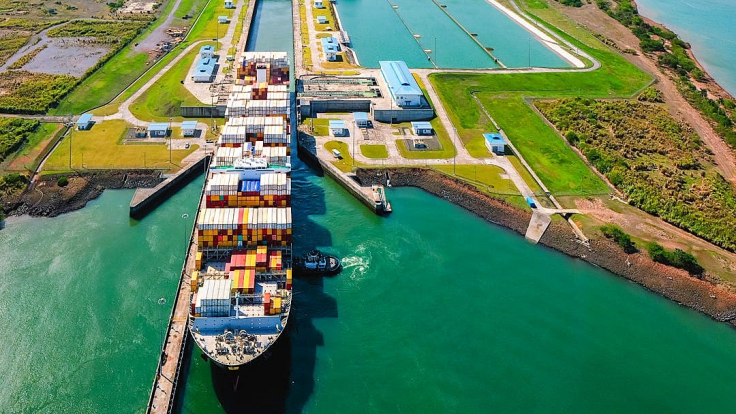
- Panama orders temporary occupation of two canal ports
- Court previously struck down CK Hutchison concession
- Government transfers operations to National Maritime Authority
- CK Hutchison subsidiary calls takeover illegal
A sudden move by Panamanian leader José Raul Mulino triggered short-term control over two vital canal terminals run by a firm tied to CK Hutchison Holdings Ltd., after top judges canceled the operating rights, deepening tensions with wider international echoes. Though legal grounds shifted overnight, regional influence questions now ripple beyond borders.
On Monday, during a public address, Mulino announced that control over the Port of Balboa and a second site will return to Panama's National Maritime Authority, aiming for steady, secure, and smooth functioning. This step comes after the country's highest court decided in January to cancel CK Hutchison's operating rights at those locations.
Occupying movable gear at port sites, cranes included, is temporary, clarified Mulino, stressing it does not strip owners of legal title. Once conditions triggering the takeover dissolve, authorities will give back what was taken. Should sale to another operator occur, repayment won't follow. Compensation happens only if no resale takes place.
A court challenge emerged when CK Hutchison's Panama unit labeled the acquisition unlawful, citing potential liability on part of officials. Early Tuesday saw its Hong Kong-traded stock dip up to 0.9%, following a 0.4% drop during the prior day's close, per figures from Reuters.
At the heart of the disagreement lie two key sites near where the canal meets the Pacific Ocean, a vital passage connecting Atlantic and Pacific waters for international shipping.
Canal Assets Amid Geopolitical Strains
Nowhere has the tension escaped notice, as experts frame the clash within a wider power struggle between the U.S. and China across Latin American states. Although Washington welcomed the January judicial decision, Beijing responded coolly, talks on fresh infrastructure efforts in Panama allegedly stalling afterward. Despite differing reactions, both powers watch closely, their interests quietly shaping regional dynamics.
Early Tuesday, the U.S. dollar index held steady during Asian hours, with little shift across emerging-market currencies in Latin America amid muted responses from investors. Panama's dollar-denominated government bonds saw minimal fluctuation in after-hours trading Monday, tracking levels seen at last week's end.
Starting in the early stages of talks, CK Hutchison, created by Hong Kong tycoon Li Ka-shing, has explored handing over 43 international port sites to a group supported financially by BlackRock Inc. Though revealed previously, the potential agreement might bring in excess of $19 billion should it reach finalization.
Nowhere has drawn more attention in these talks than the Panama Canal terminals. Earlier coverage by Bloomberg indicated discussions centered on reshaping the agreement, possibly dividing holdings across distinct control frameworks, as global political concerns intensified.
Earlier reports indicated that CK Hutchison included China Cosco Shipping Corp in the buyer group to ease worries in Beijing. Now, Panama's newest decision throws another layer of doubt onto these discussions.
On Monday, BlackRock's stock rose by half a percent, according to Reuters figures. That marked a slight uptick from the previous day's increase of three-tenths of one percent. Overall steadiness among American finance-related equities helped shape the trend.
Interim Operators and What Happens Next
Following talks, temporary deals were put in place by Panama's shipping regulators with APM Terminals, part of AP Moller-Maersk, and MSC Mediterranean Shipping Company from Switzerland. Separate long-term agreements will come later, once public bidding begins under state strategy.
Valuation of machinery inside the sites will shape payoffs or resale conditions, according to Mulino, who clarified the government's presence there serves as a stopgap until updated concession rules take effect.
At the start of the month, CK Hutchison told Maersk that legal steps might follow should its terminal arm move to take control of both ports. Despite pressure from Panama's government to cancel the operating agreement, the firm has held its position firmly.
Each year, around 5 percent of worldwide sea-based commerce moves through the Panama Canal, based on figures from Reuters, showing why port oversight matters to international freight routes and raw material transport. When activity slows there, deliveries between Asia, the Americas, and Europe may face delays.
So far, those involved in trade view the move more through a political lens than as a disruption to daily operations. Shipping costs worldwide held steady over the past few days. Rates from Asia to the U.S. West Coast show minimal shift compared to previous figures, based on data gathered by Reuters.
Back in January 2025, just ahead of Donald Trump taking office, Panama's Comptroller General made public a review that sparked disagreement. Afterward, the courts overturned CK Hutchison's agreement, setting off talks along with reactions between governments.
At present, Panama's authorities describe the takeover as a way to maintain stability during the rollout of a fresh bidding round. Still, CK Hutchison has made clear it plans to challenge the decision, paving the way for possible court involvement.
Control of key infrastructure often ties into larger global power struggles, along with business deals. In the weeks ahead, details about bidding procedures and who holds stakes should emerge. As Panama advances toward finalizing fresh contracts, transparency around these elements will likely grow.
FAQs
Why is Panama taking control of CK Hutchison's canal ports?
Panama's Supreme Court struck down CK Hutchison's concession to operate two ports at the Panama Canal. President José Raul Mulino ordered a temporary occupation to ensure uninterrupted and safe operations.
Does Panama's move mean CK Hutchison loses ownership of the ports?
The government said the occupation applies only to movable equipment and does not mean permanent loss of ownership rights. Panama said the property would be returned once the determining reason for the occupation ends.
How has CK Hutchison responded to the port takeover?
CK Hutchison's Panama subsidiary called the move illegal and said it would hold the government responsible for damages. The company's Hong Kong-listed shares fell during early trading.
Who will operate the Panama Canal ports during the dispute?
Panama's maritime authority signed interim contracts with APM Terminals and MSC Mediterranean Shipping Company. The government plans to launch an open tender to award new concessions to two separate firms.
How is the Panama port dispute linked to US-China tensions?
The court ruling and takeover have become part of broader geopolitical tensions between Washington and Beijing. The dispute affects a proposed sale of CK Hutchison's global port assets to a consortium backed by BlackRock.


