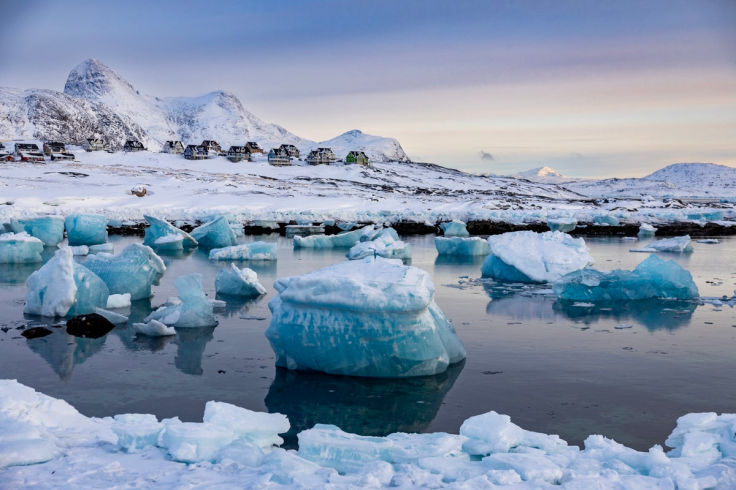
- Radar detected plume-like distortions within Greenland ice sheet.
- Study models thermal convection in 2.5-kilometer-thick ice.
- Simulations link geothermal heat to basal ice upwellings.
- Findings suggest softer basal ice in northern Greenland.
At very low points within the ice sheet at Greenland, radar excavations have revealed strange plume like forms that are a distortion of the traditional compacted snow and ice layers of the area. Ten years after realizing, scientists believe that such structures can be produced in a process that is not often associated with ice -- thermal convection.
Around the island, approximately 80 percent of which is covered in the Greenland ice sheet, constitutes one of the largest deposits of frozen freshwater on planet Earth. With the rise in world temperatures, there is more importance in comprehending the internal processes of this huge ice mass so that forecasts of its rise in sea level can be better refined.
Scientists have been mapping internal layers created through the snowfall that mainly compacted on ice over thousands of years using ice-penetrating radar. The layers represent minor differences in chemical composition, dust substance and acidity. Largely, upwards-buckling features as observed in Greenland northward in 2014 by radar imaging seem not to have a connection to the underlying bedrock topography, and continue to be a puzzle over time.
Current modeling studies have proposed that the structures are very similar to convection plumes-more generally the rising columns that are thereby linked to molten rock found deep in the mantle of the earth.
It is a bit of a surprise that thermal convection can occur in an ice sheet and therefore is against our intuition and expectations. Glaciologist Robert Law of the University of Bergen in Norway at least recalled the much deeper ice and thought that it was a million times more malleable than the mantle of the planet, so the physics just worked out.
As though an exhilarating freak of nature
Convection normally takes place when the material that is heated up will become lighter and rise to the surface and the cold air will be heavy and it will sink down as well as this is well known in the geology and atmospheric sciences. It crusts and moves plate tectonics and mantle plumes but has hardly been thought of as a possibility within solid ice.
In a test on the possibility of convection taking place in the ice sheet of Greenland, Law et al. created a simplified computer model of a 2.5-kilometer-thick sheet of ice. They modified a geodynamics computer package that had customarily been applied to enact mantle movements and altered factors such as snowfall rates, ice depth and surface flow velocity and hardness of ice at the bottom.
Plume-like upwellings were observed when basal ice temperatures in the model were raised and when it was supposed that the ice was inherently less dense than conventional estimates have it. These electronic plumes distorted the layers that were found on top in highly resemblant patterns to those taken in radar images.
Heat From Below
The geothermal heat pumped up through the crust of the earth was a small but continuous heat source in the model. Gas and radiations of elements and remnant heat are used to create this energy during the formation of the earth. Even though insignificant, through thousands of years, under a thick insulating blanket of ice, this heat might produce a slow softening of basal ice, so that slow convection would be possible.
The plumes in the simulations were only the case when the ice at the bottom was much warmer and so weaker than it was believed. In case the radar structures observed are actually due to convection, the results indicate that some of the ice cap on northern Greenland might be intrinsically softer than commonly thought.
A popular conception usually regards ice as a hard substance, and it is startling and yet lively at the same time that some portions of the Greenland ice bed experience thermal convection, similar to boiling pasta.
Is ice behaving like liquid?
Experts point out that this does not imply that melting of the ice is taking place or the ice behaves like liquid. The kind of convection that takes place is the modeled one which has a timescale of a thousand years and the ice does not thaw due to the process. This flow would be very slow like the slow percolation of the mantle of the earth rather than the movement of water.
Previous theories had already proposed other explanations about what the radar structures would be due to; either freezing of melt water at the bottom of the ice or movement of slippy areas under the ice sheet. The early quantitative test of the mechanism of convection is through its new modeling.
Scientists are warning that additional studies should be done to either confirm or disprove that convection is taking place under nature and how it can affect the long term stability of the ice sheet. Internal churning does not necessarily mean that the melting is prevented faster, but this might cause a redistribution of heat and stress in the ice.
The fact that Greenland and its nature is something exceptional. The ice head you see there is more than one thousand years old and the only one on the earth to have a back or margin culture and permanent people.
The more we know about what takes place under the surface of the ice, the better we will be capable of the changes that will be facing the coastline globally.
The fact that the ice sheet at Greenland acts in a manner that scientists had never imagined before is an additional complication to a body of knowledge about one of the most vital climate regimes on Earth as scientists continue to refine models and collect more information on radar.
FAQs Recommended:
What are the plume-like structures found in Greenland's ice sheet?
Radar imaging has revealed upward-buckling features deep within the ice that distort normal layered patterns. Scientists now think these formations may be caused by slow thermal convection within the ice.
How could thermal convection happen in solid ice?
Researchers found that geothermal heat from Earth's crust may slowly warm and soften basal ice over thousands of years. If the ice becomes weak enough, it can circulate very slowly, similar to mantle convection.
Does convection mean Greenland's ice sheet is melting faster?
Scientists say the modeled convection would occur over millennia and does not mean the ice is melting like liquid. However, internal heat redistribution could influence long-term stability.
Why is understanding Greenland's internal ice processes important?
The Greenland ice sheet holds one of the largest freshwater reserves on Earth. Better knowledge of its internal behavior helps improve sea-level rise projections.
What evidence supports the convection theory in Greenland?
Computer models simulating a 2.5-kilometer-thick ice sheet reproduced plume-like distortions similar to radar observations. The plumes appeared when basal ice temperatures were raised and the ice was assumed to be softer than previously estimated.


