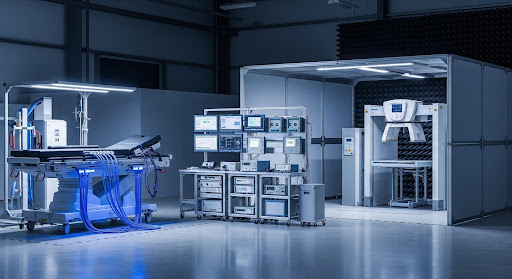
March 2020. ICUs across America were filling up fast. Doctors needed every piece of equipment they could get their hands on, especially the specialized rotating beds that help the sickest patients breathe. But more than 200 of these beds were stuck not because of supply chain problems or shipping delays, but because they'd failed their safety tests after modification.
Nearly one-third of U.S. hospitals reported critical staff shortages that spring. What got less attention was the equipment problem. The country had around 62,000 ventilators, but what about the prone-positioning beds that worked alongside them? Many couldn't pass the electrical safety standards required for hospital use. IEC 60601-1 and 60601-1-2 aren't suggestions; they're mandatory, and for good reason. Faulty medical equipment kills people.
That's where Chirag Parikh came in. An electrical safety engineer who'd spent years certifying high-risk medical devices, he got a call about the ArjoHuntleigh RotoProne system. The 800-pound rotating bed had bombed its initial certification. A few major problems. Leakage current was running at 1.2 milliamperes, way over the safe threshold. Insulation was breaking down. The electronics were vulnerable to static discharge, which in a hospital setting could mean catastrophe.
Working on site instead of by the book
Here's how medical device certification normally works: ship the equipment to an accredited lab, run tests for weeks or months, ship it back, fix problems, repeat. For something as big as the RotoProne, 12 feet of metal, motors, and electronics, just the logistics eat up weeks. In April 2019, those weeks meant lives. He made a call that broke with fifty years of industry practice. He'd do the certification on-site at the manufacturer's facility. Pack up the test equipment, set up at their location, and work around the clock if needed.
The grounding system required significant attention. The power cable was upgraded to medical-grade specifications to ensure proper electrical safety standards. Several technical adjustments were made to connection points, which helped reduce leakage current and eliminate multiple unwanted current pathways.
Medical equipment that touches patients directly has to meet Class I standards with CF applied part compliance. That's the toughest category. The system maintains operational integrity when subjected to electrostatic discharges up to 1500-3000V, with no effect on data or system charges. One test cycle. No do-overs.
Three weeks before the deadline, the beds were shipped. More than 200 units went to hospitals in the U.S. The engineer who worked weekends and on-site "saved hundreds of lives." Not marketing language, a plain statement of what happened when equipment arrived instead of sitting in a warehouse. Due to his consistent hard work and smart execution, Chirag received the Intertek Customer Hero Award, as well as the "2020 Exceptional Customer Service Award."
Airport scanners are too big to fit through the lab door
A year later, he hit a different kind of wall. A security equipment maker needed certification for a full-body scanner that combined X-ray and millimeter-wave imaging. The ClearPass system stood 12 feet tall. The X-ray tube ran at over 160 kilovolts. There was no way to fit it inside a standard testing lab.
TSA spent $781.2 million in 2022 buying CT scanners for airports. The whole industry was upgrading security screening technology. But the certification process assumed you could disassemble equipment, truck it to a lab, and put it back together. With integrated systems like ClearPass, taking it apart would throw off the safety-critical alignments. You'd be testing something different from what passengers would actually walk through.
So he built the lab around the machine. Portable Faraday cage. Anechoic materials on wheels. He created a controlled electromagnetic environment inside the client's facility and ran the full safety and X-ray tests there: IEC 61010-1, IEC 61010-2-091 for X-ray safety, ANSI N43.17. Same precision as a fixed lab, just mobile.
The radiation readings came back ten times over safe limits at first. He went after the collimator shielding, the metal structures that shape where X-rays can go. Redesigned the geometry. Rewrote the interlock code so the system wouldn't generate X-rays unless every safety check passed. Final result: 0.05 microsieverts per hour at full power. Occupational safety guidelines give you up to 20 microsieverts per hour for workers. This was a fraction of that.
Standard timeline for this kind of certification: three to four months. He finished in 42 days. Twelve major airports and border checkpoints got their scanners installed on schedule. Other Nationally Recognized Testing Laboratories now use the approach when they're dealing with equipment that won't fit in their buildings.
From X-Ray Microscopes to Security Scanners
At the same time Chirag was working on the security scanner project, he was also certifying a Sigray Apex XCT-100 X-ray microscope. Research instrument for materials science. Universities wanted to install these in regular labs, not radiation vaults, which meant getting leakage below 0.1 microsieverts per hour.
The X-ray tube kept overheating. Thermal runaway occurs when rising temperature causes more heat generation in a feedback loop. He installed redundant interlocks and active cooling validation. Got the leakage numbers where they needed to be. Universities could now put a synchrotron-alternative microscope in a standard room without building special shielding. That matters when construction costs for a radiation vault start at six figures.
Then there was the industrial machinery work. Shadow Systems had CNC equipment sitting idle because it couldn't pass NFPA 79 and IEC 60204-1 certification. Arc-flash protection. Emergency stop circuits. Basic industrial safety, but 10 problems were flagged in the first evaluation. Grounding conductors are too small. E-stop wiring is wrong. The plant was 48 hours from shutting down a production line worth $2.4 million a month.
Cleared all 10 non-conformities in one cycle. Introduced a color-coded wiring system that Shadow Systems rolled out to three factories. The machines passed. Production kept running.
This kind of range of medical devices, security systems, research instruments, and industrial equipment isn't common in certification work. Most engineers specialize in one sector. But the core problems repeat. Electromagnetic interference? Ferrite beads for conducted emissions, optimized shielding for radiated emissions, and proper filtering on power lines. Electrical safety? Trace the current paths, size your conductors correctly, and make sure your grounds are actually grounded.
Chirag also did MIL-STD-461 work for defense communications systems. Handled lighting systems that had to meet both UL 8750 energy rules and UL 1598 fire safety requirements. Different industries, different standards, same underlying physics.
Average project time dropped 28 percent after he standardized the test plans. Lab budget performance went up 35 percent when workflows moved to digital systems. Those aren't flashy numbers, but they're what reliability looks like in accreditation work.
The Future of Safety & Compliance Engineering
Medical devices are no longer just electromechanical systems; they're now connected, software-driven, and deeply integrated with hospital networks. Industrial equipment is shifting to programmable controllers. Security scanners increasingly combine multiple imaging technologies in a single platform.
This convergence means that certifying a modern CT scanner isn't about checking one discipline, but requires understanding X-ray physics, electromagnetic theory, software validation, mechanical safety, and how every subsystem interacts.
The pandemic accelerated this shift. Certification timelines tightened, but safety requirements didn't. Regulatory bodies began approving field evaluations for equipment too large or impractical to move into testing labs. That flexibility only works if the engineers involved can maintain laboratory-grade measurement accuracy under real-world conditions. It's a combination of technical depth and practical judgment.
Cybersecurity has also entered the picture. Connected medical devices now fall under both safety and security scrutiny. Industrial automation is adopting AI, which requires new validation frameworks. And energy-efficiency standards continue to tighten, pushing designers toward more complex power-management systems. Each regulatory change adds another layer to an already technical domain.
Despite that complexity, the impact of this work is tangible, even if unseen. The prone-positioning beds certified in 2020 have treated thousands of patients. The airport scanners cleared in 2021 screen millions of passengers each year. Most people walking through those checkpoints never think about the certification work behind the scenes. That's the point: safety systems should be invisible when they're working.
But as devices get smarter, systems get more interconnected, and deployment timelines shrink, the engineers who can balance rigor, speed, and cross-domain expertise will become even more critical. The equipment keeps evolving. The need for it never slows down.


