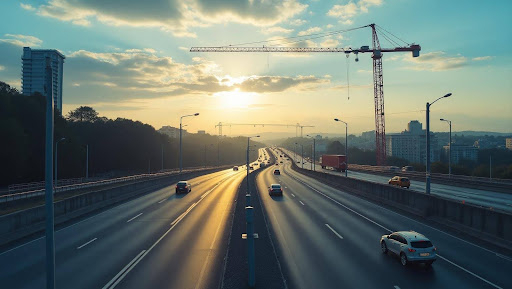
Infrastructure across the United States is not only represented by the concrete and steel constructions, but also in the quiet and frustrating daily lives of the people. Every pothole is a wake-up call for those who drive. A bridge closure reroutes school buses, adding an hour to children's days. Freight trucks slow on battered highways, inflating costs that ripple through the economy. These are not isolated inconveniences. They are the lived reality of a system long neglected.
The 2025 Report Card for America's Infrastructure, a sober assessment by civil engineers, gave roads a "D+." Bridges managed only a "C." The figures behind those grades carry enormous meaning. A significant share of public roadways need repair, and tens of thousands of bridges across the country have been deemed structurally deficient. Such data might seem somewhat remote until one understands its actual impact. It represents thousands of delayed journeys, lost dollars, and silent risks.
What those numbers also indicate is that infrastructure is not just a dilemma in the field of engineering. It is a question of being vigilant, how much oversight we require, and how well accountability is incorporated into the system.
That is where the construction oversight figure comes into play. Essentially, the inspector is a last line of defense against failure making sure what is built is safe and durable. On the ground, this philosophy succumbs most times under routine paperwork and reactive fixes. Problems are spotted, yes, but usually after they've already caused delays or cost overruns. The inspector, in practice, becomes a clerk of hindsight rather than a custodian of foresight.
Vinod Kumar Enugala's career is a reminder that this role need not be so diminished. Working with a leading engineering and consulting firm known for its work on large transportation projects, he has tried to reclaim inspection as something more meaningful. He aimed to redefine inspection as a proactive discipline focused on anticipating problems and preventing their growth.
He refused to treat inspection as the ritual of checking boxes on a list. Instead, he approached it as a craft, part technical rigor, part human coordination, part systemic thinking. "Inspection should not be about pointing fingers after the fact," he says. "It should be about creating conditions where problems don't have a chance to grow."
This philosophy shaped Vinod's contributions in ways that went beyond what his job title might suggest. He simplified processes that had grown bloated and bureaucratic. He tightened documentation standards so that projects carried clearer, more reliable records. He really pushed for higher standards of safety on the location, not just because it was required but as something that should be ingrained in the culture. He was the link that connected different stakeholders, including clients, contractors, and regulators. These individuals, often prone to conflict or misunderstanding, were brought together by his efforts. In doing so, he reduced delays and disputes, the hidden taxes of infrastructure building.
Some of his most significant work was in bridge rehabilitation and paving inspection, fields notorious for defects that appear after the fact. Instead of treating such failures as inevitable, he designed frameworks for rigorous monitoring across every phase of a project. The goal was not merely to catch defects but to reduce their probability of occurring at all.
Equally transformative was his approach to documentation. Traditionally, Daily Work Reports in construction were treated as an afterthought: notes scribbled hastily, often inconsistent, sometimes incomplete. These reports rarely provided the clarity needed to resolve disputes or spot emerging issues. Vinod reimagined this practice into a real-time system of documentation and quality assurance. The effect was to create transparency where opacity had been the norm. With clearer records, accountability grew sharper, and problems could be corrected before they metastasized into failures.
The results were measurable. Compliance rates climbed above 95%. On-site inspection errors dropped by roughly 30%. The costly ritual of corrective rework, familiar to anyone in the construction world, became noticeably less common. Each of these outcomes matters not only as an efficiency metric but as a safety dividend: fewer risks for workers, fewer delays for commuters, more reliable infrastructure for the public.
But the story does not stop at methodology. Vinod also ventured into research on sustainable materials, including exploratory work on biocement. While early in development, this line of inquiry holds the promise of shifting industry practices toward more environmentally responsible materials. Here again, his approach expands the definition of what an inspector can be: not just an enforcer of present standards but a contributor to the standards of the future.
Recognition followed, though not in flashy ways. Senior managers within his firm credited his methods with improving outcomes. Inspectors from the Connecticut Department of Transportation singled out his documentation practices as exemplary. Colleagues across projects began informally adopting his frameworks, an act of imitation that often says more than awards ever could.
What makes his contributions especially notable is their scalability. A structured inspection protocol, once proven, does not stay confined to a single bridge or highway. It can be replicated across projects, raising the baseline of safety and reliability across the sector. In a field where millions of people interact daily with the outcomes, these cumulative gains are profound.
When asked about the essence of his work, Vinod keeps the focus not on himself but on the people who use the infrastructure. "At the end of the day, it's about public trust," he says. "People drive on these roads and cross these bridges without thinking twice. My job is to make sure they never have to."
That sentiment is telling. Infrastructure, when it functions well, is invisible. We do not notice the bridge that holds steady, only the one that cracks. We do not thank the inspector whose vigilance prevented a failure, only question the one whose absence allowed it.
In an era when America's infrastructure problems are glaring and urgent, Vinod Kumar Enugala's story would teach us that progress does not necessarily follow from sweeping reforms or billion-dollar investments. Sometimes, it comes from seeing a role differently, from injecting foresight where before there was just routine, from seeing inspection not just as paperwork but as stewardship.
The cracks in America's roads and bridges remain, and they will take years and vast sums to repair. But stories like Vinod's suggest another possibility. Individuals on the ground can already be shifting the culture of infrastructure toward one of greater accountability and resilience.
His work reminds us that trust in public systems is built in quiet ways, through daily diligence, better processes, and the refusal to treat oversight as a formality. It shows us that the people tasked with preventing failure can, if they choose, become architects of improvement. And perhaps that is the larger lesson. In a country where the infrastructure grades are dismal, the future will not be secured by concrete alone. It will also be built by those willing to rethink what it means to inspect, to monitor, and to care.


