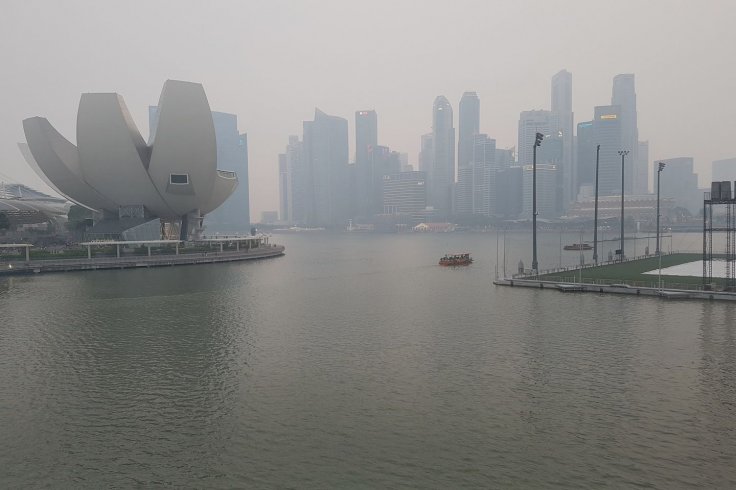
As Singapore enters its windiest month of the year, smoke haze from regional fires could be blown into the Republic if hot spots to the north persist, weather experts have warned.
However, air quality is unlikely to deteriorate significantly unless there is a sharp escalation in intense fires combined with sustained winds directed towards Singapore.
Urban climatology professor Matthias Roth from the National University of Singapore said elevated pollution levels would require a confluence of unfavourable conditions.
"Elevated readings are unlikely as this would require a significant increase in intense regional fires, combined with persistent winds blowing directly towards Singapore," he said, as quoted by The Straits Times.
February also marks the dry phase of the north-east monsoon, which can create conditions conducive to vegetation fires and transboundary haze.
On February 2, the National Environment Agency (NEA) said a small number of persistent hot spots continued to be detected near Singapore, including in parts of Malaysia and Indonesia such as Bintan.
Dry weather is expected to persist until February 4, when showers are forecast. As at 6 pm on February 2, Singapore's 24-hour Pollutant Standards Index ranged from 51 to 59, within the moderate range.
One-hour PM2.5 levels remained normal across the island, with the highest reading of 28 in central Singapore. PM2.5 refers to fine inhalable particles up to 2.5 micrometres in diameter, with elevated levels starting from a reading of 56.
According to updates from the ASEAN Specialised Meteorological Centre (ASMC) on February 2, dry weather is expected to continue over parts of Malaysia and central Sumatra. The centre cautioned that under such conditions, hot spot activity and smoke haze could remain elevated over fire-prone areas, although expected showers may help suppress fires in other parts of the region.
February is typically Singapore's windiest month, driven by intense winter cold over Asia that creates high pressure systems and strong north-easterly winds sweeping across the South China Sea.
Prof Roth said the average wind speed in February is about 2.8 metres per second, compared with the annual average of around 2 metres per second. January was also drier and windier than usual.
"If forest fires develop to the north of Singapore, the prevailing winds could transport smoke haze towards us," NEA said, as quoted by The Straits Times.
In late January, parts of Singapore experienced hazy conditions and a burning smell due to vegetation fires in Johor. On January 24, NEA reported that PM2.5 levels were slightly elevated. A peatland fire in Pengerang, Johor, which began on January 23, burned nearly 100 hectares before being brought under control on January 29.
Dr Koh Tieh Yong, a member of the Working Group on Asian-Australian Monsoon under the World Climate Research Programme, said the haze outlook depends largely on how quickly fires are contained, especially during the drier monsoon phase expected over the next four weeks.
As at Jan 30, smaller fires were still observed, but they were not producing enough smoke to significantly affect Singapore's air quality. Occasional afternoon showers are expected to help mitigate pollution levels, he added.
In the first half of February, thundery showers are forecast over parts of Singapore on most afternoons, sometimes extending into the evening. Across South-east Asia, many current hot spots are concentrated in the northern region, including Cambodia and Vietnam, which is in its traditional dry season.
Satellite observations have detected clusters of hot spots emitting smoke plumes over Cambodia, with some drifting into central Thailand, where severe haze has affected areas including Bangkok.
Dr Koh explained that monsoon winds lose much of their moisture as air rises over Vietnam's mountainous terrain. "When the wind descends over Cambodia and Laos, it is relatively dry. Dry, windy conditions make it easier for fires to get out of control once started," he told The Straits Times.
Prof Roth added that such conditions also facilitate slash-and-burn agriculture, with prevailing winds spreading smoke across borders and contributing to widespread haze episodes.


