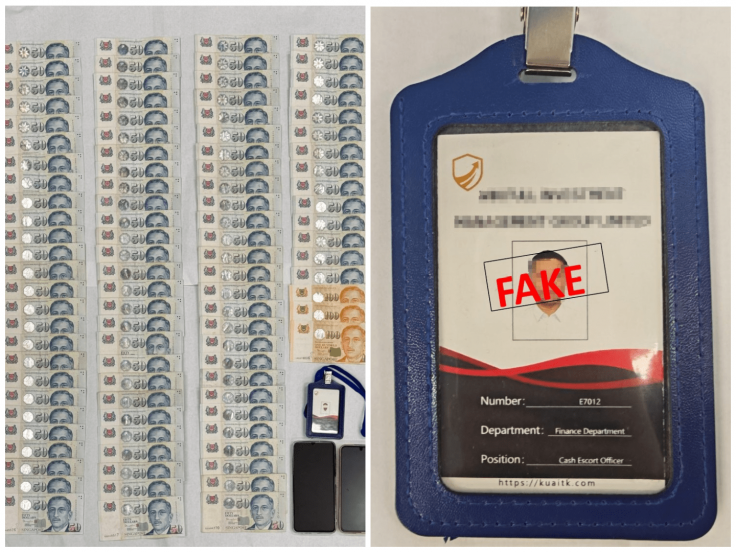
Two men, aged 24 and 47, will be charged in court on Friday, December 12, for their suspected roles in multiple government official impersonation scam (GOIS) cases.
The police said that the case began on December 3, when a victim reported receiving a video call from an individual posing as a Singapore Police Force officer.
The scammer, dressed in what appeared to be a police uniform, claimed the victim had unknowingly purchased an insurance policy and that her personal information had been misused.
She was allegedly instructed to "surrender" her money and valuables for investigation purposes. Believing the ruse, she handed over more than S$7,000 in cash to an unknown person. She was later told to buy gold worth over S$53,000, which she also handed to another unidentified man.
The officers from the Anti-Scam Command later identified the two unknown collectors as a 47-year-old Malaysian man and a 24-year-old Singaporean man. Both are believed to have been involved in similar scams locally.
The Malaysian suspect was arrested on December 10 at the point of departure as he attempted to leave Singapore. Police seized two mobile phones, and a fake investment company staff pass from him.
The Singaporean suspect was arrested the following day, with S$5,000 in cash recovered as case exhibits.
Preliminary investigations revealed that the pair had been working on behalf of a transnational syndicate, collecting money, gold, and valuables from scam victims before passing the items to other individuals linked to the network.
The Malaysian suspect had allegedly used the fake staff pass to identify himself when approaching victims.
The two men will be charged with abetment by conspiracy to assist another in retaining benefits from criminal conduct under Section 51 of the Corruption, Drug Trafficking and Other Serious Crimes (Confiscation of Benefits) Act 1992. If convicted, they could face up to 10 years' jail, a fine of up to S$500,000, or both.
The police also highlighted the recent passage of the Criminal Law (Miscellaneous Amendments) Bill on November 4, 2025.
When the amendments take effect, members and recruiters of scam syndicates will face mandatory caning of at least six strokes, and up to 24 strokes. Scam mules, those who facilitate scams by laundering proceeds, providing SIM cards or Singpass credentials, may face up to 12 strokes of discretionary caning under related offences, including money-laundering and cybercrime laws.
The authorities also noted a growing trend of Malaysian nationals travelling to Singapore to assist syndicates by collecting cash, gold and valuables from victims. The police stressed that they take a firm stance against all scam-related activities and offenders will be dealt with seriously.
Members of the public are reminded not to hand over money or valuables to unknown individuals, place items in designated locations for collection, or share their device screens with strangers. Government agencies, including the Monetary Authority of Singapore, will never ask individuals to transfer money, disclose banking credentials, install apps from unofficial sources, or transfer calls to the police.


