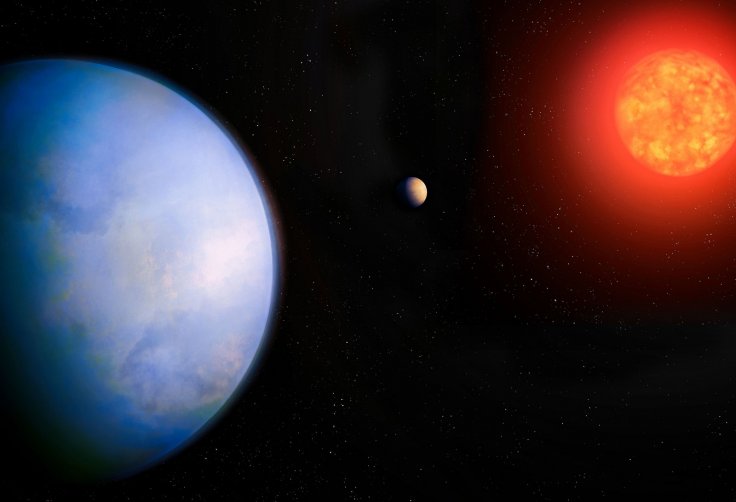
A planet has been found by astronomers at the University of California, Irvine that orbits within the "habitable zone" of its parent star, an area where temperatures may permit the surface to support liquid water. Given that water is necessary for all known life, this discovery suggests that the planet may have conditions conducive to life.
The planet, which is a "super-Earth," is situated in a relatively close region of the Milky Way Galaxy and resembles Earth in appearance but is many times more massive. In a new paper, published in The Astronomical Journal, the group of scientists from UC Irvine and their partners explain their analysis of the planet.
"We have found so many exoplanets at this point that discovering a new one is not such a big deal," said co-author Paul Robertson, UC Irvine associate professor of physics & astronomy. "What makes this especially valuable is that its host star is close by, at just about 18 light-years away. Cosmically speaking, it's practically next door."
The planet, GJ 251 c, revolves around an M-dwarf star, the most prevalent and ancient kind of star in the Milky Way. Strong stellar activity, such as flares (sudden bursts of energy released into space) and starspots (cool, dark regions on the star's surface), is characteristic of these stars. Sometimes, this activity can mimic the weak radial velocity (RV) signals used by astronomers to find planets in orbit, which could result in false positives when looking for exoplanets.
But given its closeness to Earth, GJ 251 c is a prime candidate for upcoming direct imaging missions using the University of California's Thirty Meter Telescope, which is currently under development.
TMT may be able to directly image faint exoplanets like GJ 251 c and verify the presence of water due to the size of its mirrors.
"TMT will be the only telescope with sufficient resolution to image exoplanets like this one. It's just not possible with smaller telescopes," said Corey Beard, Ph.D., data scientist at Design West Technologies, a former graduate student from Robertson's group and the study's lead author.
Data from the exoplanet-hunting instruments Robertson helped build, the Habitable-zone Planet Finder and NEID, enabled the discovery of GJ 251 c. The subtle impacts that an orbiting exoplanet has on its host star are picked up by HPF and NEID.
The gravitational pull of GJ 251 c causes slight, regular changes in the light that the star emits. These minute changes in light, called radial velocity signatures, were captured by HPF and used to establish the orbiting exoplanet's existence.
By monitoring the night sky in the infrared, a region of the spectrum where stellar activity signals are weaker, HPF helps mitigate some of M-dwarf's stellar activity problems.
Future direct imaging observations with TMT are crucial, as the team's computational modeling work has statistical significance sufficient to identify GJ 251 c as an exoplanet candidate.
"We are at the cutting edge of technology and analysis methods with this system," said Beard. "While its discovery is quite statistically significant, we are still determining the status of the planet due to the uncertainty of our instruments and methods. We need the next generation of telescopes to directly image this candidate, but what we also need is community investment."
In order to prepare for the direct imaging capabilities of next-generation ground-based observatories such as the Thirty Meter Telescope, Beard and Robertson hope that their work will inspire the exoplanet science community to delve deeper into GJ 251 c.


