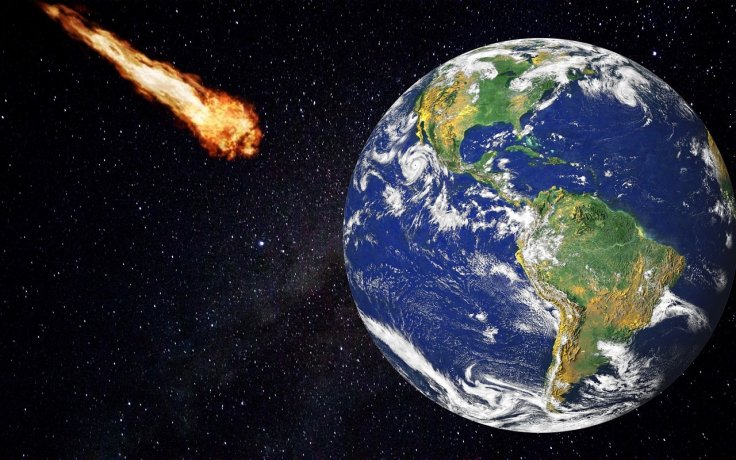
NASA has confirmed that two large asteroids will "closely approach" Earth on Friday, but scientists emphasize that there is no risk of an impact.
The two space rocks will sail past at a distance of millions of miles, but if they were to strike, they would cause significant regional damage.
The first, known as 2025 OJ1, is roughly 300 feet across, or the height of a building with 30 stories. NASA's Near-Earth Object tracking system predicts it will pass within 3.2 million miles of our planet.
It is followed by 2019 CO1, a somewhat smaller asteroid that is about 200 feet wide—roughly the length of a Boeing 747. The estimated distance at which it will pass is 4.24 million miles.
Although neither of them is dangerous, their simultaneous arrival on the same day has given an element of cosmic drama to what would otherwise be a routine event. Both are traveling at very high speeds.
NASA experts stated, "These are not rare events, but seeing two sizable asteroids making flybys within hours of each other is certainly unusual."
Both objects have been observed for years by the agency's Planetary Defence Coordination Office, which uses cutting-edge telescopes and tracking systems to monitor thousands of near-Earth objects.
Unfortunately, it will be impossible to see the asteroids with the unaided eye because they will be too far away. To investigate their speed, composition, and orbital paths, astronomers will be mounting powerful telescopes on them. This data could be crucial for research on planetary defense.


