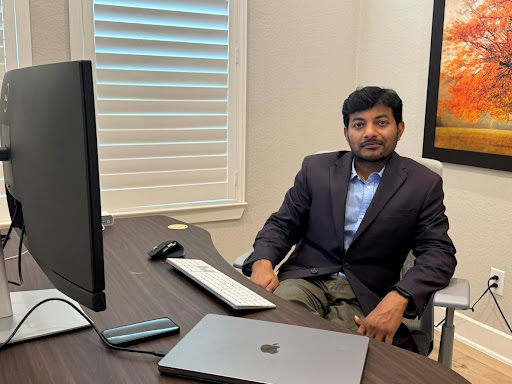
From Earth Sciences to Intelligent Systems
When reporters sit down with Dr. Singaiah Chintalapudi, they don't just find another AI architect they discover a technologist whose journey began far from the confines of a data center. With a Ph.D. in Environmental Science and Engineering from the University of Texas at San Antonio, Chintalapudi cut his teeth solving real-world problems through hydrological Modeling, geospatial analytics, and simulation-driven insights.
"Even then, I was using a wide range of software tools to clean, model, and interpret large datasets," he reflects. "That's where my love for engineering systems and their potential to solve complex problems really began."
That academic rigor, grounded in empirical data and systemic Modeling, became the unlikely but powerful foundation for his later career as a software engineer, enterprise architect, and AI innovator.
Building Future-Ready Digital Ecosystems
Today, as AI Director and Architect at Synopsys, one of the world's foremost semiconductor and software design companies, Chintalapudi leads digital transformation initiatives that touch millions of users globally. His remit spans platform modernization, cloud-native adoption, and AI integration all executed with an emphasis on usability, resilience, and scale.
From migrating legacy CMS environments into scalable, AI-ready platforms to designing enterprise-grade productivity studios complete with copilots, secure AI pipelines, and personalized digital experiences his work consistently redefines how global enterprises unlock efficiency and intelligence.
"I design systems that serve people not the other way around," he explains. "AI should enable creativity and productivity, not complicate it."
Bridging Research, AI, and Real-World Impact
What makes Chintalapudi's story resonate with the media is his ability to straddle both research and practice. He has authored peer-reviewed work in respected outlets like the International Journal of Intelligent Systems and Applications in Engineering (IJISAE), offering frameworks that measurably enhance enterprise outcomes.
His models have shown quantifiable impact: reducing debugging time by nearly 30% and accelerating AI system deployments by over 40%. For enterprises navigating the AI adoption curve, such results aren't theoretical they're transformative.
Awards, Recognition & Leadership
Chintalapudi's track record has not gone unnoticed. His achievements have been recognized globally, with honors including:
- Gold Stevie Award for Blog UX
- Global Recognition Award
- Adobe MVP Honors and AEM Community Awards
- Shortlisting at the U.S. Search Awards
- Software Development Stellar Award
- Global Leader Award
- Best Electronic Site Web Award
For journalists, what stands out is not just the breadth of accolades, but how consistently they affirm both his technical mastery and his influence on digital ecosystems. Beyond awards, he is also an active mentor, RSA Fellow, and thought leader, guiding the next generation of engineers while contributing to international dialogues on responsible AI.
Human-Centered AI: The Vision
When asked what truly sets his work apart, Chintalapudi points to his vision for human-centered, trust-driven AI ecosystems. His architectural frameworks are anchored in three non-negotiables:
- Transparency and traceability
- Secure, privacy-compliant data workflows
- AI as a creative enabler, not a replacement
As organizations race toward generative AI adoption, he offers a blueprint for scalable, responsible innovation. "Enterprise AI shouldn't just scale," he insists. "It should align with people, policy, and purpose."
Final Word
For media outlets covering the evolving AI landscape, Chintalapudi represents the kind of figure whose story demands to be told: a researcher turned enterprise leader, a visionary whose ideas translate into measurable business outcomes, and a globally recognized innovator whose work continues to inspire trust and transformation.
In an era where enterprises grapple with both the promise and perils of AI, Singaiah Chintalapudi has emerged as one of the few architects proving through research, platforms, and recognition that it is possible to engineer intelligence with both scale and integrity.


