Skywatchers will be treated to a close pairing of the moon and Saturn on Saturday, November 29, with both celestial bodies appearing low in the southeastern sky shortly after sunset. While Saturn will shine brightly beside the moon, the distant ice giant Neptune will be hiding nearby, though it will remain invisible without optical aid.
On this night, the moon will be in a waxing gibbous phase, just a day past its first quarter. It will sit against the backdrop of the constellation Pisces, glowing with sunlight reflected off its cratered surface.
Saturn will appear less than 5 degrees to the moon's lower right — a separation comparable to the width of a fist held at arm's length — making it easy to spot as one of the prominent "evening stars" in the sky.
The days surrounding the first quarter moon offer ideal conditions for lunar observation. As the boundary between lunar night and day — known as the terminator — slowly shifts, shadows cast across the moon's rugged terrain make craters, mountains and valleys stand out in vivid detail.
Amateur astronomers using a mid-sized telescope of around 6 inches in aperture will be able to enjoy particularly clear views of the moon's surface features that evening.
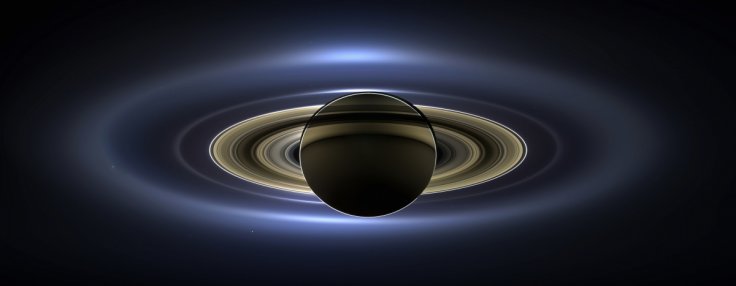
Saturn, too, will provide a captivating sight for both casual observers and telescope users. Through an 8-inch telescope, viewers may discern the gas giant's subtle atmospheric banding. However, its iconic rings will appear unusually thin, as they are currently tilted nearly edge-on from Earth's perspective, reducing them to a narrow line bisecting the planet.
The night also marks a celestial milestone for Saturn: the end of its apparent westward, or "retrograde," motion against the background stars. This phenomenon occurs after opposition, when Earth's faster orbit causes it to pass outer planets, creating the illusion that they are moving backward. Following November 29, Saturn will resume its usual eastward drift through Pisces.
Meanwhile, Neptune will sit roughly 2 degrees below the moon, though it will remain far too faint to be seen without assistance. Under darker skies and with a telescope of at least 8 inches in aperture, the planet might appear as a small blue dot. However, the moon's brightness may make spotting Neptune more challenging on this particular night.
For those with a clear horizon and cooperative weather, the celestial trio promises an engaging night for both seasoned stargazers and casual skywatchers.


