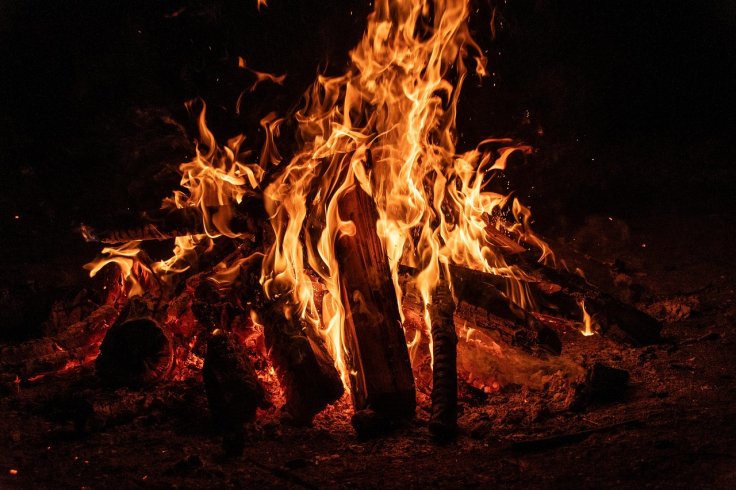
Scientists have uncovered what is now considered the earliest known evidence of deliberate fire-making by prehistoric humans, found in Suffolk, England.
The discovery points to a Neanderthal-made hearth dating back roughly 415,000 years, pushing back the timeline for when our ancient relatives first mastered fire.
The site, located in a former brickmaking clay pit near the village of Barnham, revealed a section of clay altered by intense heat, fragments of flint handaxes that had been shattered by fire, and two pieces of iron pyrite. Iron pyrite can produce sparks when struck against flint, and researchers believe these items together indicate the presence of a repeatedly used campfire.
The hearth was situated close to a natural water source where these early humans are thought to have set up camp.
Archaeologist Nick Ashton, curator of Palaeolithic Collections at the British Museum in London and leader of the research, published on Wednesday, December 10, in the journal Nature, said, "We think humans brought pyrite to the site with the intention of making fire. And this has huge implications pushing back the earliest fire-making."
Up until now, the earliest known evidence of fire-making dates back approximately 50,000 years to a location in northern France that is also thought to have been inhabited by Neanderthals.
For the human evolutionary lineage, the controlled use of fire was a turning point because it allowed hunter-gatherers to flourish in colder climates by providing warmth, cooking, and protection from predators.
"Places like Britain, for example," British Museum archaeologist and study co-author Rob Davis said.
Our ancestors were able to remove toxins from edible roots and tubers and pathogens from meat through cooking. These foods became softer and easier to digest after cooking, releasing energy from the stomach to support brain growth.
The researchers found that being able to eat a wider variety of foods improved human survival and made it possible to feed larger populations of people.
Fire may have played a role in the evolution of society. By using fire at night, these people were able to congregate and interact with one another, possibly telling stories and creating language and belief systems.
"The campfire becomes a social hub," Davis said.
"We're a species that has relied on fire to transform our surroundings," Davis said, adding that the discovery highlights how this ability was shared not only by modern humans but also by Neanderthals and perhaps other large-brained human groups of the era, such as the Denisovans.
The Palaeolithic site at Barnham dates back to a period that predates the oldest known Homo sapiens fossils found in Africa.
The team concludes that Neanderthals — our close evolutionary relatives — were responsible for creating the fire, adding to the growing body of evidence that these long-misunderstood humans possessed considerable intelligence and resourcefulness.
Paleoanthropologist and study co-author Chris Stringer said that no human remains were recovered from the Barnham site itself.
However, he pointed out that fragments of a human skull dating to around 400,000 years ago, displaying features typical of Neanderthals, were discovered in the mid-20th century at Swanscombe, a town located less than 100 miles (160km) to the south.
According to Stringer, these skull pieces closely resemble Neanderthal remains found at Sima de los Huesos — the "Pit of the Bones" — near Burgos in Spain, which are approximately 430,000 years old.
"Thus, the Barnham fire-makers were very likely to have been early Neanderthals, like Swanscombe and the Sima people," Stringer said.
Neanderthals disappeared about 39,000 years ago, shortly after modern humans spread across the parts of Europe they once inhabited. Yet traces of them remain in the DNA of most people today, a result of interbreeding between Neanderthals and Homo sapiens before the former died out.
Earlier excavations at the Barnham site have already offered researchers a detailed picture of the environment in which the hearth was created. The area once supported a wide range of wildlife — from large animals such as elephants to smaller mammals and birds — and bore signs of human presence, including cut marks on animal bones.
While evidence from Africa shows that early humans were using naturally occurring fire more than a million years ago, those sites lack proof of intentional fire production.
To establish that the Barnham findings reflected deliberate fire-making, researchers conducted four years of analyses. Their tests uncovered multiple indicators, including geochemical traces showing exposure to temperatures exceeding 700°C (1,290°F) and signs that fires had been lit repeatedly in the same spot.


